wayground logo

Free Printable Worksheets

Font size

S
M
L
XL
Worksheets

Unit 2 Review (Physical Properties, Density, Solubility, EDD)

Total questions: 61

Worksheet time: 2hrs 12mins

Name
Class
Date
1.

The ability to be made into thin sheets is referred to as...

a)

density

b)

solubility

c)

malleability

d)

electrical conductivity

2.

The ability to conduct electric current is referred to as...

a)

density

b)

solubility

c)

malleability

d)

electrical conductivity

3.

The relationship between mass and volume is referred to as...

a)

density

b)

solubility

c)

malleability

d)

electrical conductivity

4.

The ability of a substance to dissolve is referred to as...

a)

density

b)

solubility

c)

malleability

d)

electrical conductivity

5.

A characteristic that can be observed or measured such as color, state, or hardness is referred to as a...

a)

Physical property

b)

Chemical property

c)

Physical change

d)

Chemical change

6.

If you poured three liquids (that do not mix completely) into a cup, how could you tell which one is the densest liquid?

a)

The liquid that is floating on top is the densest liquid.

b)

The liquid that settles to the bottom is the densest liquid.

c)

The liquid with the deep red color is the densest liquid.

d)

There is no way to tell which liquid is densest from the description.

7.

What happens to a solid object with a density that is less than water when it is placed in water?

a)

The object sinks about halfway into the water.

b)

The object displaces a quantity of water greater than its volume.

c)

The object settles to the bottom of the water.

d)

The object floats on top of the water.

8.
No Definite Shape and No Definite Volume
a)
Gas
b)
Liquid
c)
Solid
9.
Definite shape and a definite volume.
a)
Gas
b)
Liquid
c)
Solid
10.
No definite shape, but has a definite volume
a)
Gas
b)
Liquid
c)
Solid
11.
The 3 State of Matter are?
a)
Idaho, Texas, and Florida
b)
Matter, Mass, and Weight
c)
Solids, Liquids, and Gas
d)
Steel, Copper, and Brass
12.
Which tool measures liquid volume?
a)
Test tube
b)
Beaker
c)
Graduated cylinder
13.
What is the formula for finding volume?
a)
l + w + h
b)
l x w x h
c)
l x h
14.
What is the volume of liquid in this graduated cylinder?
a)
40.0 mL
b)
40.3 mL
c)
43.0 mL
d)
44.0 mL
15.
What measures the amount of matter in an object?
a)
Distance
b)
Mass
c)
Time
d)
Volume
16.

What is the volume of the liquid in the picture

a)

35 mL

b)

35 grams

c)

35 cm3

d)

35 L

17.

What is the volume of the rock in the picture?

a)

30 mL

b)

40 mL

c)

40 cm3

d)

10 cm3

18.

What is the metric measuring unit for mass?

a)

Meter

b)

Liter

c)

Pounds

d)

Grams

19.

What is the mass on this triple beam?

a)

142.0 g

b)

42 g

c)

102.0 g

d)

140.2 g

20.

What is the reading on the triple beam balance? Record the number in the space below.

a)

320.6g

b)

311.0g

c)

310.3g

d)

411.3g

21.

What is the volume of the Green Jade sample?

(a)  

22.
What two types of measurements make up DENSITY
a)
Mass and Volume
b)
Temperature and Mass
c)
Grams and Centimeters
d)
Volume and Weight
23.
Jack has a rock. The rock has a mass of 14g and a volume of 2cm3. What is the density of the rock?
a)
7 mL
b)
7 g/cm3
c)
28 g/cm3
d)
1/7 g/cm3
24.
Look at this image.  Which object has the LOWEST density in water? How
a)
The Ping Pong Ball because it floats to the top 
b)
The bolt because it has sunk to the bottom
c)
The soda cap because it is not just full of air like the Ping Pong ball
25.
If an object has a density of .6 g/mL and you put it into water, will it sink or float?  
a)
sink
b)
float
26.
If an object has a density of 3.6 g/mL and you put it into water, will it sink or float?  
a)
sink
b)
float
27.
Frank has an eraser. It has a mass of 4g, and a volume of 2cm3. What is its density?
a)
8 g/cm3
b)
2 g/cm3
c)
1/2 g/cm3
d)
24 g/cm3
28.
What is the formula for density?
a)
density = mass x volume
b)
density = mass / volume
c)
density = mass + volume
d)
density = mass - volume
29.
Helium balloons rise on earth because
a)
helium is less dense than air
b)
helium is more dense than air
c)
helium is cooler than air
d)
helium is warmer than air
30.
True or False:  The density of a specific type of material never changes.  
a)
True
b)
False
31.
Calculate the density of the cube.
a)
2 g/cm3
b)
4 g/cm3
c)
6 g/cm3
d)
8 g/cm3
32.
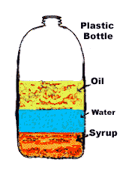
Which liquid is the least dense?
a)
oil
b)
water
c)
syrup 
d)
plastic bottle
33.

A homogeneous mixture is the same thing as...

a)

a solution

b)

a heterogeneous mixture

c)

a compound

d)

an element

34.
What is a solvent
a)
the liquid in which a solute is dissolved to form a solution.
b)
Another word for solution
c)
A thing that make drinks turn colors
d)
Its a metal molecole
35.

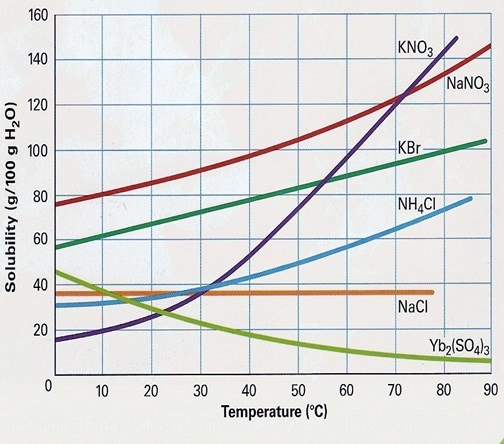
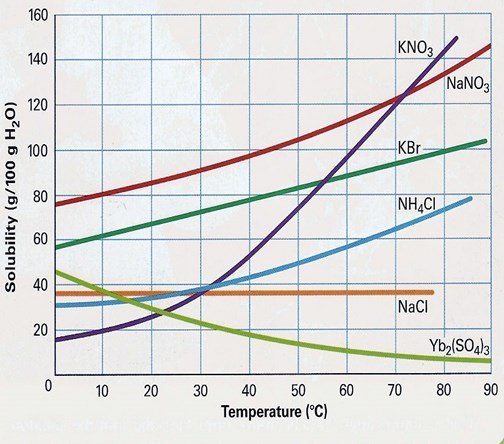
Which substance is least soluble at 0 ºC?

a)

KI

b)

KNO3

c)

KClO3

d)

Ce2(SO4)3

36.

How many grams are soluble in 100 g of water at 100 ºC?

a)

300 grams

b)

250 grams

c)

100 grams

d)

50 grams

37.

When 40 grams of NaCl is dissolved in 100 grams of water at 90 ºC, the solution can be correctly described as:

a)

supersaturated

b)

saturated

c)

unsaturated

38.
Solution where more solute can still be dissolved at the given temperature. 
a)
Saturated
b)
Unsaturated
c)
Supersaturated
d)
Homogeneous solution
39.
A solution of potassium chlorate, KClO3, has 20 grams of the salt dissolved in 100 grams of water at 70 ºC. Approximately how many more grams of the salt can be added to the solution before reaching the saturation point?
a)
10 grams
b)
30 grams
c)
80 grams
d)
60 grams 
40.

Identify how many grams of KNO3 is required to make a saturated solution at 40'C.

a)

50 g

b)

45 g

c)

55 g

d)

33 g

41.
If I dissolve sugar in water, what is the solute?
a)
Water
b)
Hydrogen
c)
Sugar
d)
Carbon
42.
What will allow more solute to be dissolved in a solvent.
a)
adding more solute
b)
stiring
c)
cooling solution
d)
heat
43.

At which temperature do KBr and KNO3 have the same solubility?

a)

60

b)

55

c)

50

d)

Never

44.
Which is an example of a solvent?
a)
Salt
b)
Egg whites
c)
Water
d)
Sugar
45.
Solutions are composed of __________ .
a)
salts and solutes
b)
solvents and salts
c)
solutes and alloys
d)
solutes and solvents
46.

Define the term soluble.

a)

Can dissolve in water

b)

Cannot dissolve in water

c)

Partially dissolves in water

47.

Define the term insoluble.

a)

Can dissolve in water.

b)

Cannot dissolve in water.

c)

Partially dissolves in water.

48.
On a graph, which axis shows the dependent variable?
a)
x-axis
b)
y-axis
c)
neither
d)
it changes
49.
On a graph, which axis shows the independent variable?
a)
x-axis
b)
y-axis
c)
neither
d)
it changes
50.
Name the INDEPENDENT variable from the table below.
a)
words
b)
minutes
51.

In the table, Bubbles is the ______________.

a)

independent variable

b)

dependent variable

52.

Sarah is bringing treats to her elementary school class on her birthday. The number of treats she brings in is based on the number of students in her class.


t = the number of treats

s = the number of students


Which of the variables is INDEPENDENT?

a)

s

b)

t

53.

Sophie earned $5 for every A she got on her report card.


m = money

A = A on report card


The dependent variable is:

a)

m = money

b)

A = A on report card

54.

Which of the following is the label for the independent variable.

a)

Money Collected

b)

Raising Money

c)

Boxes Sold

d)

None of the above

55.

What is the dependent variable in this research question: "How does the distance a person kicks a soccer ball affect how well they will do on a math test?"

a)

How far they kick the soccer ball

b)

who the person is

c)

how well they do on the math test

d)

Type of soccer ball.

56.
When experimenting with the growth of a plant, a scientist uses three (of the same type of) plants, two different fertilizers, equal light, and equal water. What type of variable is the fertilizer?
a)
Dependent
b)
Independent
c)
Control
d)
Compound
57.
What would the INDEPENDENT variable be in an experiment testing which types of paper airplane goes furthest?
a)
the paper used
b)
the type of paper airplane
c)
the distance of each plane's flight
d)
how hard the plane is thrown
58.

What is the independent variable in this research Question: "How does the type of gasoline affect the car speed?"

a)

Type of gasoline

b)

which car the gas is put into

c)

how fast the car can drive

d)

how much gas is put into the car

59.

In an experiment, constants should always be

a)

different

b)

the same

c)

kind of the same

d)

none of the above

60.

This part in an experiment is the one being changed or manipulated by the scientist.

a)

dependent variable

b)

independent variable

c)

constants

d)

control

61.

Justin usually blows his nose using Kleenex tissues. His snot keeps leaking through the tissue. He decided he is going to create an experiment to find the best tissue brand. What would be 1 constant?

a)

amount of tissue

b)

type of tissue

c)

kleenex

d)

which one works better