wayground logo

Free Printable Worksheets

NEW

Font size

S
M
L
XL
Worksheets

3rd 9 Weeks Review

Total questions: 70

Worksheet time: 1hrs 28mins

Name
Class
Date
1.
What is the energy transformation?
a)
Kinetic to Mechanical to Electrical
b)
Chemical to Mechanical to Kinetic
c)
Electromagnetic to Chemical to Electrical
d)
Kinetic to Sound to Chemical
2.
What is the energy transformation?
a)
Kinetic to Mechanical and Electrical
b)
Chemical to Thermal and Electromagnetic (light)
c)
Electromagnetic to Chemical and Electrical
d)
Kinetic to Sound and Chemical
3.
What is the energy transformation?
a)
Kinetic to Mechanical to Electrical
b)
Mechanical to Electrical to Kinesthetic
c)
Electromagnetic to Chemical to Electrical
d)
Kinetic to Sound to Chemical
4.

A swing has potential energy if

a)

it is sitting still

b)

moving at a constant speed

c)

accelerating at a fast pace

d)

using multiple units of kinetic energy

5.

What energy transformations take place when a battery operated radio is in use?

a)

electrical to chemical to sound

b)

thermal to nuclear to electrical

c)

chemical to electrical to sound

d)

chemical to sound to thermal

6.

According to the Law of Conservation of Energy, energy cannot be ______ or _______

a)

destroyed, determined

b)

created, nuclear

c)

destroyed, remade

d)

created,destroyed

7.

What energy transformations take place when a battery operated radio is in use?

a)

electrical to chemical to sound

b)

thermal to nuclear to electrical

c)

chemical to electrical to sound

d)

chemical to sound to thermal

8.

What type of energy is represented in the picture?

a)

potential

b)

chemical

c)

thermal

d)

mechanical

9.

Turning on a lamp is an example of energy transformation from electrical to 3 forms of energy. Which of these is NOT created by the lamp?

a)

thermal

b)

electrical

c)

chemical

d)

electromagentic

10.

Which of the following transfers occurs when food is digested?

a)

Chemical to mechanical

b)

Mechanical to thermal

c)

Mechanical to solar

d)

Chemical to thermal

11.

Plants turn_______ energy into _______ energy for food.

a)

thermal, mechanical

b)

radiant, chemical

c)

electromagnetic, light

d)

potential, kinetic

12.

On a rollercoaster, where is maximum kinetic energy?

a)

At the top of the big hill

b)

At the bottom of a big hill

c)

On the way up a big hill

d)

At the top of the hill ,where the car stops for a brief moment

13.
Electrical Energy is transferred to _____ Energy.
a)
Solar
b)
Mechanical
c)
Chemical
d)
Electrical
14.

Stored energy or energy due to its position is called

a)

mechanical energy

b)

potential energy

c)

kinetic energy

d)

thermal energy

15.

Which of the following statements about a skier skiing down a steep slope is true?

a)

His kinetic energy decreases and his potential energy increases

b)

His potential energy decreases and his kinetic energy increases

c)

His chemical energy increases

d)

Both his potential and kinetic energy increases

16.

Which of the following objects has kinetic energy?

a)

A lamp that is turned off

b)

A bike parked at the top of a hill

c)

a ball thrown across the yard

d)

Fallen leaves laying on the ground below a tree

17.

Energy in motion is called

a)

kinetic energy

b)

potential energy

c)

nuclear energy

d)

transfer energy

18.

All of the answer choices are examples of kinetic energy Except-

a)

A volleyball player spiking a ball

b)

A race car speeding down the highway

c)

A bowling ball sitting on the rack

d)

A bowling ball rolling down the alley

19.

When stored energy begins to move the object______ energy from _______ to _________.

a)

energy, force, motion

b)

transfers, kinetic, potential

c)

forces, mechanical, nuclear

d)

transfers, potential,kinetic

20.

Which point has the most potential energy?

a)

G

b)

F

c)

B

d)

A

21.

What is the net force

a)

10 N to the right

b)

30 N to the right

c)

10 N to the left

d)

30 N to the left

22.

What is the net force?

a)

38 N to the left

b)

38 N to the right

c)

2 N to the left

d)

2N to the right

23.
Students are playing tug-of-war. If group B pulls the rope to the right with a force of 400 N and group A pulls the rope to the left with a force of 250 N, what will happen to the ribbon in the middle of the rope?
a)
The ribbon will move to the left and group A will win the tug-of-war.
b)
The ribbon will move to the right and group B will win the tug-of-war.
24.
Balanced or Unbalanced?
a)
Balanced 
b)
Unbalanced
25.

What is the unit to MEASURE force?

a)

Kilogram

b)

Meter

c)

Pounds

d)

Newton

26.
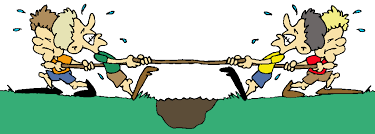
If these teams are pulling with the same amount of force what will happen?
a)
The boy in blue will win.
b)
They will not move at all.
c)
The boy in red will win.
d)
Both will fall down.
27.
If you have balanced forces on a ball what happens
a)
It STAYS the SAME
b)
CHANGES its MOTION
c)
:(
d)
:)
28.
Forces that have a force of Zero (0).
a)
Balanced force
b)
Unbalanced force
29.
If there are two forces going in the SAME direction, you would ...?
a)
(-) Subtract the forces
b)
(+) Add the forces
c)
Neither
d)
(x) Multiply
30.
What is the FORCE? 
a)
5 N
b)
10 N
c)
400 N
d)
0 N
31.
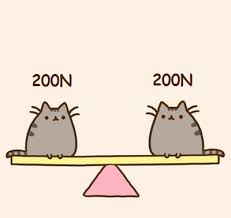
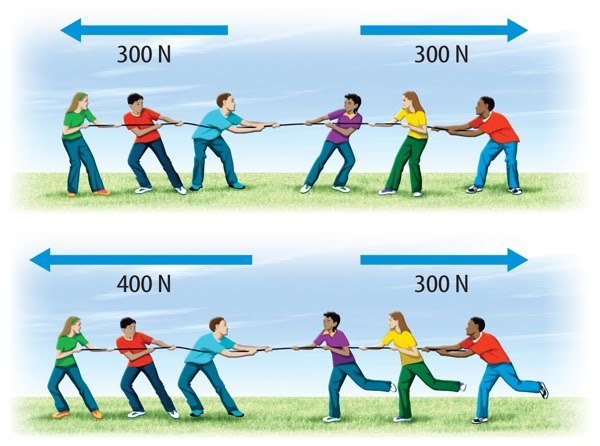
Which one is balanced?
a)
top
b)
bottom
c)
both
32.
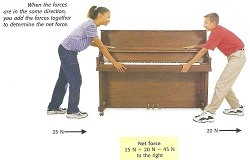
What is the net force?
a)
5 N
b)
45 N to the left
c)
5 N to the right
d)
45 N to the right
33.
What is a force?
a)
the PUSH or PULL on an object 
b)
The MOTION an object creates
c)
The objects HITTING one another
d)
Going REALLY FAST
34.
Friction is a force that acts in an ___________ direction of movement.
a)
similar
b)
opposite
c)
parallel
d)
west
35.
Rougher surfaces have ...
a)
greater friction
b)
less friction
c)
the same level of friction
36.
How does friction affect speed?
a)
more friction decreases speed
b)
more friction increases speed
c)
less friction decreases speed
d)
less friction doesn't affect speed
37.

Which would create more friction?

a)

carpet

b)

metal

38.

What happens when two magnets repel each other?

a)

A. Their magnetic fields get bigger.

b)

B. They come closer together.

c)

C. They push away from each other.

d)

D. They point to the North Pole.

39.

What are the two poles on a magnet?

a)

A. north and south

b)

B. east and west

c)

C. north and west

d)

D. south and east

40.
Is the force of gravity on the diver a push or a pull?
a)
push
b)
pull
41.

Newton’s law states that for every action, there is an ________ reaction.

a)

unequal and opposite

b)

equal and similar

c)

stronger and opposite

d)

equal and opposite

42.

When a small car pushes a big truck, the truck applies an equal and opposite force on the car.

a)

False

b)

True

43.

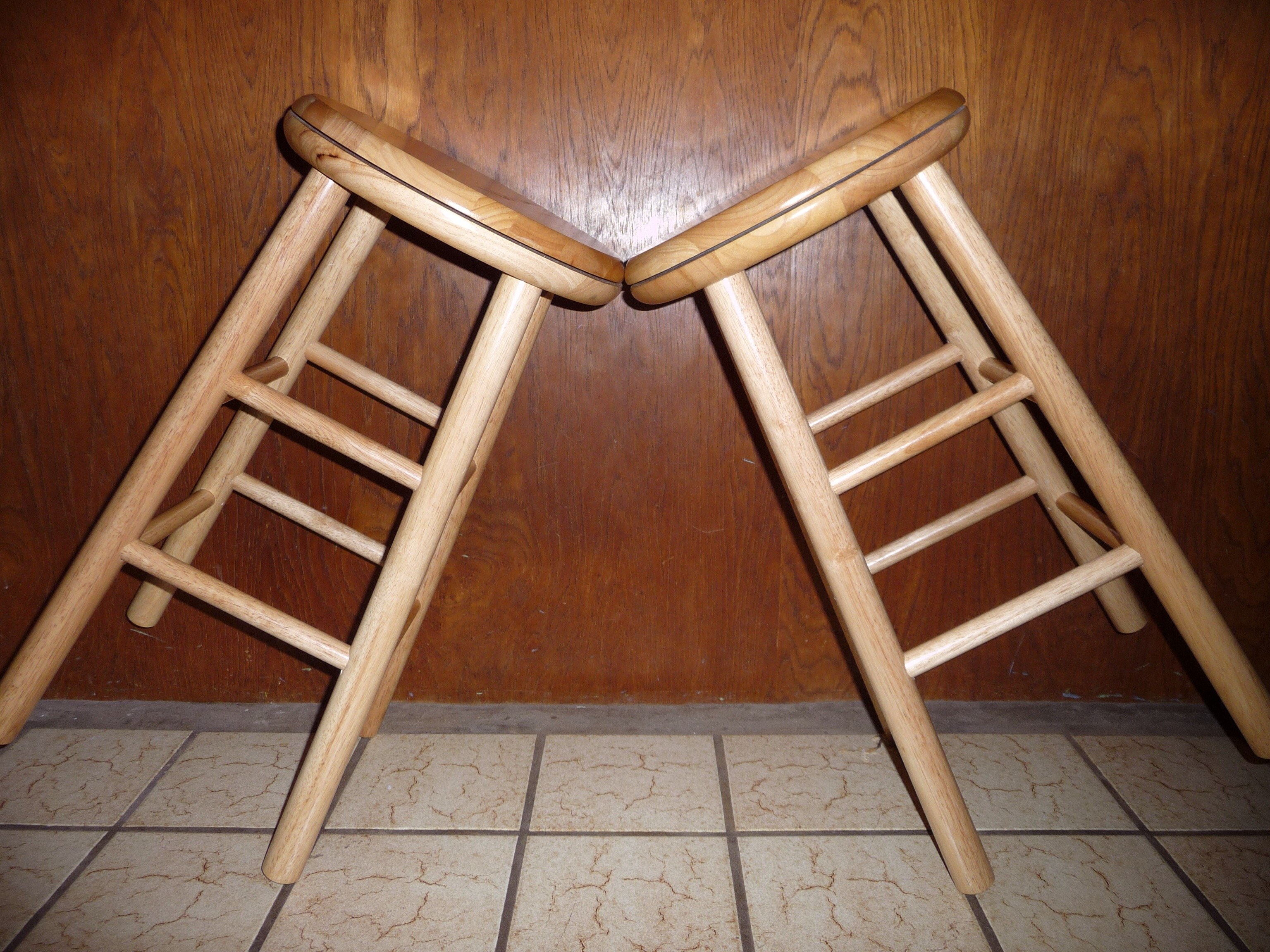
How is this an example of Newton’s Third law?

a)

Only the ball is using the head

b)

They are both exerting an equal force on each other

c)

Only the head is pushing the ball

44.

Force always come in________

a)

waves

b)

triplets

c)

pairs

45.
A person steps out of the boat and onto the dock.  As the person moves forward onto the dock, the boat moves backward.  Which statement best describes the backward motion of the boat as the person steps forward?
a)
For every action there is an equal and opposite reaction.
b)
Every mass exerts a force on every other mass.
c)
An object at rest tends to stay at rest.
d)
Friction opposes the motion of an object.
46.

A book pushes down on a table with a force of 5N, the table..

a)

Pushes back with a force of 5N

b)

Pushes back with a force less than 5N

c)

Pushes back with a forcec greater than 5N

d)

Does nothing. A table has no force.

47.

According to Newton’s Third Law, when you lean on a wall, which force is greater?

a)

Wall's foce

b)

Your force

c)

Wall's friction

d)

They are equal

48.

When a cannon fires a cannonball we observe the action of the cannonball pushing forwards off of the cannon. Which is the reaction force?

a)

The cannon pushing up on the ground

b)

The cannon pushing backwards off of the cannonball

c)

The cannonball pulling backwards

d)

The cannonball falling forward

49.

This picture shows .............

a)

Newton 2nd law of motion

b)

Newton 3rd law of motion

c)

Newton 1st law of motion

d)

I don't know

50.
Newton's Third Law States...
a)
Objects in motion stay in motion and objects at rest stay at rest
b)
Force is equal to mass times acceleration
c)
For each action there is an equal and opposite reaction
51.
An archer shoots an arrow. The action force is the bowstring against the arrow, the reaction force is...
a)
Air resistance against the bow
b)
the arrow's push against the bowstring
c)
the grip of the archer's hand on the bow
52.
A player throws a ball. The action force is the player impact on the ball. The reaction force is...
a)
The force of the ball impact on the player
b)
The force of the grip of the ball
c)
The celebration the player is thinking of
53.
A player hits a ball with a bat. The action force is the impact of the bat against the ball. The reaction force is...
a)
The grip of the player's hands on the ball
b)
the air resistance of the ball
c)
the force of the ball against the bat
54.
A baseball player bats a ball with a force of 1,000 N. The ball exerts a reaction force (without any additional forces action on it) against the bat of...
a)
Less than 1, 000 N
b)
1,000 N
c)
More than 1,000 N
55.
A rocket pushes exhaust 10, 000 N. Without any other forces acting on the rocket, how much force does the rocket go forward?
a)
15,000 N
b)
1,000 N
c)
10, 000 N
56.
What is the reaction force to a foot pushing down on the floor?
a)
The foot going through the floor
b)
The floor pushing back against the foot
c)
The floor breaking to the foot
57.
According to Newton's Third law the strength or magnitude of forces will be...
a)
smaller
b)
equal
c)
larger
58.
Which best explains why we are able to accelerate forward when starting to run?
a)
As one leg moves backward, it provides an equal and opposite force for the other foot to move forward.
b)
No acceleration takes place. Runners are always at a fixed velocity.
c)
The striking foot pushes backward against the ground. The friction with the ground provides an equal and opposite force forward.
d)
The runner's upper body quickly leans forward, causing the entire body to begin accelerating forward
59.

What happens when two objects, such as a baseball and a bat, collide?

a)

They hit each other with the same force in the same direction.

b)

They hit each other with the same force in opposite directions.

c)

They hit each other with unequal force in opposite directions.

d)

One remains still while the other one moves in the same direction.

60.

Which type of wave is illustrated?

a)

Longitudinal

b)

Transverse

61.

A wave created by shaking a slinky up and down is called a _______.

a)

longitudinal

b)

transverse

c)

surface

62.

What is represented by the letter X on the longitudinal wave?

a)

compression

b)

rarefaction

c)

wavelength

d)

medium

63.
Which of these is the best way to produce a longitudinal wave?
a)
heating a block of iron
b)
freezing a tray of water
c)
squeezing and releasing a metal spring
d)
shaking a rope up and down
64.
A disturbance that travels through a medium as a longitudinal wave
a)
sound
b)
wavelength
c)
pitch
d)
frequency
65.

Which type of wave is illustrated?

a)

Longitudinal

b)

Transverse

66.

What type of waves are these?

a)

Transverse waves

b)

Longitudinal waves

67.

Sound travels in which kind of wave?

a)

Longitudinal waves

b)

Transverse waves

68.
Which energy type?
A new car battery
a)
Potential
b)
Kinetic
69.
Which energy type?
An ant crawling across a sandwich at a picnic
a)
Potential
b)
Kinetic
70.
What increases as the passengers in the coaster go up the hill?
a)
fear
b)
potential energy
c)
kinetic energy