wayground logo

Free Printable Worksheets

Font size

S
M
L
XL
Worksheets

8.1 & 8.4 Review

Total questions: 57

Worksheet time: 1hrs 5mins

Name
Class
Date
1.

Which layer of Earth is located ABOVE the outer core?

a)

asthenosphere

b)
inner core
c)

lower mantle

d)
lithosphere
2.
A dense ball of solid iron and nickel.
a)
crust
b)
inner core
c)
mantle 
d)
outer core
3.

Which of the following two terms could be used to describe the outermost layer of The Earth?

a)

Lithosphere

b)

Asthenosphere

c)

Inner Core

d)
Crust
4.
Is the outer core a liquid or solid?
a)
liquid
b)
solid
5.
Temperature _____________________ as you go deeper into the earth.
a)
increases
b)
decreases
c)
goes up and down depending on the layer
d)
stays the same
6.
Pressure ______________________ as you go deeper into the Earth
a)
increases
b)
decreases 
c)
goes up or down depending on the layer
d)
stays the same
7.

Which layer of Earth is characterized by rock that is plasticky, or soft enough to flow, but very slow moving.

a)
asthenosphere
b)
crust
c)
lithosphere
d)
inner core
8.

Which of the following do scientists use to learn about the Earth's layers?

a)

Volcanic Activity

b)

seismic waves

c)

Meteorites

d)

Exploring Mines and drilling

e)

Traveling into the Earth

f)

D

9.

Which is the correct order of the Earths layers by COMPOSITION?

a)

Crust, Mantle Core

b)

Lithosphere, Asthenosphere, Lower Mantle, Outer Core, Inner Core

c)

Mantle, Crust, Core

d)

Asthenosphere, Lower Mantle, Lithosphere, Inner Core, Outer Core

10.
As scientists explore deeper and deeper into Earth's crust, what have they noticed about temperature and pressure?
a)
both temperature and pressure decrease
b)
both temperature and pressure increase
c)
pressure increases while temperature decreases
d)
temperature increases while pressure decreases
11.
What causes the waves that scientists have used to gain most of their understanding of the composition of Earth's interior?
a)
earthquakes
b)
magnetic fields
c)
meteor strikes
d)
winds
12.
True or False
The Earth's thin shell of hard rock is called the crust.
a)
True
b)
False
13.
5. Which layer is the thickest?
a)
Core
b)
Crust
c)
Mantle
14.
Which layer of Earth is the thinnest? 
a)
Crust
b)
Mantle
c)
Inner Core
d)
Outer Core
15.
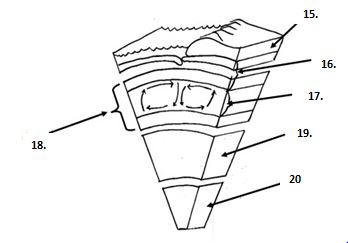
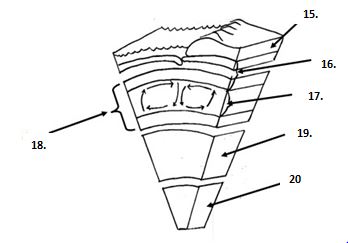
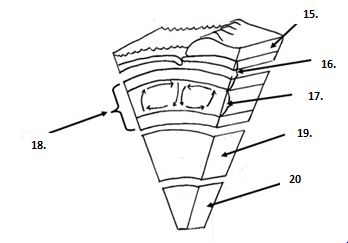
Identify each layer - #15.
a)
Lithosphere
b)
Mantle
c)
Crust
d)
Asthenosphere
16.

Identify each layer - #16. Which contains the CRUST and UPPER MANTLE.

a)
Crust
b)
Mantle
c)
Lithosphere
d)
Asthenosphere
17.
Identify each layer - #17.
a)
Crust
b)
Mantle
c)
Lithosphere
d)
Asthenosphere
18.
Identify each layer - #20.
a)
mantle
b)
asthenosphere
c)
inner core
d)
outer core
19.
Identify each layer - #19.
a)
mantle
b)
lithosphere
c)
inner core
d)
outer core
20.

The vibrations in the earth caused by the sudden release of energy is called an ______________.

a)

epicenter

b)

aftershock

c)

earthquake

d)

tsunami

21.

What is the point on the surface of the earth directly above the focus of an earthquake?

a)

epicenter

b)

fault

c)

focus

d)

intensity

22.

What is a fracture in bedrock along which blocks of rock on opposite sides of the fracture move?

a)

focus

b)

epicenter

c)

intensity

d)

fault

23.

What is the location where the rupture of an earthquake begins and energy is released called?

a)

epicenter

b)

focus

c)

intensity

d)

S wave

24.

What is a wave generated by earthquake vibrations called?

a)

seismogram

b)

surface wave

c)

seismic wave

d)

seismology

25.
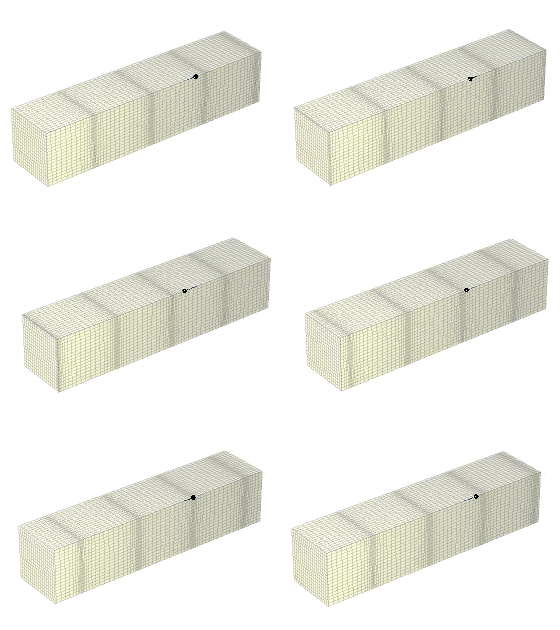
Which body wave is pictured?
a)
P-Wave
b)
S-Wave
c)
Rayleigh Wave
d)
Love Wave
26.

Primary (P) Waves can pass through...

a)

solids only

b)

liquids only

c)

gases only

d)

solids, liquids, and gases

27.
S Waves travel through...
a)
Soilds
b)
Liquids
c)
Both
28.
P Waves travel through...
a)
Solids
b)
Liquids
c)
Both
29.
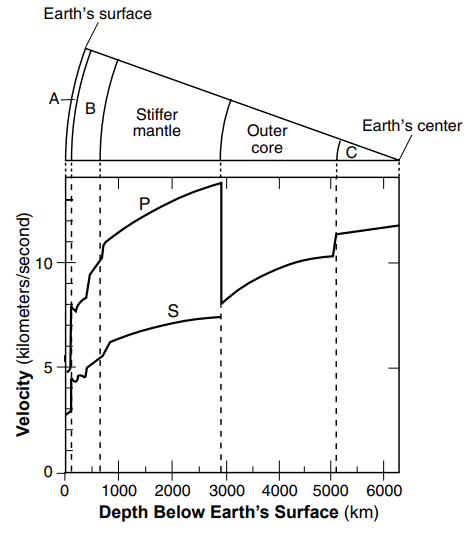
Which kind of waves travel through the Earth’s core?
a)
P waves
b)
S waves
c)
Both
30.
Earthquakes happen every day. Most are too small for humans to notice.
a)
True
b)
False
31.
The shaking and trembling that results from the Earth's plates movement
a)
Mountains
b)
Earthquakes
c)
Volcanoes
d)
Fault-block mountains
32.
When plates break or slip past each other they form these
a)
mountains
b)
tectonic plates
c)
Fault lines
d)
earthquakes
33.
Earthquakes release these which let us study what the Earth is made out of
a)
Tectonic Plates
b)
Seismic Waves
c)
Plateaus
d)
P Waves
34.
These are the secondary, or second waves to be released. They cannot travel through the liquid outer core
a)
S waves
b)
Surface Waves
c)
P waves
35.
This is the area beneath the Earth's surface where the earthquake begins
a)
epicenter
b)
focus
c)
fault line
d)
tectonic plate
36.
This is the area above ground where the earthquake starts
a)
focus
b)
epicenter
c)
p waves
d)
plate boundary
37.
Which layer of the Earth is responsible for Earth's magnetic field?
a)
outer core
b)
inner core
c)
mantle
d)
crust
38.
Why is the Inner Core solid?
a)
Extreme Heat
b)
High Pressure
c)
All the layers are solid
d)
It's made of rock
39.
The core is made-up of what two elements?
a)
iron and nickel
b)
iron and oxygen
c)
nickel and silicon
d)
oxygen and silicon
40.
What is the thinnest layer of the earth’s composition?
a)
mantle
b)
inner core
c)
crust
d)
outer core
41.
The solid, outer layer of the Earth that consists of the crust and the rigid upper part of the mantle
a)
Lithosphere
b)
Mesosphere
c)
Mantle
d)
Crust
42.
What are the two kinds of crust that the Earth has?
a)
Oceanic and Crustatious Crust
b)
Oceanic and Continental Crust
c)
Optic and Continental Crust
43.

On which layer can we find the tectonic plates?

a)

Lithosphere

b)

Asthenosphere

c)

Lower Mantle

d)

Upper Mantle

44.
Is the layer of rock between the Earth's crust and core.
a)
Lithosphere
b)
Mantle
c)
Core
d)
Mesosphere
45.
Which is made up mostly of iron and nickel.
a)
Inner Core
b)
Outer Core
c)
Crust
d)
Mantle
46.
The upper mantle is also known as the 
a)
Lithosphere
b)
Asthenosphere
c)
Mesosphere
d)
Core
47.
The crust is also know as the 
a)
Lithosphere
b)
Asthenosphere
c)
Mesosphere
d)
Mantle
48.
The thinnest layer of Earth is the 
a)
Inner Core
b)
Mantle
c)
Crust
d)
Outer Core
49.

The point within the earth where rock is under stress is called _________________________.

a)

Focus

b)

Epicenter

50.

The point directly above the focus on the surface is called ___________________.

a)

Epicenter

b)

Hypocenter

51.

Which type of wave is the first to arrive after an earthquake occurs?

a)

P Wave

b)

Rayleigh Wave

c)

S Wave

d)

Shear Wave

52.

Which body waves cause particles of rock material to move at right angles to the direction in which the waves are traveling?

a)

Body Waves

b)

P Waves

c)

S Waves

d)

Surface Waves

53.

Which type of seismic wave is shown in the picture?

a)

P-Wave

b)

S-Wave

54.

Which type of wave is shown in the picture?

a)

P-Wave

b)

S-Wave

55.

This wave type is the ______ of the two wave types studied

a)

Slower

b)

Faster

56.

This type of wave will arrive ________ at a seismographic station.

a)

First

b)

Last

57.
Earthquakes happen every day. Most are too small for humans to notice.
a)
True
b)
False