Wayground logo

Free Printable Worksheets

Font size

S
M
L
XL
Worksheets

Ions and Bonding

Total questions: 45

Worksheet time: 56mins

Name
Class
Date
1.
If an atom has an equal number of protons and electrons it is a...
a)
Positive ion
b)
Negative ion
c)
Isotope
d)
Neutral atom
2.

Elements in the same group or column have the same ...

a)

# of valence electrons

b)

# of shells

c)

# of protons

d)

Mass Number

3.
Are the atoms more stable when they are bonded together or when they are apart? 
a)
Bonded Together
b)
Apart
4.
What do atoms that form positive ions tend to do?
a)
Tend to lose electrons 
b)
Tend to lose protons
c)
Tend to gain electrons
d)
Tend to gain protons
5.
What usually forms the positive ion?
a)
Metal
b)
Non Metals
c)
None
6.

Because carbon has 4 valence electrons

a)

it can form up to 4 covalent bonds

b)

it can form ionic bonds

c)

it can form only double bonds

d)

it can form covalent bonds with H only

7.
Valence electrons are: 
a)
Electrons farthest away from the nucleus
b)
Electrons closest to the nucleus
c)
Electrons that just come and go - they don't stay with the atom
8.
Ions are: 
a)
atoms with a positive or negative charge
b)
atoms with no charge
c)
atoms with ONLY a positive charge
d)
atoms with ONLY a negative charge
9.
When an atom loses a valence electron, it becomes a(n) _____________ ion.
a)
positive
b)
negative
c)
neutral
d)
polyatomic
10.
Negative ions form when atoms _________ valence electrons.
a)
lose
b)
gain
c)
share
11.

Na ionizes to a charge of _______

a)

+1

b)

+2

c)

-1

d)

-2

12.

Li ionizes to a charge of _________

a)

+2

b)

+1

c)

-1

d)

-2

13.

F ionizes to a charge of ________.

a)

-2

b)

-1

c)

+1

d)

+2

14.

N ionizes to a charge of _______.

a)

+3

b)

-3

c)

+2

d)

-2

15.
An example of a polyatomic ion is:
a)
O2-
b)
Na+
c)
CO32-
d)
Ag+
16.

What is the formula for the compound when Na+ and (SO4)2- combine?

a)

Na(SO4)

b)

Na2(SO4)2

c)

NaSO4

d)

Na2SO4

17.
KCl
a)
Krypton Chloride
b)
Potassium Chlorine
c)
Potassium Chloride
d)
Potassium Monochloride
18.
LiBr is called
a)
lithium bromine
b)
lithium (I) bromine
c)
lithium bromide
d)
lithuim (I) bromide
19.
When forming an ionic bond, a metal atom
a)
Gains electrons to form a cation
b)
Loses electrons to form a cation
c)
Gains electrons to form an anion
d)
Loses electrons to form an anion
20.
What elements generally make an ionic bond?
a)
metal and nonmetal
b)
2 or more nonmetals
c)
metal
d)
none of the above
21.
What elements generally make a covalent bond?
a)
metal and nonmetal
b)
2 or more nonmetals
c)
metal
d)
none of the above
22.
Predict the bond that will form between Be and F.
a)
Ionic
b)
Covalent
23.
Predict the bond that will form between Se and Cl.
a)
Ionic
b)
Covalent
24.
How many atoms of Oxygen are in this compound?
a)
4
b)
1
c)
12
d)
7
25.

How many different elements make up this compound?

a)

6

b)

4

c)

2

d)

3

26.

According to the Octet Rule, atoms of elements react with each other in order to attain ____ electrons in their outermost energy level or shell.

a)

2

b)

4

c)

6

d)

8

e)

10

27.

Which of the following elements GAINS 2 electrons in order to attain an octet?

a)

cesium

b)

magnesium

c)

phosphorus

d)

sulfur

e)

iodine

28.
The blue numbers in the image below represent ________
a)
I don't know, and don't want to try
b)
coefficients
c)
subscripts
d)
none of the answers are correct
29.
How many electrons should Carbon have around its Lewis dot model?
a)
1
b)
3
c)
4
d)
5
30.

This is a correct dot diagram for neon (Ne)

a)

True

b)

False

31.

This is a correct dot diagram for carbon (C)

a)

true

b)

false

32.
Which is the correct name for CaBr2?
a)
Calcium Bromine
b)
Bromine Calcium
c)
Calcium Bromide
33.
Name CCl4
a)
carbon carbon tetraiodide
b)
carbon tetrachloride
c)
monocarbon tetrachloride
d)
water
34.
Give the formula for oxygen dichloride
a)
OCl2
b)

O2Cl2

c)
OCl
d)
O2Cl
35.

How many electrons do Halogens have in their outer shell?

a)

0

b)

1

c)

6

d)

7

36.

You've seen the name many times, how do you spell it?

a)

Halogens

b)

Helogens

c)

Hallogens

d)

Halogans

37.
What is the basis of a metallic bond?
a)
the attraction of neutral metal atoms.
b)
the attraction between protons and neutrons.
c)
the attraction between positive metal ions and interlocking electrons.
d)
the attraction between positive metal ions and free floating electrons.
38.
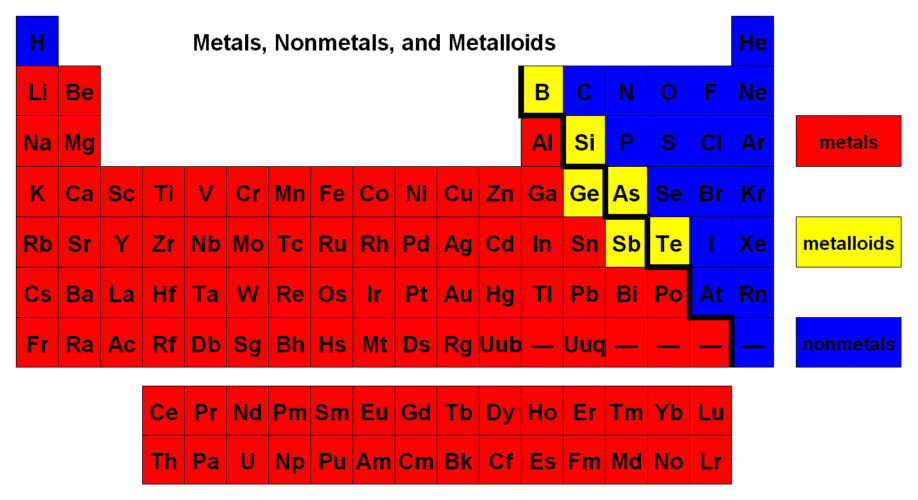
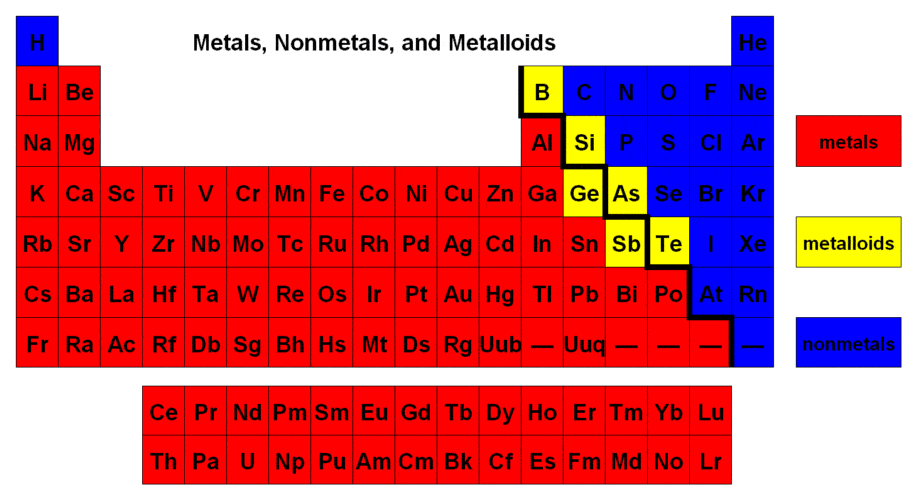
There are more metals than non metals in the periodic table.
a)
True
b)
False
39.

What is the formula for the ammonia molecule shown below?

a)

NH

b)

NH3

c)

N3H3

d)

N3H

40.

Atoms form bonds with other atoms in order to become more ______.

a)

stable

b)

happy

c)

dense

d)

energetic

41.
What two types of atoms make a covalent bond?
a)
2 Nonmetals
b)
1 Nonmetal and 1 Metal
c)
2 Metals
d)
2 Noble Gases
42.
What is the correct name for C4H6?
a)
Carbon Hexahydride
b)
Pentacarbon Pentahydride
c)
Hexacarbon Tetrahydride
d)
Tetracarbon Hexahydride
43.
What is the correct name for NO?
a)
Mononitrogen Monoxide
b)
Nitrogen Monoxide
c)
Mononitrogen Dioxide
d)
Nitrogen Oxide
44.
What is the formula for Tricarbon Octahydride?
a)
Ca3O
b)
C2H8
c)
C3H8
d)
Ca3H8
45.
P2O5
a)
Phosphorus Oxide
b)
Pentaphosphorus Dioxide
c)
Diphosphorous pentoxide
d)
Phosphoric Oxygen