
 Worksheets
Basics of Economics Unit 1 Final Assessment
Total questions: 93
Worksheet time: 3hrs 32mins
Which of the following groups are confronted with the problem of scarcity?
governments
businesses
people
all of these
Which of the following items would best fulfill a need?
automobile
food
shoes
a Play Station
Which of the following is NOT necessary for an item to be considered scarce?
be limited in quantity
be desirable
be inexpensive
have more than one valuable use
Which of the following is a good?
A car
Having your tax returns done
A haircut
A pedicure
Which of the following is a service?
Having your taxes calculated
A car
A baseball bat
A water hose
The best word to describe scarcity is ____________.
sunshine
choices
air
unlimited wants
The reason that scarcity exists is because consumers _______________.
have unlimited wants, but limited resources.
don’t produce items efficiently
have a limited number of wants, but endless resources
have limited wants, resources, but limited wants.
What is the best way to define the word “want”?
Most wants are limited.
People will eventually be satisfied with what they have.
Wants are unlimited.
Wants are fixed and do not change.
The study of how people make choices when confronted with scarcity is _____________.
economics
unlimited wants
unlimited resources
capital
Physical products that can be purchased are called _______.
goods
services
wants
needs
When considering the costs and benefits of a decision, you should do something as long as ______________________.
the benefits are less than the costs
the costs are less than the benefits
the costs and benefits are both high
the costs and benefits are both low
What you give up when you choose one alternative over another is called _____________.
opportunity cost
marginal benefit
marginal cost
incentive
What is the fundamental problem in a society and the reason we study economics?
scarcity
lack of capital
the factors of production
labor shortage
Using marginal analysis to make a decision considers making a decision that considers the additional costs and additional benefits is called _______________.
marginal benefits, but not the marginal costs
marginal costs, but not the marginal benefits
the marginal costs and marginal benefits
marginal propensity to consume
The best way to make most decisions is to ______________________.
consider the costs but not the benefits
consider the relationship of the costs and benefits
rely on emotion and not consider the costs
always choose the decision with the least amount of cost
Which of the following is not one of the broad categories of productive resources?
capital resources
consumer resources
human resources
natural resources
Since the factors of production are considered to be scarce, an economy needs to ___________.
ignore the limit on resources and produce all that the people want
only provide the basic necessities
figure how to use the limited resources to make limited goods and services
figure how to use the limited resources to make the most goods and services
The factors of production are ________.
neither inputs or outputs
both inputs and outputs
inputs
outputs
The factors of production are ___________.
fixed resources
land, capital and entrepreneurship
goods and services
land, labor, capital and entrepreneurship
Which if the following is NOT an example of an entrepreneur?
Bill Gates, who founded Microsoft
Steve Jobs, who founded Apple
a Birmingham police officer
Jeff Bezos, founder of Amazon
All of the things used in the production of goods and services are called _______.
capital resources
labor resources
the factors of production
land resources
Which of the following is NOT considered to be a labor resource?
a waitress
a robot that simply replaces a worker
a secretary, since he or she only provides a service
a janitor
A man-made tool that is used to make other goods and services is which factor of production?
land
labor
capital
entrepreneurship
Which of the following is NOT considered to be a natural resource?
iron ore
hammer
water
the Amazon forest
Which of the following is NOT considered to be a capital resource?
a fleet of delivery trucks
stock in a large corporation
a set of company tools
a very small warehouse
Which of the following factor of production includes both physical and mental efforts?
land
labor
capital
entrepreneurship
Which of the following is NOT considered to be a natural resource?
fish
gasoline
trees
oil
Which of the following is not considered by economists to be a factor of production?
oil
money
a used tractor
a waitress
Which of the following factor of production brings together the other factors of production to make goods and services?
land
labor
capital
entrepreneurship
A farmer's tractor is an example of which factor of production?
land
labor
capital
entrepreneurship
Which factor of production is considered to be a gift of nature?
land
labor
capital
entrepreneurship
An entrepreneur must be willing to __________.
take risks
not take risks
borrow large sums of money
seek a job with an established company
The reason that individuals and societies must make choices is ____________.
most goods are considered free goods like air and sunshine
wants and needs are very limited in scope
the factors of production are unlimited
the factors of production are limited
The assumptions for drawing a production possibilities curve include all of the following EXCEPT _______________.
technology is fixed
resources are fixed
resources are not fixed
only two products can be compared
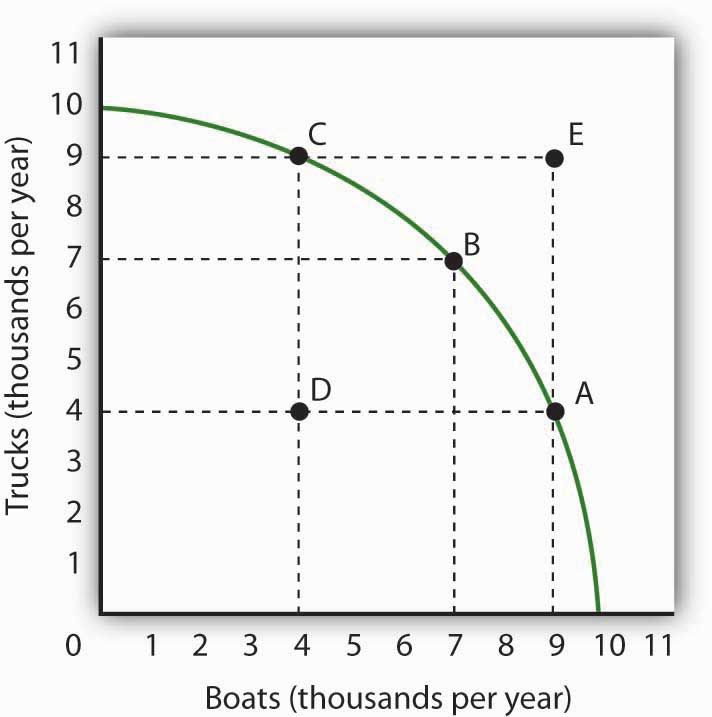
Which economic concepts may be illustrated in a production possibilities curve?
scarcity
economic growth
efficiency
all are illustrated in a PPC
The use of resources to produce the maximum amount of goods and services is considered to be __________.
efficient
wasteful
impossible
unnecessary
A point that lies inside (below) the production possibilities frontier(curve) is ____________.
possible but considered inefficient
possible to meet with current resources and efficient
impossible to meet with current resources
possible to meet with future resources only
An economy at its production possibilities frontier is operating ___________.
with slow economic growth
at full potential
without division of labor
as a free enterprise economy
When a country that produces only two goods is producing on its PPC, the decision to produce more of good A means that ___________.
more of good B also will be produced
the same amount of good B will be produced
less of good B must be produced
there are no opportunity costs involved
A point that lies outside (beyond) the production possibilities frontier (curve) is ________________.
inefficient
possible to meet with current resources
impossible to meet with current resources
possible to meet but considered inefficient
A PPC will shift outwards if ___________.
fewer workers are available to produce goods and services
there are increases in trade, technology, productivity and capital stock
tax rates are increased
there is an increase in the number of people who buy the products


A firm operating at 'X' produces 70 whips and 60 saddles. It changes production to 'Y' producing 20 whips and 90 saddles. The opportunity cost of this production change is
20 whips
30 saddles
50 whips
60 saddles


Which country has the comparative advantage in producing trucks and what is their opportunity cost?

William's opportunity cost for producing 1 cake is
1/2 pies
2 pies
2/3 pies
3/2 pies
1 pie
The best example of a private good is ___________.
Talladega National Forest
Public beaches in south Alabama
NASA
Alabama and Auburn football tickets
The best example of a public good is ___________.
3D televisions
Nike shoes
flood control
haircuts
Which one of the nations listed below has an economy that can best be described as a command economy with limited free market opportunities?
China
The United States
South Korea
Germany
Which of the nations listed below has a command economy?
South Korea
Germany
The United States
North Korea
Which of the four types of economies listed below is the most common among nations of the world?
Pure free market
Pure command
Mixed economy
Pure Traditional

In which economic system is the protection of private property rights essential?
Command
Traditional
Market
Socialism
In which economic system does the government answer all three of the big economic questions? (What to produce? How to produce? For whom to produce?)
Command
Socialism
Market
Traditional

Based on the passage, East Germany's government planned to transform its economy from: Click the magnifying glass for a better view.
Traditional to mixed
Command to traditional
Market to mixed
Command to mixed
Which of the following best explains a mixed economy?
Private ownership of the factors of production and regulation of businesses by government
Market exchanges answer all three of the big economic questions
Family customs and traditions determine what and how to produce a good
Government answers all three of the big economic questions
Which of the following is an economic system in which the government and people are used to decide how to use scarce resources?
Market economy
Command economy
Traditional economy
Mixed economy
Which of the following is an economic system in which economic decisions are made according to tradition & culture?
Market economy
Command economy
Traditional economy
Mixed economy
What is an economic system where only the government makes the economic decisions?
traditional economy
free enterprise
mixed economy
command economy
What type of economy do most countries in the world have?
Market economy
Command economy
Traditional economy
Mixed economy
The country of North Korea has a dictator that makes all of the economic decisions. What type of economy is this?
Traditional
Market
Command
Centrally Planned

The government has little to no role in the production of goods in this type of economy.
Traditional
Mixed
Command
Market
I am a farmer in Africa, and have always traded for my goods. I have a _____ economy.
Traditional
Command
Market
Mixed
The government gets to decide who gets what
Traditional
Command
Mixed
Market
Based on traditions
Command
Traditional
Market
Mixed
The goods produced will be the same, generation after generation
Mixed
Market
Command
Traditional
Businesses have freedom to produce whatever they think consumers will buy
Market
Command
Mixed
Traditional
A command economy is when the government is in control.
True
False
Traditional economy
Mixed economy

