
Font size
 Worksheets
SW Asia Geography Review
Total questions: 91
Worksheet time: 1hrs 15mins
What is the belief in one God called?
Tritheism
Monotheism
Polytheism
Ditheism
Which of the following is NOT one of the Five Pillars of Faith?
Fasting in the month of Ramadan
Pilgrimage to Mecca (hajj)
Reading the Qur'an daily
Prayer five times a day facing Mecca
The oldest religion in Southwest Asia is:
Judaism
Christianity
Islam
Buddhism
What ethnic group does not have their own country?
Christianity
Persians
Kurds
Arabs
Which language do Persians speak?
Arabic
Farsi
Kurdish
English
What could Muhammad have done to avoid the division of Islam into Sunni and Shia?
Changed religions
Added a new pillar
Visited the Wailing Wall
Picked the next leader
Which religion was Abraham the founder of?
Christianity
Islam
Judaism
Buddhism
Which statement is true ONLY of Islam?
Followers believe Abraham is an important ancestor.
Followers use mosques as a place of worship.
Followers believe in only one God.
Followers consider Jerusalem a holy place.
The majority of people in Southwest Asia belong to which ethnic group?
Jews
Arabs
Kurds
Persians
What do Sunni Muslims believe when it comes to their leader?
Leader needs to be related to Muhammad
Leader needs to live in Mecca
Leader needs to read the Qur'an daily
Leader does NOT need to be related to Muhammad
Where do the majority of Arabs live and what is their language?
Iran, Arabic
Mountains of Turkey, Farsi
On the Arabian Peninsula, Arabic
Iraq,Kurdish
Which ethnic group lives mainly in Iran?
Arabs
Kurds
Jews
Persians
How does the diversity of religious groups and ethnic groups impact life in Southwest Asia today?
Diversity has little effect on the region because the groups avoid interaction today.
Diversity encourages peace and cooperation throughout the region.
Diversity contributes to ongoing conflict and fighting throughout the region
Diversity attracts many tourists who visit the region's many varied cultures.
Who was the father/founder of Christianity?
Abraham
Jesus
Muhammad
Ali
What is the sacred text (holy book) of Christianity?
Quran (and parts of the Bible)
Bible (Old and New Testaments)
Torah and the Hebrew Bible
The Vedas
Who was the father/founder of Islam?
Abraham
Jesus
Muhammad
Ali
What is the sacred text (holy book) of Islam?
Quran (and parts of the Bible)
Bible (Old and New Testaments)
Torah and the Hebrew Bible
The Vedas
A man in Palestine wakes up early every morning and reads the Quran. He thinks upon Muhammad’s teachings and visits the holy city of Mecca every year. He prays many times during the day to one god, and spends his nights reflecting on the prophets Abraham and Moses. This man is part of which religious group?
Judaism
Christianity
Islam
A woman in Israel prays to God and the Messiah, Jesus Christ. She reads both the Old Testament and the New Testament of the Bible. She tries to follow the teachings of the prophets, and she often visits places in the Holy City that were important in the life of Jesus Christ. This woman is part of which religious group?
Judaism
Christianity
Islam
All of the following are religious groups EXCEPT
Judaism
Christianity
Persian
Islam
Which of the following is the LARGEST ethnic group in Southwest Asia?
Persians
Kurds
Jews
Arabs
Identify the ethnic group being described here:
- Largest ethnic group in Iran
- Unified by their language, Farsi
- Originally practiced Zoroastrianism
- Today most are Muslims
Arabs
Persians
Kurds
Muslims
Identify the ethnic group being described here:
- Have no official homeland, but would like one
- Speak both Kurdish and Arabic
- Forced to abandon nomadic lifestyle post-WWI
Arabs
Kurds
Persians
Muslims
All of the following are characteristics of Arabs EXCEPT for:
Originally nomads before forming villages along rivers long ago
Many converted to Islam following the teachings of the prophet Muhammad
Their language is the prominent and unifying language of the region
Most are found in Israel, read out of the Torah, and worship in Synagogues or Temples
What are the three major religions in Middle East?
Spartans, Turks, Bantu
Kurd's, Arabs, Persians
Christianity, Islam, Judaism
Jews, Christians, Arabs
What is the largest religion in the world?
Christianity
Islam
Judaism
Buddhism
Ramadan is a holiday for what religion?
Christianity
Islam
Judaism
Monotheism
Which religion worship in synagogues?
Christianity
Judaism
Islam
Buddhism
What is the oldest religion in the Middle East?
Christianity
Judaism
Islam
Hinduism
The Sunni and Shia Muslims split over the issue of
which city to pilgrimage to
what should be part of the sacred text, the Qua'ran
who should be the leader of the Muslims after Muhammad died
whether or not Muhammad had received a message from Allah
Which religion originated in SW Asia?
Christianity
Judaism
Islam
All of the above
None of the above
Which country has more Jews than anywhere else in the world?
Iraq
Israel
Saudi Arabia
Egypt
Which two ethnic groups have a majority of their members practice Sunni Islam?
Arabs
Persians
Kurds
Most Arabs are part of which sect?
Sunni Muslim
Shia Muslim
Most Persians are part of which sect?
Sunni Muslim
Shia Muslim
Which ethnic groups have the most conflict?
Arabs and Kurds
Arabs and Persians
Kurds and Persians
Countries where Kurds live resist because there is ___________ in the territory.
Water
Lumber
Oil
Gold
Which is TRUE of the difference between an ethnic and religious group?
An ethnic group can have members of different races, but a religious group cannot.
All members if a religious group worship the same god; members of an ethnic group may have different religions.
Members of religious groups may have different religious beliefs; ethnic group members have the same religious beliefs.
An ethnic group has a common race or culture, but not a common religion; religious groups have a common race or culture and religion.
Natural resources are not overly evenly distributed among countries.
Which of the following correctly show how the Middle Wast is an example of uneven distribution?
abundance of oil, but a scarcity of water
abundance of coal, but scarcity of copper
abundance of natural gas, but a scarcity of oil
abundance of water, but a scarcity of phosphates
Which two rivers run through the heart of modern-day Iraq and have provided water to the region for thousands of years?
Nile and Jordan Rivers
Indus and Ganges Rivers
Congo and Zambezi Rivers
Tigris and Euphrates Rivers
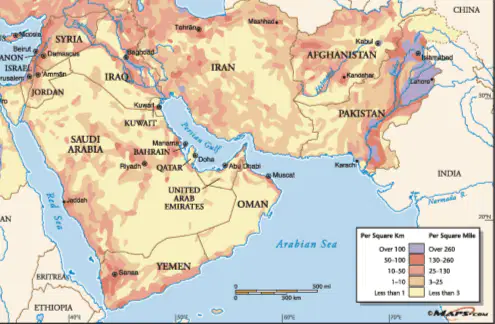
What conclusion can be drawn based on the information presented in the map?
The northern region of SW Asia is home only to nomads and small groups.
Most of the people in SW Asia live near rivers, coastlines, or water sources.
The harsh climate in the northern region of SW Asia keeps people from settling there.
The large, flat plains in the southern region of SW Asia can support large populations.
1. What is desalination?
The process of bringing water to dry land, especially for growing crops.
The process of removing salt and other chemicals from seawater.
The process of collecting water from underground aquifers
The process of flooding rivers to help crops grow
What is irrigation?
The process of bringing water to dry land, especially for growing crops
The process of removing salt and other chemicals from seawater
The process of collecting water from underground aquifers
The process of flooding rivers to help crops grow
What does OPEC stand for?
Official Petroleum Expecting Continents
Oil and Petroleum Exporting Continents
Organization of Petroleum Exporting Countries
Oil Planning and Environmental Committee
Why does OPEC play a powerful role in the world economy today?
OPEC membership includes many oil companies owned by firms in the United States
OPEC builds dams along rivers shared by several countries
This organization is part of the United Nations
OPEC controls the price and supply of oil in the world market
How have the citizens of oil-rich countries benefitted from their oil supplies?
Citizens of oil rich countries no longer have to work to earn a living
Having oil has made very little difference in the lives of citizens in oil-rich countries
Oil wealth has improved their standard of living, leading to better education, housing, and health
They no longer have to be a member of OPEC
How has the discovery of oil in some Southwest Asian countries affected the economic development of this area?
The discovery of oil has meant that no other industries have developed in the region
Those countries with oil reserves are much richer than those countries that have not found oil in their territory
Having oil has made very little difference in the economy of this region
Those with oil need less water than the other countries around them
What are the two most valuable natural resources in Southwest Asia (Middle East)?
water and cotton
phosphates and oil
oil and natural gas
sulfur and natural gas
How has the use of chemical fertilizers affected water supplies in many countries in Southwest Asia (Middle East)?
The use of chemical fertilizers means crops must be watered constantly
Water supplies have been contaminated by the chemicals through runoff from the fields
Chemical fertilizers help take the salt out of water supplies in Southwest Asia (Middle East)
Enormous amounts of water must be used to produce chemical fertilizers
Why aren’t desalination and drip irrigation used more in Southwest Asia (Middle East)?
These technologies are very expensive for countries to use
Few countries in Southwest Asia have access to seawater
Drip irrigation is not very effective in the hot, dry climate
Ancient methods of irrigation are much more effective and helpful
How has the building of dams created problems for countries sharing rivers in Southwest Asia?
Countries in Southwest Asia are not allowed to build dams along shared rivers
Dams are too expensive to build
Few countries have the technology to build dams
Dams limit the water available to countries further downstream


Israel
Syria


The Gaza Strip is located along the banks of which body of water?
the Arabian Sea
the Mediterranean Sea
the Persian Gulf
the Red Sea
The Suez Canal connects which two bodies of water?
the Mediterranean Sea and the Black Sea
the Mediterranean Sea and the Red Sea
the Persian Gulf and the Arabian Sea
the Persian Gulf and the Caspian Sea
"The Jordan River basin is shared by five different nations: Lebanon, Syria, Jordan, Palestine, and Israel. It has been estimated that Israel is consuming up to four times the amount used by the other nations."
What would be the MOST LIKELY topic of discussion among the leaders of these nations?
Reaching an agreement that guarantees fair access to the limited water supply.
The construction of pipelines to divert water into other areas of the region.
Developing guidelines to prevent pollution and contamination of the water.
Creation of desalinization plants to produce more fresh water.
Which natural resource has caused many disputes in the Middle East?
Water
Food
Clothing
Bed
Limited quantities of resources to meet unlimited wants.
Bedoins
Oasis
Scarcity
Dams

What conclusion be drawn based on the information presented in the maps?
The northern region of Southwest Asia is home only to nomads and small groups.
Most of the people in Southwest Asia live near rivers, coastlines, or other water sources.
The harsh climate in the northern region of Southwest Asia keeps people from settling there.
The large, flat plains in the southern region of Southwest Asia can support large populations.
Vast areas of the Middle East are deserts. How has this impacted the use of
water?
Irrigation is essential for growing crops.
In the Middle East, few people use water.
Water is plentiful in the Middle East.
All water is piped in from the Arabian Sea.
Which statement best describes how oil is distributed among the countries of SW Asia?
One country has all the oil reserves.
Some countries have far more oil than others.
Every country draws oil from one large deposit.
Oil is evenly distributed to all countries in the region.
How has the discovery of oil in some SW Asian countries affected the economic development of this area?
Those with oil need less water than other countries around them.
The discovery of oil has meant that no other industries have developed in the region.
The countries with oil reserves are much richer than those countries that have not found oil in their territory. Oil rich countries can show improvement in education, health care, higher life expectancy, and standard of living.
Having oil has made very little difference in the economy.
Which branch of Islam believes the supreme leader MUST be a blood relative (descendant) of Muhammad?
Shi'a
Sunni
What did Muslims disagree about after Muhammad's death?
The location of the holy city
Who should be Muhammad's successor and the next leader of Islam.
Whether the Quran or Bible should be used as the holy book.

