wayground logo

Free Printable Worksheets

Font size

S
M
L
XL
Worksheets

PRACTICE - Predicting Weather + Sea/Land Breezes

Total questions: 37

Worksheet time: 32mins

Name
Class
Date
1.

What kind of weather is a low-pressure system most likely to bring?

a)

Clear weather

b)

Hot, sunny weather

c)

Precipitation (rain or snow)

d)

Light breezes

2.

At which humidity is it most likely to rain?

a)

50%

b)

20%

c)

77%

d)

99%

3.

What kind of weather is a high-pressure system most likely to bring?

a)

Clear, sunny weather

b)

Hot, sunny weather

c)

Precipitation (rain and snow)

d)

Light breezes

4.

What type of front is associated with thunderstorms and leaves behind cooler, drier air?

a)
b)
5.

How is a warm front shown on a weather map?

a)
b)
6.

In which general direction is the cold front near Florida moving?

a)

north

b)

south

c)

east

d)

west

7.

What symbol is used to represent a high pressure system on a weather map?

a)
b)
c)
d)
8.

Which of the following statements best describes the weather conditions at positions A and B in the diagram?

a)

It's raining at position A and clear at position B.

b)

It's cloudy at position A and clear at position B.

c)

It's cooler at position A than at position B.

d)

It's warmer at position A than at position B.

9.

In which direction is D moving?

a)

north to south

b)

south to north

c)

east to west

d)

west to east

10.

Which direction will a WARM FRONT typically originate from?

a)

West

b)

East

c)

South

d)

North

11.

Which direction will a COLD FRONT typically originate from?

a)

West

b)

East

c)

South

d)

North

12.

When you see a cold front on a map, all the cold air is

a)

behind the front

b)

in front of the front

13.

The greatest factor in determining the weather is most often

a)

Temperature

b)

Wind Speed

c)

Air Pressure

d)

Humidity

14.

A cold or warm front does not impact you until

a)

the system has moved past your location

b)

the system is approaching your location

15.
What type of weather is associated with areas of low pressure?
a)
Low pressure = humid, because there is room in the air for moisture to get in 
b)
Low pressure = dry, because there is not room in the air for moisture to get in
16.
What type of weather is associate with areas of high pressure?
a)
High pressure = dry, because there is not room in the air for moisture to get in
b)
High pressure = humid, because there is room in the air for moisture to get in 
17.
What direction is the cold front moving?
a)
Northwest
b)
Southeast
c)
Northeast
d)
Southwest
18.
What direction is the warm front moving?
a)
Northeast
b)
Northwest
c)
Southeast
d)
Southwest
19.
Which city can expect to see an increase in temperatures over the next 24 hours?
a)
Billings, Montana
b)
Atlanta, Georgia
c)
Minneapolis, Minnesota
d)
Miami, Florida
20.
What does this symbol show? 
a)
High pressure
b)
Low pressure
c)
Low humitidy
d)
Longing for someone (strong feelings)
21.
This symbol represents
a)
a cold front
b)
an occluded front 
c)
a stationary front
d)
a warm front
22.

What is the weather like in Los Angeles?

a)

fair and dry

b)

Sunny

c)

rainy and storms

d)

Cold

23.

On the weather map, which area just had a cold front move through?

a)

Little Rock

b)

Chicago

c)

New York

d)

Miami

24.

According to the map, which city will most likely be having a cold front enter the area in the next few days?

a)

Little Rock

b)

Miami

c)

Seattle

d)

New Orleans

25.

According to the map, which city will be experiencing a cold front in the next 24 hours?

a)

Denver

b)

Atlanta

c)

St. Louis

d)

Billings

26.

Which city on the map will have an increase in temperature over the next 24 hours?

a)

Atlanta

b)

Denver

c)

St. Louis

d)

Billings

27.

According to the map which city just had a cold front move through the area?

a)

Los Angeles

b)

Salt Lake City

c)

San Francisco

d)

Billings

28.

Which city just had a warm front move through?

a)

Washington D. C.

b)

Detroit

c)

Atlanta

29.
Do sea breezes typically happen during the day or night?
a)
Day
b)
Night
30.
Do land breezes typically happen during the day or night?
a)
Day
b)
Night
31.
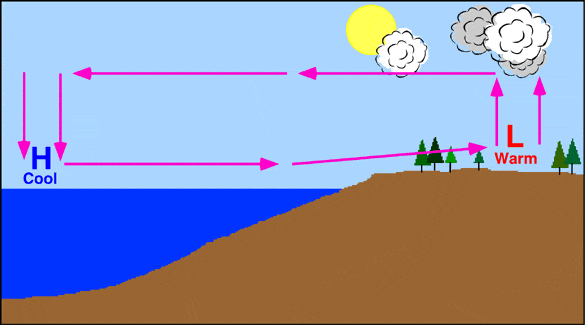
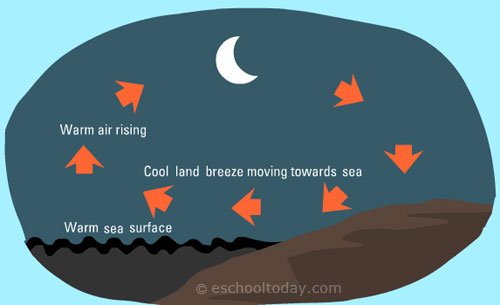
Is this a land or a sea breeze?
a)
land breeze
b)
sea breeze
32.
Is this a land or a sea breeze?
a)
land breeze
b)
sea breeze
33.
How does the air move in a land breeze?
a)
From east to west
b)
From west to east
c)
From the land to the ocean
d)
From the ocean to the land
34.
The strength of a sea breeze depends on
a)
the heat of the day
b)
the difference between the temperature of the sea and the land
c)
the wind speed
d)
the amount of precipitation that day
35.
How does the air move in a sea breeze?
a)
wind moves from north to south
b)
wind moves from ocean to the land
c)
wind moves from the land to the ocean
d)
wind moves from south to north
36.
In a sea breeze, the air is warmer above the _____.
a)
land
b)
ocean
c)
sky
d)
beach
37.
Where does the initial source of energy come from that creates winds?
a)
the moon
b)
the sun
c)
the Earth's surface
d)
the rotation of the Earth