
 Worksheets
Properties of Water
Total questions: 60
Worksheet time: 35mins


What is water's molecular formula
H2O
H2O2
O2H
CO2
The atoms in a water molecule are held together by covalent bonds. This means that the bonded atoms
Lose protons
Lose electrons
Share electrons
Switch neutrons
A water molecule has the chemical formula H2O. This means that the water molecule is made up of
Two hydrogen atoms and one oxygen atom
Two oxygen atoms and one hydrogen atom
Two hydrogen atoms and two oxygen atoms
Two molecules of water
The water molecule is a polar molecule. A water molecule is polar because
The electrons are shared equally
Oxygen has a stronger attraction for electrons than hydrogen
It is very cold
Hydrogen atoms have a stronger attraction for electrons than oxygen
Water molecules are attracted to each other because
They are all positively charged
Each water molecule has the same number of protons as electrons
The positive area of one water molecule is attracted to the negative area of another
All water molecules are neutral
Water is able to dissolve sodium chloride because
The polar areas of water molecules attract the oppositely charged ions of sodium chloride
The shape of the water molecules pushes the sodium and chloride ions apart
The oxygen in the water molecules reacts with the sodium and chloride ions
Water molecules and sodium chloride are covalently bonded
Capillary Action is key for
Water moving from roots to leaves in plants
Air moving from mouth to lungs
Ice floating on water
Water moving to lower areas
When you mix oil and water they immediately separate because
Water is too good for oil
Oil is dirty and water is clean
Both oil and water are polar
Water is polar and oils are non polar
Describe COHESION.
Water molecules attracted to other substances.
Water molecules climbing upwards against the force of gravity.
Water molecules dissolving many substances because of its polarity.
Water molecules attracted to other water molecules.
Describe ADHESION.
Water molecules attracted to other substances.
Water molecules climbing upwards against the force of gravity.
Water molecules dissolving many substances because of its polarity.
Water molecules attracted to other water molecules.
Why can water striders walk across the surface of water without falling through?
They are light enough so they don't break the hydrogen bonds holding the water molecules together
The insects actually use their wings to hover slightly above the water’s surface
The insect’s feet are non-polar, so they are repelled by the polar water molecules and are pushed away from the water’s surface.
The insects are small enough to see the individual water molecules, so they are able to step carefully from one molecule to the next
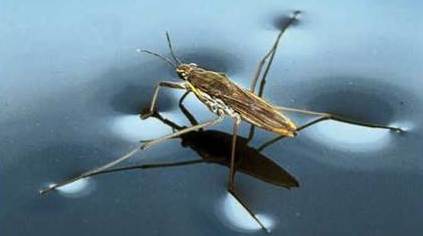
Refer to the picture; the insect is not falling through the water because of:
surface tension
capillary action

Which end of the water molecule has a slightly positive charge?
the oxygen end
the hydrogen end
both ends are slightly positive
neither end is positive

What phases are water found in on earth?
liquid
liquid and gas
liquid and solid
liquid, solid, and gas

The substance that gets dissolved in water is known as that
solvent
solute
solution

How would you identify a substance with a pH less than 7?
acid
base
neutral
alkaline

What is the only substance with a neutral pH of 7?
Water
Milk
Orange juice
Soap

What is a mixture?
A mix of ingredients that will keep their physical traits
A mix of things that will all dissolve once put together
Do not separate easily
Can not tell the ingredients apart
Homogenous Solutions are formed when
one substance dissolves uniformly in another substance
liquids are mixed together
a compound is created
solids and liquids are mixed together
Is a solution a type of mixture?
Yes
No
Which of the following is an example of a solution?
A jar of coins
Fruit Salad
Kool Aid
A box full of plastic forks, knives, and spoons
When something is soluble what happens when it is put into water?
It grows in size
It dissolves
Nothing happens and it either sinks or floats.
It becomes colder
Combination of two or more different kinds of substances that keep their own physical properties and can be easily separated.
Solution
Mixture
Solubility
Miscibility
Sugar dissolved in water is an example of a
Solution
Mixture

Why does ice float in water?
It is less dense than liquid water
It is more dense than liquid water
It has no density

As a whole, this bowl of chicken noodle soup would generally be considered a
heterogenous mixture
heterogeneous solution
homogeneous mixture
homogeneous solution

A cup of coffee would be considered a
mixture
solution

Salt and pepper would be an example of a
mixture
solution
What is a solute?
The liquid used to dissolve.
The material being dissolved.
What is a suspension?
The mixture of a undissolved particles in solution.
The mixture of two solids.

A snow globe would be an example of a __________________.
colloid
solution
suspension


How would you identify a substance with a pH greater than 7?
acid
base
neutral
alkaline
When you mix oil and salt together, the salt does not dissolve. This is because salt is _______ in oil.
soluble
insoluble
solvent
solute
Blood appears purple/red when remove from the body. One would think it is a homogeneous solution, but it is not. Blood is a ...
homogeneous solution
homogeneous suspension
solution
suspension


capillary action
atoms
The _____________ is the part of the solution that is dissolved.
Smaller molecule
Larger molecule
Solute
Solvent
The ______________ is the part of the solution that dissolves the other substance.
Large molecule
small molecule
Solvent
Solute
The ________________ is the amount of heat it takes to raise the temperature of one gram of a substance by one degree Celsius.
Heat of vaporization
Specific Heat
Capillary Action
Surface tension
Water molecules are strongly attracted to one another due to _______________ bonds, which causes ________________.
Hydrogen; Adhesion
Hydrogen; Cohesion
Ionic; Adhesion
Ionic; Cohesion
When water molecules bond to the xylem in plants, it is displaying the property of
Cohesion
Adhesion
Surface tension
Polarity
Ice floats on water because it ___________ when it freezes, and becomes __________ dense than water.
Contracts; more
Contracts; less
Expands; more
Expands; less
Due to its polarity, water doesn't mix with ____________ substances like _____________.
polar; oil
polar; salts
Non-polar; oil
Non-polar; salts
When a lake freezes over in the winter,
the ice only forms on the top layer and acts as insulation for the rest of the lake.
the ice freezes the entire lake into one giant ice cube.
the ice freezes on the top layer, but then sinks to the bottom because ice is more dense than water.
the ice only forms on the bottom layer, and melts quickly.
Large bodies of water tend to resist large temperature changes due to water's __________________ which allow it to
heat of vaporization; store cold air
heat of vaporization; keep the water from evaporating
high specific heat; reflect heat
high specific heat; absorb and store heat.
Water appears to bulge out in a spherical droplet when ___________ is a large factor.
Adhesion
Capillary action
Cohesion
Density
When water moves up a piece of paper, or up a tree against gravity, it is displaying the property of water known as
Adhesion
Capillary action
Cohesion
Density



