Wayground logo

Free Printable Worksheets

Font size

S
M
L
XL
Worksheets

Unit 7

Total questions: 20

Worksheet time: 16mins

Name
Class
Date
1.
Mutations are important because they bring about
a)
death of the organism in which they develop
b)
genetic variation needed for a population to evolve
c)
benefits for the individual, not for the population
d)
Hardey-Weinberg equilibrium within a population
2.

What is the term for a feature that allows an organism to survive better in its environemtn?

a)

variation

b)

adaptation

c)

homologous structure

d)

vestigial structure

3.
Natural selection results in change over time by acting on traits that are
a)
heritable
b)
new
c)
mutated 
d)
better than the best
4.
This is the trace or remains of an organism that lived long ago, most commonly preserved in sedimentary rock.
a)
Competiton
b)
Extinction
c)
Evidence
d)
Fossil
5.

Adaptations are:

a)

physical or behavioral tendencies.

b)

physical or behavioral characteristics that help an organisms survive and reproduce.

c)

physical or behavioral characteristics that do not help the organism in any way.

d)

genetic mutations that have gone wrong.
6.
Which term refers to the process by which individuals that are better suited to the environment survive and reproduce therefore passing down their genes to their offspring? 
a)
Evolution 
b)
Variation 
c)
Adaptation
d)
Natural Selection 
7.
Which of the following is NOT an example of natural selection? 
a)
People selectively breeding hamsters.
b)
Insect populations developing resistance to certain pesticides.
c)
Bacteria becoming resistant to antibiotics.
d)
Male birds of certain species developing colorful feathers to attract female mates.
8.
What do we call similar physical structures that indicate a link to a common ancestor?
a)
absolute dating
b)
adaptations
c)
gradualism
d)
homologous structures
9.
Which of the following is an example of a vestigial structure?
a)
the wings of a red-tailed hawk
b)
the hind limbs of a house cat
c)
the fins of sharks
d)
the tailbone of a human
10.
The diagram shows fossils in different rock layers. Which of these statements about the age of these fossils is most likely correct?
a)
Fossil A and C are the same age
b)
Fossil B is older than fossil C
c)
Fossils A is older than fossil B
d)
Fossil D is older than fossil C
11.

What do we call a change in a species over time?

a)

Adaptation

b)

Evolution

c)

Extinction

d)

Environmental influences

12.
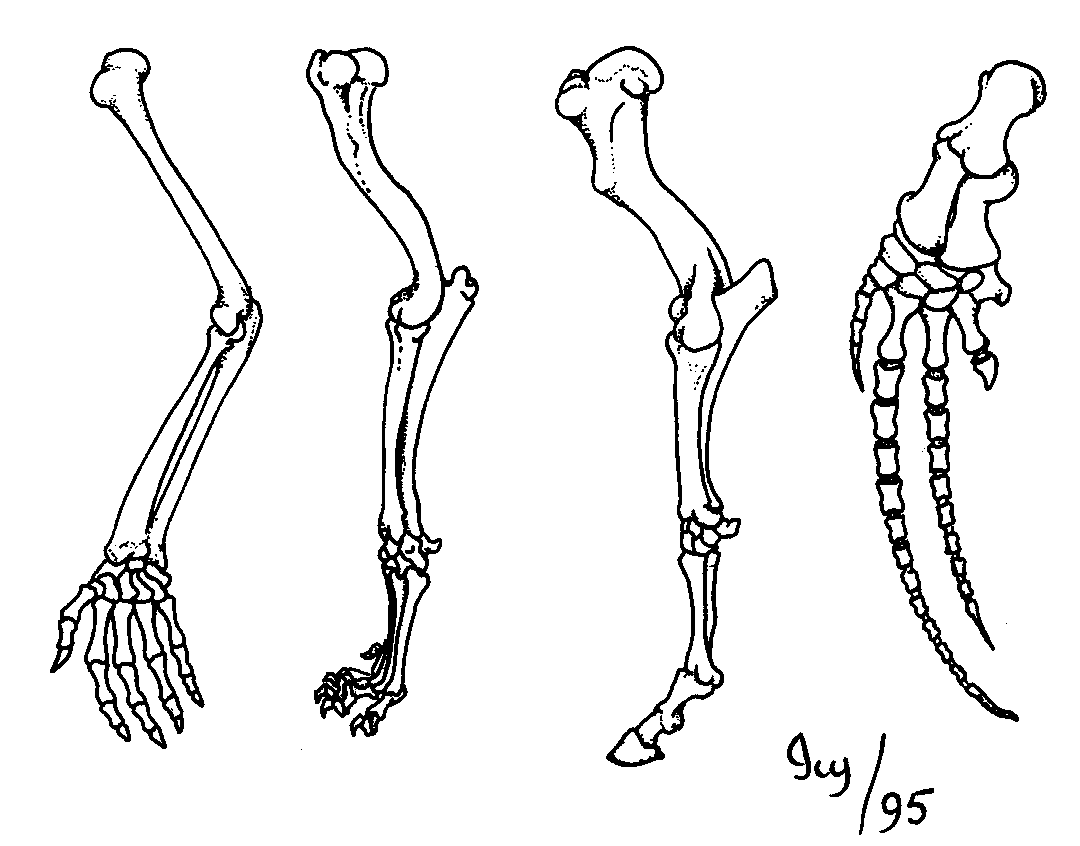
Structures with the same parts have different functions; suggests that organisms share a common ancestry
a)
vestigial structures
b)
homologous structures
c)
adaptive radiation
d)
fossil
13.
The environment around Manchester, England, changed during the Industrial Revolution.  How did this change affect peppered moths living in the area?
a)
Natural selection favored moths with dark wings because predators could not see them on the soot-colored trees.
b)
Natural selection favored moths with white wings that were easy for predators to see.
c)
Natural selection favored moths with white wings because predators could not see them on the soot-colored trees.
d)
Natural selection caused moths with white wings to become extinct.
14.
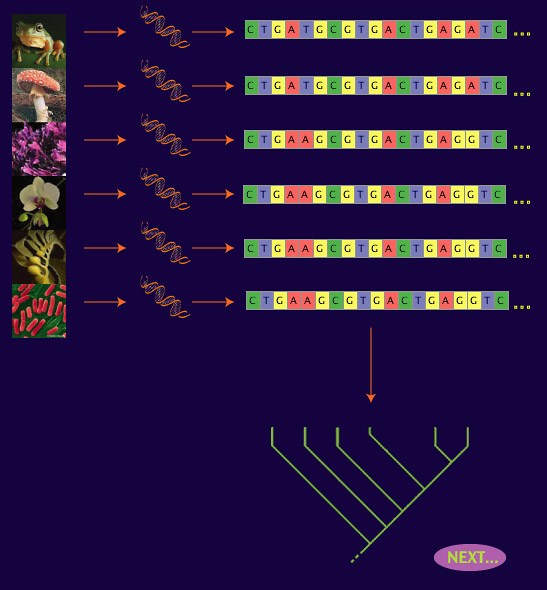
Two organisms that are closely related would have
a)
very similar DNA sequence
b)
exactly the same DNA sequences
c)
no proteins in common
d)
completely different DNA sequence
15.
Which of the following organisms the kingdom animalia are not closely related?
a)
mouse and hagfish
b)
mouse and lizard
c)
mouse and pigeon
d)
mouse and chimp
16.

Why are homologous structures important to the theory of evolution?

a)

Scientists use them as evidence that many species must have had a common ancestor.

b)

Scientists use them as evidence that many species must have independently evolved and are not related to other species.

c)

Scientists use them as evidence to show that all kinds of structures in our bodies work to help us survive.

17.

Why are vestigial structures evidence for evolution?

a)

They are useful in the organism and show natural selection at work.

b)

They are not useful in the organism but they were probably useful in some ancestor of that species.

c)

They show that these organs or behaviors help an organism adapt to new environments

18.

How do scientists use embryology to support the theory of evolution?

a)

Embryos of many species have a lot of similar characteristics when they are first forming showing different creatures must have a common ancestor

b)

Embryos of many species have very little in common until they start developing for long periods of time

c)

Features like gills and tails prove that all animals are really just fish

19.

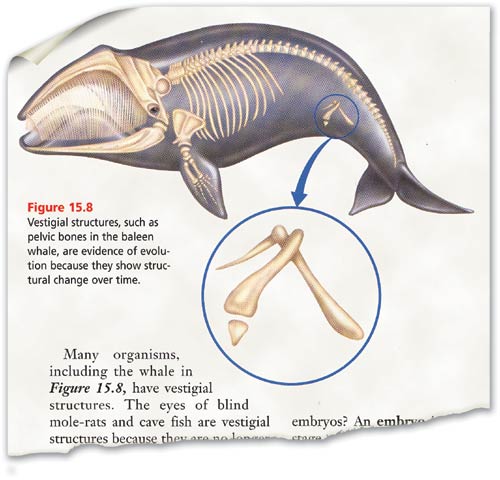
What type of evidence is shown in the picture above?

a)

Ancestral traits

b)

Embryonic Development

c)

Homologous Structures

d)

Vestigial Structures

20.

Structures are similar in function but not in structure

a)

Vestigial

b)

Homologous

c)

Analogous Structures

d)

Embryonic