
NEW
Font size
 Worksheets
Chapter 13 & 14 Test Review: Heat, Temp., Work, & Energy
Total questions: 36
Worksheet time: 25mins
Kinetic energy is the energy an object has due to its
mass
weight
motion
position
Convert 20°C into °F.
7.2°C
32°C
75.2°F
°68


What is the gravitational potential energy of a 26 kg eagle, flying at an altitude of 65 m at a speed of 19 m/s?
32,110 J
1690 J
172.4 J
16,562 J


We measure temperature in degrees...
Fahrenheit
Celsius
Both Celsius and Fahrenheit
Kelvin
All of the above
Convert 589 Kelvin into °C.
252K
316°C
303K
-163°C

The ability to do work (move) is called...
Matter
Energy
Weight
Force
True or false: Energy cannot change from one type to another.
True
False
Convert -21°C into Kelvin.
252K
316°C
303K
-163°C
Which of the following is an example of thermal energy?
A light bulb
The movement of a car
The digestion of food
Heat from a fire
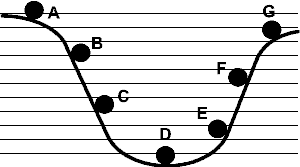
At which point does the ball has the greatest gravitational potential energy (GPE)?
A
G
D
C
G
Which would have the LEAST gravitational potential energy (GPE)?
A ball sitting on the ground
Moon viewed from the Earth
An airplane flying 30,000 feet above the ground
A rock sitting on top of Mt. Everest
Convert 89°F into °C.
7.2°C
32°C
32°F
212°F
How could you increase the gravitational potential energy of an object without changing its mass and gravity?
Make the object larger
Lower the object towards the ground
Raise the object farther off the ground
Allow the object to roll on the ground

You throw a ball into the air as shown in the diagram. At what point does the ball have the most gravitational potential energy?
W
X
Y
Z
Which is the correct unit for expressing gravitational potential energy?
Joule
Newton
m/s2
meter
What is the value of the Earth's acceleration due to gravity (g)?
9.8 m/s2
100 m/s2
25 m/s2
3.14 m/s2
Which of the following is the correct equation for calculating an object's gravitational potential energy?
PE = mgh
PE = mg / h
PE = mg + h
PE = gh
What is the gravitational potential energy (GPE) of a 1 kilogram book that is 1 meter above the ground?
g = 9.8 m/s2
9.8 Joules
1.0 Joule
0.10 Joule
11.8 m/s2

An Olympic high jumper, with a mass of 82 kg, has a maximum gravitational potential energy of 1970 J. How high was the jump?
24 m
161,540 m
2.5 m
201 m

What can you say about the potential energy of the two sleds shown above?
Sled B has more potential energy.
There is not enough information to know which sled has more potential energy.
The two sleds have the same potential energy.
Sled A has more potential energy.
Which of the following is a correct statement?
Both the mass and speed of an object affect the amount of kinetic energy it will have.
Only the speed of an object affects the amount of kinetic energy it will have.
Only the mass of an object affects the amount of kinetic energy it will have.
Neither the mass nor speed of an object affects the amount of kinetic energy; only the height of the object.


Units of force are...
Newtons
Grams
Joules
Meters

