wayground logo

Free Printable Worksheets

Font size

S
M
L
XL
Worksheets

Chemistry Common Assessment Grade 8 (PS1-1, 1-2, 1-4, 1-5)

Total questions: 60

Worksheet time: 44mins

Name
Class
Date
1.

Which subatomic particle determines the element?

a)

protons

b)

neutrons

c)

electrons

2.
Which statement best describes an electron?
a)
Smaller mass than a proton and a negative charge
b)
Smaller mass than a proton and a positive charge
c)
Greater mass than a proton and a negative charge
d)
Greater mass than a proton and a positive charge
3.

What particle is Y?

a)

Proton

b)

Neutron

c)

Nucleus

d)

Electron

4.

What particle is X?

a)

Proton

b)

Neutron

c)

Nucleus

d)

Electron

5.

What is the basic unit of matter? (Hint: What is all matter made up of?) Cells Light Atoms Nucleus

a)

Cells

b)

Light

c)

Atoms

d)

Nucleus

6.

Which of the following is NOT part of an atom?

a)

Electron

b)

Element

c)

Proton

d)

Neutron

7.

Are made from a combination of 2 or more elements in fixed proportions...

a)

Molecules

b)

Pure Substances

c)

Compounds

d)

Elements

8.
A combination that can be separated by physical processes is a .....
a)
Pure Substance
b)
Glucose
c)
Element
d)
Mixture
9.
A mixture that is NOT evenly distributed is called ....
a)
Compounded
b)
Homogenous
c)
Heterogenous
d)
Salty
10.
Mixture, such as mixed nuts or dry soup mix, in which different materials are unevenly distributed and are easily identified.
a)
suspension
b)
homogeneous mixture
c)
heterogeneous mixture
d)
colloid
11.
Substance with atoms that are all alike.
a)
element
b)
compound
c)
homogeneous mixture
d)
heterogeneous mixture
12.
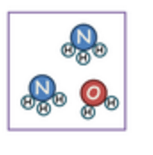
This picture represents: 
a)
Element
b)
Compound
c)
Mixture of Elements
d)
Mixture of Compounds
13.
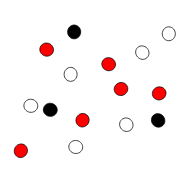
This picture represents: 
a)
Element
b)
Compound
c)
Mixture of Elements
d)
Mixture of Compounds
14.
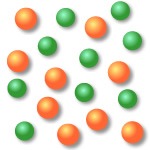
This picture represents: 
a)
Element
b)
Compound
c)
Mixture of Elements
d)
Mixture of Compounds
15.
All matter is made up of .....
a)
Compounds
b)
Atoms
c)
Molecules
d)
Sunshine
16.
This picture represents which of the following?
a)
element
b)
compound
c)
mixture
17.
Which of the following is an element?
a)
Sugar
b)
Salt
c)
Water
d)
Oxygen
18.
A mixture that is so evenly mixed you can't see the parts.  Such as Kool-Aid
a)
Homogeneous Mixture
b)
Heterogeneous Mixture
c)
Pure Substance
19.
True or False: Matter is divided into two main groups: substances and mixtures.
a)
True
b)
False
20.
True or False: The two types of substances are elements and compounds.
a)
True
b)
False
21.

table salt (NaCl)

a)

compound

b)

homogenous mixture

c)

heterogenous mixture

d)

pure substance

22.

rust (Fe2O3)

a)

compound

b)

heterogenous mixture

c)

homogenous mixture

d)

pure substance

23.

air (clean or polluted)

a)

compound

b)

heterogenous mixture

c)

homogenous mixture

d)

pure substance

24.

Choose all the physical changes.

a)

Liquid water becomes water vapor.

b)

Combining sulfuric acid and sodium chloride gives off hydrogen chloride gas.

c)

Sodium chloride (NaCl) dissolves in water.

d)

Burning a scented candle.

e)

Dry ice (solid CO2) sublimates to CO2 gas.

25.

Choose all the chemical changes.

a)

Liquid water becomes water vapor.

b)

Combining sulfuric acid and sodium chloride gives off hydrogen chloride gas.

c)

Sodium chloride (NaCl) dissolves in water.

d)

Burning a scented candle.

e)

Dry ice (solid CO2) sublimates to CO2 gas.

26.

How are chemical reactions different from a physical change?

a)

physical changes create a new substance, chemical reactions do not

b)

chemical reactions create a new substance, physical changes do not

c)

chemical reactions happen more, physical changes happen less

d)

physical changes happen more, chemical reactions happen less

27.

Which is not a physical property

a)

flammability

b)

melting point

c)

boiling point

d)

density

28.

A physical change happens when …

a)

the substance does not change into a new substance with new chemical properties

b)

the substance changes into something different with new chemical properties

29.

Which of the following is NOT an example of a physical change

a)

Cutting paper

b)

Burning wood

c)

Melting glass

d)

Boiling water

30.

Which of the following is a common sign that a chemical change has occurred?

a)

A chemical has turned a different color

b)

A chemical has changed to a different state of matter

c)

A chemical has changed size

d)

A chemical has become a different shape

31.

Chemical changes can be reversed.

a)

True

b)

False

32.

A substance that starts a chemical reaction is called ...

a)

reactant

b)

product

c)

element

d)

atom

33.

A substance produced by a chemical reaction is called ...

a)

reactant

b)

product

c)

atom

d)

element

34.

Which phrase describes particle movement in a solid?

a)

Particles can slip past one another

b)

Particles move independently from one another

c)

Particles vibrate within fixed positions

35.

Which phrase describes particle movement in a liquid?

a)

Particles move independently from one another

b)

Particles can slip past one another

c)

Particles vibrate within fixed positions

36.

Which phrase describes particle movement in a gas?

a)

Particles vibrate within fixed positions

b)

Particles can slip past one another

c)

Particles move independently from one another

37.

The diagram representing space and speed of these molecules matches which state of matter?

a)

Solid

b)

Liquid

c)

Gas

38.
Which process does the diagram show?
a)
freezing
b)
boiling
c)
evaporation
d)
melting
39.
The particles of a gas move ____than the particles of the same substance in the liquid or solid state.
a)
faster
b)
slower
c)
same speed
40.
All matter is made of _____ that are constanly moving.
a)
insulators
b)
particles
c)
convection
d)
pieces of plastic
41.

Hector is standing in a closed room with a balloon filled with helium gas. If Hector pops this balloon, what will happen to the molecules in the helium gas?

a)

They will condense into a cloud around Hector.

b)

They will fall to the floor as a structured solid.

c)

They will expand and flow through the room

d)

They will flow to the floor and form a puddle.

42.

When you heat a sample of gas, what happens to the particles that make up the gas?

a)

The particles move faster

b)

The particles break apart

c)

The particles get smaller

d)

The particles become more dense

43.
What happens when my glass of water is sitting in the sun and disappears into a gas?
a)
evaporation
b)
burning
c)
melting
d)
freezing
44.

As temperature decreases, what happens to particles?

a)

They speed up

b)

They slow down

45.

As temperature increases, what happens to particles?

a)

They speed up

b)

They slow down

46.
The Law of Conservation of Mass states
a)
that matter exists in all states and reacts the same
b)
that matter can only be changed into new substances by introducing a catalyst
c)
that matter exists in the same state throughout any chemical change
d)
that matter cannot be created or destroyed and that the mass of the products must equal the mass of the reactants
47.
How many Al atoms are in this compound?         4Al2O3
a)
2
b)
8
c)
6
d)
4
48.
At the end of chemical reactions, what is the total mass of the reactants compared to the total mass of the products?
a)
the product is doubled
b)
the product is half the mass of the reactants
c)
the mass is the same
d)
the mass changes depending on the reaction
49.
10g of white powder reacts with 10g of clear liquid. The reaction bubbles and changes color producing a black liquid that has a mass of 13g. What can be concluded?
a)
5g of gas was produced
b)
This experiment violates the conservation of mass
c)
7g of gas was produced
d)
The excess reactant is destroyed & disappears during the reaction
50.
There are two reactants in a chemical equation, and one product.  The mass of the product is 30g.  The mass of the first reactant is 17g.  What must the mass of the second reactant be, if the equation is to follow the law of conservation of mass?
a)
47g
b)
13g
c)
23g 
d)
You cant tell with the given information
51.
What are the reactants in the chemical equation pictured?
a)
CH4 and CO2
b)
CH4 and O2
c)
CO2 and H2O
d)
O2 and H2O
52.
What is the large number written before a chemical formula called?
a)
Coefficient
b)
Subscript
c)
Reactant
d)
Product
53.
What is the small number written after a chemical symbol called?
a)
Coefficient
b)
Subscript
c)
Product
d)
Reactant
54.
What is a shorthand notation that represents a compound or molecule called?
a)
Chemical Equation
b)
Chemical Formula
c)
Chemical Reaction
d)
Chemical
55.
A molecule is________
a)
a glob of gelatinous goo
b)
smaller than an atom
c)
filled with raisons
d)
more than one atom bonded together
56.

Chemical Reaction

a)

a substance formed as a result of a chemical reaction

b)

a change in matter that produces one or more new substances

c)

the process in which substances undergo chemical changes that result in the formation of new substances

d)

a substance that enters into a chemical reaction

57.

Is this equation balanced?

a)

yes

b)

no

c)

Not enough information

58.

Matter is anything that has __________ and _________.

a)

Atoms and Molecules

b)

Mass and Volume

c)

Thermal and Kinetic.

d)

Compounds and Mixtures

59.

What is the center of an atom called?

a)

Middle

b)

Proton

c)

Neutron

d)

Nucleus

60.

If a mixture of sand and water is separated, what happens to the particles that made up the original mixture?

a)

The particles rearrange to make a new substance.

b)

The particles retain their original properties.