Wayground logo

Free Printable Worksheets

Font size

S
M
L
XL
Worksheets

Unit 1 (Part 2) Test Review

Total questions: 55

Worksheet time: 41mins

Name
Class
Date
1.
If the number of births in a population is the same as the number of deaths in a population, what will happen to the growth of the population?
a)
It will increase.
b)
It will decrease.
c)
It will stay the same.
d)
It will fluctuate.
2.
If the number of births is greater than the number of deaths in a population, what will happen to the growth of the population?
a)
It will increase.
b)
It will decrease.
c)
It will stay the same.
d)
It will fluctuate.
3.

What might happen if the earth exceeds its carrying capacity?

a)

There might not be room for people to move around.

b)

There might not be enough food and water for everyone.

c)

The continents might sink into the oceans.

d)

Most of the people on the planet would starve.
4.
What growth pattern describes a population whose growth rate slows or stops following a period of exponential growth?
a)
logistic growth
b)
population growth
c)
exponential growth
d)
predator-prey cycle
5.
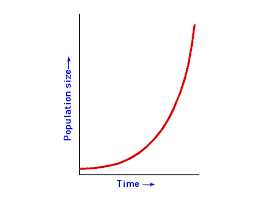
What type of growth is shown in the diagram?
a)
exponential growth
b)
logistic growth 
c)
predator-prey cycle
d)
boom-bust curve
6.
Largest number of individuals of a population that the environment can support...  
a)
carrying capacity
b)
population crash
c)
lag phase
d)
mutualism
7.
Plants and animals that are not native to a habitat (nonindigenous)...
a)
predators
b)
biological magnification
c)
invasive species
d)
prey
8.
What do you call a period of rapid growth?
a)
exponential growth
b)
logistic growth
c)
emigration
d)
predator-prey cycle
9.
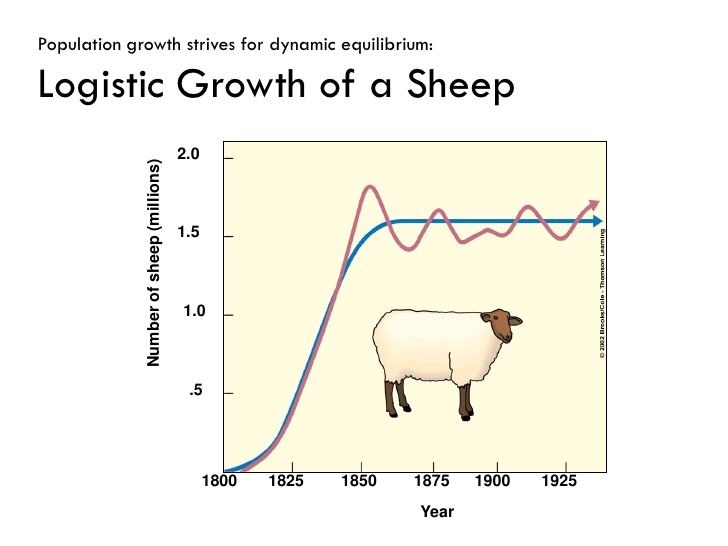
What is the carrying capacity for this sheep population?
a)
1.8 million
b)
1.25 million
c)
1.6 million
d)
1.o million
10.
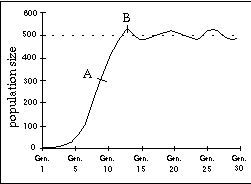
What is the carrying capacity of the graph?
a)
around 500
b)
more than 500
c)
less than 500
d)
around 600
11.
If the amount of food or resources available increases, the carrying capacity for an animal:
a)
Stays the same
b)
Increases
c)
Decreases
d)
Fluctuates
12.
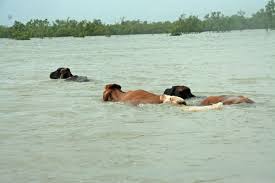
Excessive amounts of rain caused a flood in the southwest United States that resulted in substantial amounts of deaths in the rabbit population? This situation is an example of a density _____________ limiting factor.
a)
density-independent
b)
density-dependent
c)
density- too high
d)
density- too low
13.

Natural disasters can be considered limiting factors.

a)

true: density independent limiting factors

b)

false; natural disasters are not limiting factors

c)

true: density dependent limiting factors

d)

false: because Mrs. Schaffer said

14.

A lion and a cheetah attempt to occupy the same niche. The more aggressive lion survives; the cheetah does not.

a)

Density-Dependent: Competition

b)

Density-Independent: Competition

c)

Density-Dependent: Predator-Prey

d)

Density-Independent: Predator-Prey

15.

Coyotes cross the winter pack ice and enter Newfoundland. The moose population starts to decline.

a)

Density-Dependent: Competition

b)

Density-Independent: Competition

c)

Density-Dependent: Predator-Prey

d)

Density-Independent: Predator-Prey

16.

Travelers who visit a crowded African village become infected with a disease caused by parasites.

a)

Density-Dependent

b)

Density-Independent

17.

Due to stress, large numbers of female lemmings miscarry their young and fail to reproduce.

a)

Density-Dependent

b)

Density-Independent

18.

Many fish die due to a change in the winds and the appearance of the El Nino ocean current off the coast of Peru and Chile.

a)

Density-Dependent

b)

Density-Independent

19.

An extensive drought in the Serengeti Plain threatens wildebeest, giraffe, zebra, and springbok populations.

a)

Density-Dependent

b)

Density-Independent

20.
Organisms that lay eggs, do no nurturing of their young and are adults for only short periods of time:
a)
Type 1
b)
Type 2
c)
Type 3
d)
Zebras
21.
Organisms that either die at birth or get eaten as eggs show this type of survivorship.
a)
Type 1
b)
Type 2
c)
Type 3
d)
Elephants
22.
Organisms that have gestation (pregnancy) periods and usually only give birth to one offspring at a time.
a)
Type 1
b)
Type 2
c)
Type 3
d)
Foxes
23.
Which of the following statements about primary succession is true?
a)
It begins with a climax community
b)
Small mammals are the first to live there
c)
It begins with bare rock
d)
It begins with rock and soil
24.
Which of the following is a density-independent limiting factor?
a)
natural disaster
b)
predation
c)
disease
d)
parasitism
25.
Lichens and mosses that first live in uninhabited areas are examples of
a)
secondary species
b)
non-native species
c)
pioneer species
d)
climax species
26.
A sequence of biotic changes that regenerate or create an ecological community is known as
a)
factors
b)
erosion
c)
succession
d)
progression
27.

The type of succession in which the initial conditions are very harsh & the conditions changes very slowly. Changes can take hundreds to thousands of year.

a)

primary

b)

secondary

c)

tertiary

d)

pioneer

28.

A series of predictable changes that occurs in a ecological community over time.

a)

succession

b)

adaptation

c)

evolution

d)

progression

29.

A series of predictable changes that occurs in a ecological community over time.

a)

succession

b)

adaptation

c)

evolution

d)

progression

30.

Species that are able to in survive hostile environments. Usually autotrophs, these species are the first to colonize areas. Their niche is to create new ecological niches for other species.

a)

pioneer

b)

self-perpetuating

c)

intermediate

d)

community

31.

Tracks organisms that tend to live long lives (low death rate and high survivorship rate); toward the end of their life expectancies, however, there is a dramatic increase in the death rate.

a)

Type I

b)

Type II

c)

Type III

d)

Type IV

32.

Describes organisms with a high death rate (or low survivorship rate) immediately following birth. Examples include bacteria, fishes, and invertebrates.

a)

Type I

b)

Type II

c)

Type III

d)

Type IV

33.

These organisms typically live in unstable, unpredictable environments & are able to reproduce rapidly (exponentially). They do not take care of their young & are subject to predation.

a)

k-strategist

b)

r-strategist

c)

m-strategist

d)

s-strategist

34.

Biodiversity, aka biological diversity, usually refers to

a)

the same species in a general location

b)

the number of different species in a given area

c)

the number of animal species in a given area

d)

the number of plant species in a given area

35.

Species that are clearly critical to the functioning of an ecosystem are known as

a)

biodiversity

b)

keystone species

c)

main species

d)

native species

36.

a species that is not native to a particular region and has no natural predators and little competition

a)

consumer species

b)

producer species

c)

invasive species

d)

adapted species

37.

A common type of succession that occurs where an event such as a forest fire has occurred, or a farmer's field has been abandoned is called

a)

common succession

b)

primary succession

c)

secondary succession

d)

Quaternary succession

38.
Which biome is more biodiverse?
a)
Desert
b)
Sand
c)
Tundra
d)
Rainforest
39.

Invasive species alter the ecosystem by _____ in number quickly. This leads to _____ food for the native species.

a)

increasing, less

b)

increasing, more

c)

decreasing, less

d)

decreasing, more

40.

A life form that is very sensitive to environmental changes in its ecosystem. They can give us early-warning messages that a habitat is suffering.

a)

Indicator Species

b)

Flagship Species

c)

Predators

d)

Ecosystem Engineers

41.
One characteristic feature of the tundra is that only the surface thaws in the summer and refreezes in the winter, leaving a permanently frozen subsoil. This characteristic is known as 
a)
Hoarfrost
b)
Glaciation
c)
Permafrost
d)
Crystallization 
42.
Which of these types of information do scientists use to organize the Earth into biomes?
a)
Forest and endangered species
b)
Biomass, energy, and human populations
c)
Precipitation, temperature, and vegetation
d)
Renewable and non-renewable resources
43.
Which biome is characterized by low temperatures and low amounts of rainfall?
a)
Tundra
b)
Desert
c)
Temperate Deciduous Forest
d)
Tropical Rainforest
44.
Which biome is characterized by low temperatures and low amounts of rainfall?
a)
Tundra
b)
Desert
c)
Temperate Deciduous Forest
d)
Tropical Rainforest
45.
Which biome, because of its climate, has the largest number of species of plants and animals?
a)
Tundra
b)
Rainforest
c)
Desert
d)
Pineforest
46.
The northern United States and Southern Cnanada are characterized by forest of deciduous trees that lose their leaves in winter and coniferous trees that are evergreens. This area is a transition between which 2 major biomes?
a)
Cold woodland and arctic tundra
b)
Temperate forest and taiga
c)
Northern prairie and deciduous forest
d)
Desert and temperate forest
47.
The kangaroo rat is able to get all of the water it needs through it's food and therefore, never needs to drink liquid. This animal has adapted to survive in which biome?
a)
Forest
b)
Tundra
c)
Desert
d)
Grassland
48.
Which biome covers most of the land mass near Earth's equator?
a)
Desert
b)
Grassland
c)
Tropical rainforest
d)
Temperate forest
49.
Which biome covers most of the land mass near Earth's equator?
a)
Desert
b)
Grassland
c)
Tropical rainforest
d)
Temperate forest
50.
Earth’s biomes are divided into _________ biomes, and __________biomes
a)
terrestrial, aquatic
b)
hot, cold
c)
north, south
d)
east, west
51.

Which month has the lowest average temperature?

a)

December

b)

November

c)

January

d)

February

52.
What month has the lowest average precipitation in Dublin?
a)
March
b)
May
c)
April
d)
February
53.

A climate graph measures:

a)

Temperature (A)

b)

Precipitation (B)

c)

Landforms

d)

A and B

54.
In a climate graph, what does the bar graph represent?
a)
high temperatures
b)
amount of precipitation all year
c)
average temperatures
d)
average amount of precipitation
55.
In a climate graph, what does the line graph represent?
a)
high temperatures
b)
amount of precipitation all year
c)
average temperatures
d)
average amount of precipitation