
 Worksheets
IHUB Addie Review
Total questions: 38
Worksheet time: 41mins
The process in which certain organisms are better suited to their environment tend to survive and produce offspring is known as...
artificial selection
natural selection
punctuated equilibrium
gradualism
If there are not enough rabbits in a forest to feed a large population of foxes, then...
space becomes a limiting factor.
water becomes a limiting factor.
food becomes a limiting factor.
competition for mates becomes a limiting factor.
Influenza (the flu) is caused by...
a virus.
a bacteria.
a fungus.
a protist.
The outermost covering of a Gram (-) bacterial cell that protects it against antibiotics is called the...
cell wall
cell membrane
capsule
cytoplasm
Label the parts of the bacterial cell.
Label the parts of the bacterial cell.

The area where bacteria cannot survive because of the antibiotic is called...
the zone of prohibition.
the zone of inhibition.
the zone of proximal development.
the zone of silence.
Antibiotic resistant bacteria are a problem because...
doctors cannot help people with those types of infections.
they can be eradicated too easily.
it decreases the fitness of bacterial populations.
it contributes to a growing human population.

If you go to the doctor and are prescribed antibiotics, you probably have an illness caused by...
a strain of bacteria.
a virus.
a fungal infection.
white blood cells.
Which statements are TRUE regarding these two types of bacteria?
easier to treat with antibiotics
stains purple
difficult to treat with antibiotics
stains pink
What initial event most probably caused Addie to become so sick?
The ECMO machine was not properly sterilized.
Addie picked a scab.
Addie switched hospitals.
Bacteria reproduce by what process?
binary fission
binary fusion
conjugation
mitosis
During natural selection, the organisms with the most advantageous adaptations...
cannot pass down their traits as often.
exhibit higher fitness.
fail to survive in their environment.

Based on the image, which antibiotic prevented the growth of the bacteria the MOST?
1
2
3
4
Antibiotic resistance is becoming worse by... Select ALL that apply.
people not sharing antibiotics with others.
taking antibiotics only when they need them.
over prescribing antibiotics.
ending a round of antibiotics when the patient feels better even though instructions say to continue.

Based on the graph shown, what is the carrying capacity of this population?
21
18
1800
2000
What happens if a population grows past its carrying capacity?
The entire species will go extinct.
The carrying capacity will continue to increase.
The population begins to decline.
In a population, if the death rate equals the birth rate...
the population stays the same.
the population increases.
the population decreases.
The maximum average number of organisms that a habitat can support long term is called...
population density.
carrying capacity.
immigration.
overshoot
Which of the following would INCREASE the carrying capacity of an ecosystem?
An increase in predators.
Disease.
An increase in food availability.
Something that regulates the size of a population is called...
a limiting factor.
A limiting measure.
carrying capacity.
Which of the following is an example of a density-independent limiting factor? Select ALL that apply.
disease
hurricane
food
flooding
Which of the following is an example of a density-dependent limiting factor? Select ALL that apply.
disease
hurricane
food
flooding
What cannot be treated by antibiotics? Select ALL that apply.
bacteria
viruses
fungi
Addie went to bed feeling a bit tired but woke up the next morning feeling very sick. She was transported to the hospital that day. What could be a reason for this sudden change in her health?
Bacteria can reproduce every 20 minutes so the bacterial population grew exponentially.
She was dehydrated which caused a spike in fever.
Viruses can infect a host cell every minute so the population grew exponentially.
Which type of natural selection favors ONE extreme trait?
stabilizing
directional
disruptive
artificial
Which type of natural selection favors TWO extreme traits?
stabilizing
directional
disruptive
artificial
Which type of natural selection favors the AVERAGE trait?
stabilizing
directional
disruptive
artificial
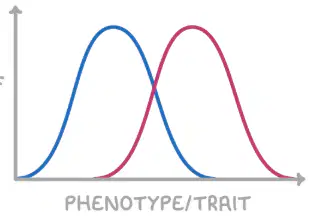
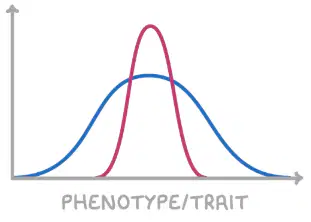
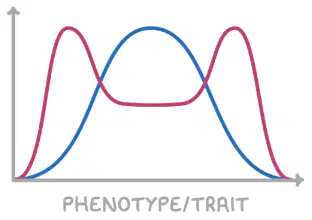
Identify the graph types that illustrate each type of natural selection.
Blue line = original population
Red line = population after natural selection has taken place
According to the cladogram, which organism is the most distantly related to a human?
According to the cladogram, which organism(s) are tetrapods? Select ALL that apply.
According to the cladogram, what traits do pigeons and perch share? Select ALL that apply.
How are gradualism and punctuated equilibrium different?
Small genetic changes in a species over thousands of generations
Genetic changes that occur in rapid bursts in a short amount of time
Which of the following ways do antibiotics kill bacteria?
destroying the cell wall
interrupting DNA replication
disrupting protein production
all the options
Label the parts of the graph.
Categorize the organisms correctly.
streptococcus pneumonia
stenotrophomonas
fungus
sea otter
sunflower
MRSA
Organize these options into the right categories
competition
disease
space
fire
pollution
hurricane
Organize these options into the correct categories
A bee receives nectar from a flowering plant and in return the flower gets pollinated.
A cowbird puts its egg in a sparrow's nest. The cowbird chick outcompetes the sparrow chicks
An orchid grows on a tree limb to get more light. The tree isn't help or harmed

