
NEW
Font size
 Worksheets
Motion - Distance/Speed/Acceleration
Total questions: 50
Worksheet time: 2hrs 40mins
Jimothy is driving to his Mom's house for Thanksgiving, and he is debating whether or not he needs to stop for gasoline. Which quantity would be most useful in making this decision?
Orientation
Distance
Displacement
Velocity

Jenny took the photo on the left, and then some time later took the photo on the right. Given that this is the same tree in front of the same mountain, what is the best explanation for the difference?
The tree moved and the mountain remained stationary.
The mountain moved and the tree remained stationary.
Jenny took the photos from within 2 different reference frames.
Each of the photos used a difference reference point.

Which path has the SMALLEST displacement relative to the START point?
Path A, ending at A
Path B, ending at B
Path C, ending at C
All 3 paths, ending at A,B, or C, have equal displacement
Velocity differs from speed in that it has:
direction
orientation
displacement
motion
A car driving in a circle at a constant speed has no overall:
velocity
acceleration
displacement
orientation
Tammy went on walk and wonders how fast her average walking speed is. What would help her figure this out?
How far she walked and for how long
How she long she walked and in what direction
How much she accelerated and in what direction
How long she walked and her final displacement

Cooper bikes at an average speed of 9 m/s. What is his acceleration from rest if he reaches average speed in 3 seconds?
3 m/s2
0.33 m/s2
-1.3 m/s2
2.5 m/s2

Bubba woke up late and is now in a rush. His school is 1 mile away and it usually takes him 12 minutes to walk there. If he has only 3 minutes to get to school today on time, what speed does he need to go?
Twice as fast
Four times as fast
2.5 times as fast
12 times as fast
Which of the following is necessary to describe an object's motion?
its velocity
its mass
a reference point
its orientation
When a car slows down at a traffic light, it is ________________________________.
accelerating
traveling at a constant velocity
decreasing its displacement
changing direction
If a car is going 55 miles per hour, this mean that every hour it travels it:
slows down 55 miles per hour
it travels 55 miles the entire trip
it travels 55 miles every hour it travels
if it goes over 55 miles per hour the car stops working
You hear that a storm is moving 15 km/hr north. You have been given the storm's ______________________________.
constant speed
velocity
acceleration
average speed
What does the "/" mark mean in m/s?
multiplied by
minus
per
for
Which are reference directions?
faster and slower
the street and the house
up and down
none of the above

Looking at the graph below, why is it not complete?
It is missing units on each axis
It is missing equal increments on each axis
It is missing plotted data
It is missing a title

According to the graph, about how long did the object take to get to the speed of 40 m/s?
2.50 seconds
2.75 seconds
2.0 seconds
2.25 seconds

Which of the following statements best describes the motion of the object in the graph?
the object moved at a constant speed
the average speed of the object was less than 1 m/s
the instantaneous speed of the object was greater than 1 m/s
the object accelerated at a constant rate
What is speed?
A push or a pull that always acts on an object
When an object changes its position
The amount of distance traveled in a given amount of time
The amount of stuff in an object
What is acceleration?
When an object changes its position
A change in a moving object's speed or direction
The amount of distance traveled from point A to point B
The location of an object
What is motion?
When an object changes its position
The amount of distance traveled in a given amount of time
A push or a pull that always acts on an object
The amount of distance traveled in a given amount of time in a particular direction
What is displacement?
The amount of distance traveled in a given amount of time
The amount of distance traveled in a given amount of time in a particular direction
When an object changes its position
The amount of distance traveled from point A to point B
What is velocity?
When an object changes its position
The amount of distance traveled in a given amount of time in a particular direction
The amount of stuff in an object
The location of an object
What is mass?
When an object changes its position
A change in a moving object's speed or direction
The amount of stuff in an object
The location of an object
What is position?
The location of an object
A push or a pull that always acts on an object
The amount of distance traveled in a given amount of time
The amount of distance traveled in a given amount of time in a particular direction
What is the speed of a runner who runs 400 meters in 40 seconds?
10 meters/second
40 meters/second
100 meters/second
1,600 meters/second

Velocity is speed with __________________________.
a unicycle helmet
direction
fight

What is motion?
the stopping of an object to a frame of reference
a change in position relative to a frame of reference
the middle ground between light and shadow, between science and superstition, and it lies between the pit of man's fears and the summit of his knowledge
a change in the time in which it takes to get an office referral

A unicyclist pedals 40 hours at 5 miles per hour without making any stops. How far does she get?
200 miles
8 miles
35 miles
45 miles
What is the speed of a bus that travels 250 km in 2 hours?
Formula ?
Answer ?
S= D/T
125km/hr
S= T/D
521km/meters
S=D/T Km/hr
All fo the above
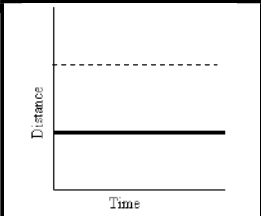
What does the solid line on this graph represent?
Constant speed
Acceleration
At rest
deceleration
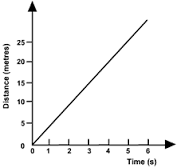
What is the line on this graph showing?
moving away from starting point at a constant speed
moving back towards the starting point at a constant speed
acceleration (getting faster)
deceleration (getting slower)


What is happening at E?
Stationary
Accelerating
Constant speed; moving away from the starting position
Constant speed; returning to start position


What happened during E to F point?
not moving
increasing speed at a constant rate
constant speed
acceleration
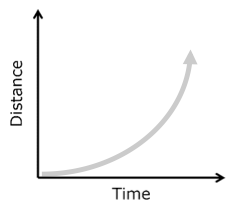

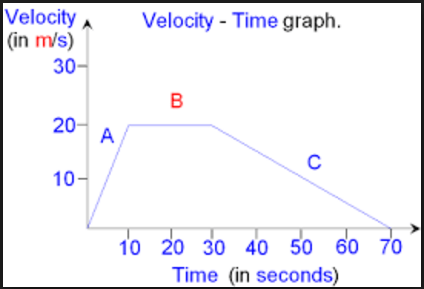
This is a velocity-time graph. What is the object doing in segment A?
Speeding up
Slowing down
Constant Velocity
Not moving
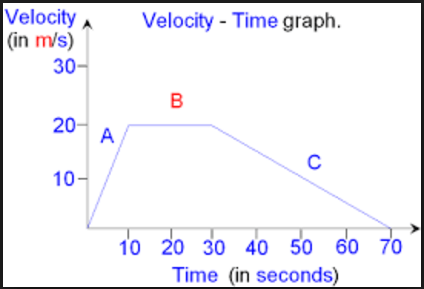
This is a velocity-time graph. What is the object doing in segment C?
Speeding up
Slowing down
Constant Velocity
Not moving


