
 Worksheets
Fluids Review #1
Total questions: 72
Worksheet time: 1hrs 11mins
What are particles?
anything that has mass and volume
a particular kind of matter with uniform properties
can be measured or observed without changing a substance into something else
tiny indivisible pieces of matter
What are three parts of the Particle Model of Matter?
Space between particles, everything made up of particles, particles are always moving
Thermal energy, kinetic energy, temperature
Particles can be heated or cooled, some things are not made up particles, particles are easy seen
True or False: All particles repel each other
True
False
Which image shows particles in a solid?


Choose the diagram where particles move very fast


Which state of matter has particles with the most kinetic energy?
solid
liquid
gas
Which state of matter has particles with the least kinetic energy?
solid
liquid
gas
Which state of matter has the highest intermolecular forces (most attraction between particles)?
solid
liquid
gas
Which state of matter has the lowest intermolecular forces (least attraction between particles)?
solid
liquid
gas
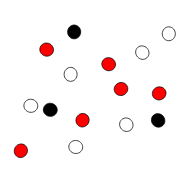
This particle picture represents:
Pure susbstance
Mixture

Mixture, such as mixed nuts or dry soup mix, in which different materials are NOT evenly mixed and are easily identified.
solution

A mixture such as koolaid that is so evenly mixed you can't see the parts.

How would you classify this image?
homogeneous mixture
heterogeneous mixture
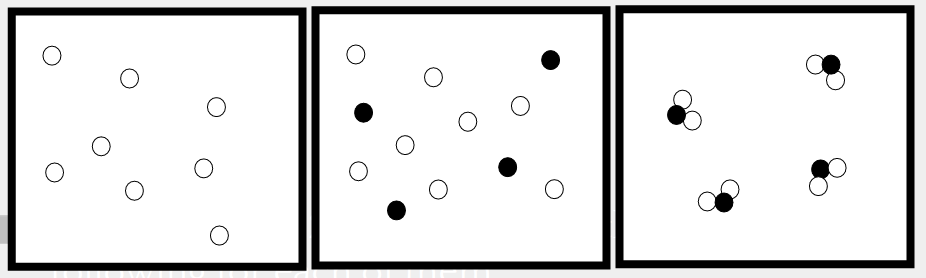

Which of these pictures represents a pure substance?
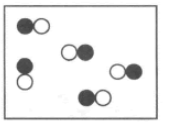
Classify the particle diagram.
mixture
pure substance
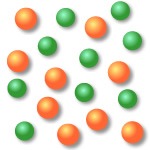
This picture represents which of the following?
mixture
pure substance

Methane contains one atom of carbon and four atoms of hydrogen that are chemically bonded. It is a main component of natural gas. Methane is a ___________________ .
pure substance
mixture
Blood is a fluid found in the bodies of humans and other animals. It can be physically separated into plasma, red blood cells and white blood cells. Blood is a ___________________
pure substance
mixture
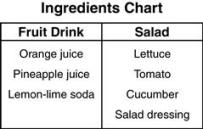
Using the information in the chart, which statement is the BEST description of the drink and salad?
Match the following lab equipment

beaker

Flask

Graduated Cylinder

Test tube
Match the uses of the lab equipment below
measuring precise volumes of liquids
graduated cylinder
finding the mass of a solid
balance scale
mixing small amounts of chemicals
test tube
storing large amounts of chemicals
beaker


Tell the teacher. so it can be disposed of in a special waste container
Sweep up the glass and put it in the classroom garbage
When you finish working with chemicals, biological specimens, and other lab substances, always
treat your hands with skin lotion
wash your hands thoroughly with soap and water
wipe your hands on a towel
wipe your hands on your clothes

Identify the WHMIS symbol by choosing the description of the hazard.
oxidizing hazards
fire hazards
corrosive damage to metals, as well as skin, eyes
explosion or reactivity hazards

What does this symbol stand for?
May cause or suspected of causing serious health effects
Can cause death or toxicity with short exposure to small amounts
May cause less serious health effects such as skin, eye and lung irritation
Causes burns yo skin, eyes, lungs, clothes and metals

What does this symbol stand for?
Can cause death or toxicity with short rxposure to small amounts
Causes burns to skin, eyes, lungs, clothes and metals
For fire hazards
May cause damage to the aquatic environment

What does this symbol stand for?
For organisms or toxins that cause diseases in people or animals
May cause damage to the aquatic environment
May cause or suspected of causing serious health effects
May cause less serious health effects such as skin, eye or lung irritation
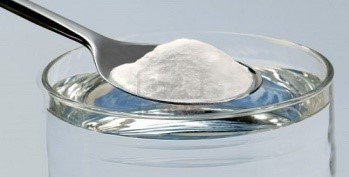
Lemonade - Water, lemon juice, and sugar
Identify the solute(s)
If I dissolve carbon dioxide in water, what is the solvent?
Carbon Dioxide
There is no solvent
Oxygen
Water
If a solvent does not (can not) dissolve a solute we say the solute is ....
immiscible
soluble
pure
insoluble
According to the particle model of matter, sugar is soluble in water because
sugar particles are very attracted to water particles
sugar particles are very attracted to each other
water particles are very attracted to each other
sugar particles repel water particles

(a) occurs when (b) in one substance are more (c) to particles in another substance than to (d)
If you put some sugar into cold water and leave it without stirring, the sugar will eventually dissolve and mix with the water. This happens because:
particles are extremely small.
particles in a liquid are always moving.
water particles are bigger than sugar particles.
sugar particles are bigger than water particles.
The amount of solute (such as salt) present in a given solution (such as water) ex: salt in the Atlantic Ocean vs. salt in Dead Sea
precipitation
concentration
saturation
evacuation
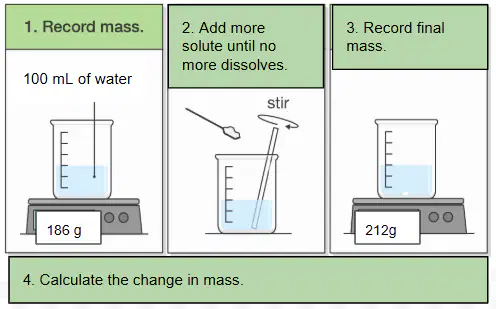
What is the solubility of the solute in g/100 mL?
398 g
186 g
212 g
26g

How many grams are soluble in 100 g of water at 100 ºC?
300 grams
250 grams
100 grams
50 grams
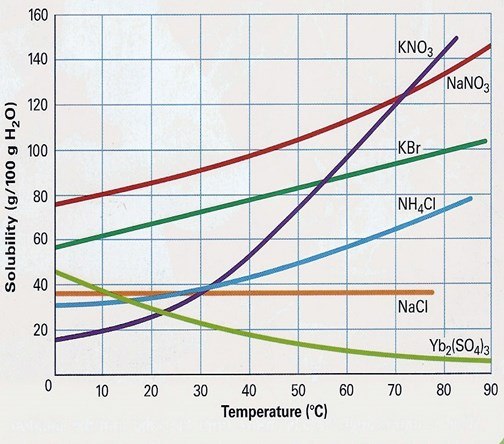
At 80'C, KBr's solubility is:
100
90
80
0

Which solute does NOT increase in solubility as temperature rises?
Jessica made a pitcher of lemonade and finds it is too sweet. What can she do to reduce the concentration?
Add water
Add sugar
Boil the lemonade
Put it in the refrigerator

What is the responding variable?
solubility
temperature
amount of water
solvent
Based on the information in the graph, which of the following is the best prediction of how many grams of the compound will dissolve at 40 C?
40 g
65 g
85 g
100 g
What trend is shown in the graph?
particles spread further apart when they are heated
solids dissolve in water because the solute and solvent particles are attracted to each other
as the temperature increases, the solubility of solids decreases
as the temperature increases, the solubility of solids increases

Which substance has 80 grams of solute dissolved in 100 grams of water at 50 C?
Potassium Bromide
Ammonium Chloride
Potassium Chloride
Lithium Hydroxide
Which one is most dilute (lowest concentration)?
10 g of sugar dissolved in 100 ml of water
10 g of sugar dissolved in 50 ml of water
20 g of sugar dissolved in 100 ml of water
20 g of sugar dissolved in 50 ml of water
Which sweet tea would you expect to taste the sweetest?
1 g/100 mL
3 g/100 mL
0.3 g/100 mL
0.1 g/100 mL
Calculate the g/100 mL solution, if there is 100 g of sugar and 400 mL of water
30
25
20
4
What is the concentration, in g/100 mL, of 8 mL of solute in 500 mL of solution?
0.58
0.0058
5.8
1.6
Check all the following that affect the solubility of a substance
type of solvent
type of solute
temperature of solvent
amount of stirring

What will allow more solute to be dissolved in a solvent?
How is solubility different from rate of dissolving?
Solubility is how MUCH, rate of dissolving is how FAST
Solubility is how FAST, rate of dissolving is how MUCH
they are both the same

What conclusion can you make from the data?
When the temperature increases, the rate of dissolving decreases
When the temperature increases the rate of dissolving increases
When you increase the temperature, the rate of dissolving stays the same
Which sugar will dissolve faster in water?


Which will dissolve the slowest?

Which of the following best explains why sample A dissolves more slowly than the other two?
It has the most volume.
It has the smallest surface area.
It has the largest number of sugar molecules.
It has the fewest bonds between sugar modules.
A student pours mineral salts into a bottle of cold water. Which of the following best explains why shaking the bottle will affect the dissolving rate of the salt?
Shaking exposes the salts to the solvent more quickly.
Shaking helps more water evaporate.
Shaking equalizes the water temperature.
Shaking causes more ions to precipitate out of solution.
What combination would dissolve a solid solute the fastest?
high temperature, no stirring
no heat, no stirring
sugar cube, no heat
high temperature, stirring
Match the methods of increasing the rate of dissolving with what is happening.
increase temperature
particles move faster
smaller pieces of solute
increase surface area
stirring / agitation
increase collisions

Hana put the same amount of salt into these two beakers of water. She stirred them into the same amount of water.
What is the manipulated variable?
amount of stirring
amount of water
temperature of water
rate of dissolving
In which beaker does the salt dissolve more quickly?
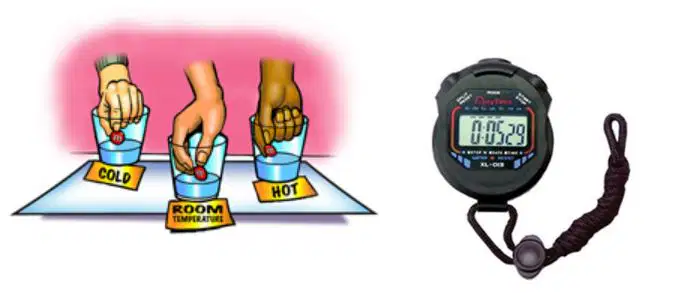
The experiment shown could be used to investigate the effect of temperature on ________
solubility
rate of dissolving
concentration

A student filled each of four beakers with 100 mL of water at 25 °C. The student added an equal amount of a different substance to each of the beakers of water.
Based on the student’s observations in the table, how many of the substances did NOT dissolve in the water?
1 substance
substances
3 substances
4 substances
A student wants to investigate whether nail polish can be removed better with water or acetone. To design a fair test, classify the following variables
Type of solvent
solubility
type of solute
temperature

Match the 3 methods of increasing the rate of dissolving with the image

increase temperature

decrease size of solute (surface area)

stir / agitate

