wayground logo

Free Printable Worksheets

NEW

Font size

S
M
L
XL
Worksheets

Year 7 Semester 2 Revision Quiz

Total questions: 60

Worksheet time: 3hrs 36mins

Name
Class
Date
1.
Tigers, Jellyfish, Gorillas and Sponges are all part of kingdom _______.
a)
Animalia
b)
Plantae
c)
Fungi
d)
Bacteria
2.
Which of the following does not belong in the Fungi Kingdom? 
a)
Yeast
b)
Ameoba
c)
Mold
d)
Mushroom
3.

Which of the following is an example of a vertebrate animal?

a)

fly

b)

worm

c)

bird

d)

starfish

4.

Invertebrates do NOT have a

a)

brain.

b)

heart.

c)

stomach.

d)

backbone.

5.
What is the purpose of a dichotomous key?
a)
to find a common ancestor
b)
to show the evolution of organisms
c)
to show relationships between organisms
d)
to identify organisms
6.
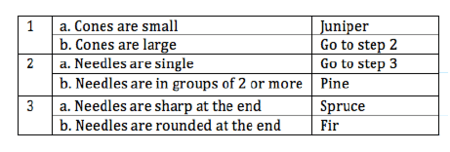
A dichotomous key for trees is provided. Hikers found a tree that has large brown cones and single sharp needles. What species of tree have the hikers found?
a)
Juniper
b)
Pine
c)
Spruce
d)
Fir
7.
A dichotomous key for insects is given. To what order does an insect with two pairs of scaly wings belong?
a)
Coleoptera
b)
Heteroptera
c)
Diptera
d)
Lepidoptera
8.
Using this dichotomous key, identity the name of the circled fish.
a)
band-tail puffer
b)
spotted goat fish
c)
peacock flounder
d)
trumpet fish
9.
What step do we always start with when using dichotomous keys?
a)
1
b)
2
c)
3
d)
4
10.
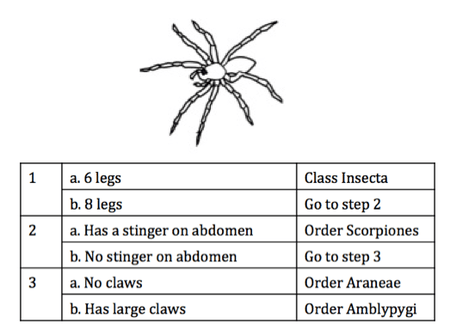
An illustration and a dichotomous key are given. What is the correct classification for this organism?
a)
Class Insecta
b)
Order Amblygygi
c)
Order Araneae
d)
Order Scorpiones
11.
Where do all life forms get their energy?
a)
Earth's Core
b)
Water
c)
Plants
d)
The Sun
12.
An organism that lives by breaking apart dead organic matter into simpler parts is...
a)
scavenger
b)
consumer
c)
decomposer
d)
carnivore
13.
Recently, a family of bobcats moved into an area with a large rabbit population. What changes may occur in the ecosystem?
a)
The rabbit population may increase
b)
The rabbit population may decrease
c)
The rabbit population may increase first, then decrease
d)
The rabbit population will remain the same
14.
A population of mice lives in a barn community. A cat population has just joined the community. What will happen?
a)
Mouse and cat populations both go up?
b)
Mouse and cat populations both go down
c)
Mouse population goes down as cat population goes up
d)
Mouse population goes up as cat population goes down
15.
Which of the following is a producer?
a)
Maple tree
b)
Sunfish
c)
Bunny
d)
Bear
16.
What is this called?
a)
Food Web
b)
Food Chain
c)
Abiotic Factors
17.
What do the arrows show in a food chain picture?
a)
They always point to the smallest animals.
b)
They point to the animal that tastes the best.
c)
They always point to the producers.
d)
They point in the direction that energy is flowing.
18.
Which food chain is in the correct order?
a)
cat, grass, bird, snail
b)
bird, snail, grass, cat
c)
grass, snail, bird, cat
d)
grass, cat, bird, snail
19.
Which of these organisms would receive energy from the snake?
a)
Plant
b)
Rabbit
c)
Mouse
d)
Hawk
20.
Humans are considered...
a)
consumers
b)
decomposers
c)
producers
21.
What is a producer?
a)
an organism that gets energy from eating other organisms
b)
an organisms that uses sunlight to make its own food
c)
an organism that gets energy from eating dead organisms, non-living material or waste
d)
an organism that uses chemical energy to make its own food
22.
A connection of food chains with many food energy paths in an ecosystem is a ____________
a)
ecosystem
b)
food web
c)
environment
d)
population
23.
Use the diagram to answer the question.
The Mayfly is a food source for which 3 organisms?
a)
Frog, Dragon Fly and snake
b)
Frog, trout and dragon fly
c)
Frog, salamander and trout
d)
Frog and phytoplankton
24.
Use the diagram to answer the question.
The trout is a source of food for the human and the eagle. When there are more than one organism vying for the same source we call this____?
a)
Population
b)
Resources
c)
Community
d)
Competition
25.
Biodiversity is 
a)
the variety of species within an ecosystem
b)
a large number of the same species in an ecosystem
c)
an abundant amount of the same primary consumers 
d)
the ability to have an abundant source from the same species
26.
What is the study of the interactions among organisms and  between organisms and their environments called?
a)
Biology
b)
Ecology
c)
Astronomy
d)
Biosphere
27.
The direction of the flow of energy in a food web is represented by ___.
a)
Light bulbs
b)
Dotted Lines
c)
Arrows
d)
Bubbles
28.
Which of the following is NOT a consumer
a)
grass
b)
dog
c)
shark
d)
fish
29.
Anything that helps an animal survive in its environment.
a)
counter-shading
b)
mimicry
c)
adaptation
d)
camouflage
30.

Anything that can be used to satisfy human needs is a:

a)

Thing

b)

value

c)

Resource

d)

Utility

31.

Resources which can be renewed or reproduced are known as:

a)

Exhaustible resource

b)

Renewable resource

c)

Non-renewable resource

d)

Useful resource

32.
Which of these sources is used for generating electricity that is NOT renewable?
a)
coal
b)
the Sun
c)
wind
d)
water
33.
Which of the following is NOT a fossil fuel?
a)
coal
b)
minerals
c)
natural gas
d)
oil
34.
Which of the following is true about coal?
a)
It is renewable because it is deep inside Earth.
b)
It is renewable because it can easily be replaced as it is used.
c)
It is nonrenewable because it cannot be replaced as fast as people use it.
d)
It is nonrenewable because it fuels many power plants that make electricity.
35.
a)
85.7%
b)
7.5%
c)
44.9%
d)
14.3%
36.
Which of the following resources is collected by the panels on the roof of his home?
a)
air
b)
water
c)
wind
d)
sunlight
37.
 Which of the following are renewable sources of energy?
a)
coal and natural gas
b)
oil and electricity
c)
sunlight and petroleum
d)
wind and water
38.
What is the source of energy that causes the blades of a turbine to move?
a)
coal
b)
wind
c)
water
d)
sunlight
39.
Which of the following is a major cause of air pollution?
a)
burning fossil fuels
b)
dumping waste in landfills
c)
using wind and solar energy
d)
releasing waste into streams
40.

Resources that cannot be replaced

a)

Conservation

b)

Renewable Resource

c)

Non-Renewable Resource

d)

Natural Resource

41.

Timber is a ______________.

a)

Renewable Resource

b)

Non-Renewable Resource

42.

Natural gas is a non-renewable resource.

a)

True

b)

False

43.

We use both renewable and non-renewable resources as sources of energy.

a)

True

b)

False

44.
The earth is tilted on its _____
a)
line
b)
equator
c)
axis
d)
core
45.
Earth does a complete revolution every _______
a)
10 years
b)
12 hours
c)
24 hours
d)
365 days
46.
The earth rotates every
a)
24 hours
b)
15 hours
c)
365 days
d)
hour
47.
How long does it take for the moon to go through all moon phases
a)
day
b)
week
c)
month
d)
year
48.
What does the tilt of the earth cause?
a)
heating
b)
Seasons
c)
Atmosphere
d)
Years
49.
How many times does earth rotate in one year?
a)
365
b)
2
c)
97
d)
120
50.
What causes day and night cycles?
a)
mars
b)
seasons
c)
earths rotation
d)
moon phases
51.
During the phases of the Moon, the Moon appears to change shape.  This change in appearance is due to the Moon...
a)
physically changing size and shape.
b)
moving closer and then farther away from Earth.
c)
reflecting a different amount of light due to alignment with Earth and the Sun.
d)
having craters on its surface.
52.
As the moon's shape appears to get smaller, we say that the moon is _.
a)
swelling
b)
waxing
c)
waning
d)
disappearing
53.
Which moon phase is when you can't see the moon at all?
a)
Waning crescent
b)
Full moon
c)
Waxing gibbous
d)
New moon
54.
Phases of the moon in which the moon appears to be getting larger are referred to as _.
a)
waxing
b)
waning
c)
new
d)
eclipse
55.
Which of the following words describe the phases of the moon?
a)
none, quarter, half, three quarters, full
b)
new, crescent, quarter, gibbous, full
c)
dark, light, half, quarter, blue
d)
first quarter, second quarter, third quarter, fourth quarter
56.

This model is showing us a...

a)

lunar eclipse

b)

solar eclipse

c)

phases of the moon

d)

earth eclipse

57.

This image is showing us a.....

a)

solar eclipse

b)

lunar eclipse

c)

phases of the moon

d)

earth eclipse

58.

If you look up at the sky and see this, you are witnessing a....

a)

solar eclipse

b)

total eclipse

c)

lunar eclipse

d)

jupiter

59.

If you are looking up at the sky and see this, you are looking at a....

a)

solar eclipse

b)

total eclipse

c)

lunar eclipse

d)

jupiter

60.

Which of the following is not true about a total solar eclipse?

a)

It can be viewed once a year from every spot on earth

b)

It is dangerous to look at without the proper device

c)

When it happens, the moon blocks all of the sun except the corona

d)

You must be within the moon's umbra to see it