
 Worksheets
Unit 5 Review: Electrons
Total questions: 65
Worksheet time: 2hrs 40mins


How many electrons can each p orbital hold?
6
3
2
4

How many electrons can the d sublevel hold?
8
10
2
4

This orbital diagram represents which element?
C
B
N
O
How many electrons can an p sublevel hold?
2
3
6
10
How many electrons can an f sublevel hold?
2
6
10
14
Electrons fill energy levels and sublevels of _____ energy first.
lower
higher
What is the correct Noble Gas shorthand electron configuration for phosphorus atom?
[Ar] 4s2
[He]2s22p4
[Ne] 3s23p4
[Ne] 3s23p3
What noble gas should be used to write the shorthand configuration for Te (#52)?
Ar
Kr
Xe
Sb
How many orbitals does an s sublevel have?
1
3
5
7
How many orbitals does a d sublevel have?
1
3
5
7
1s2 2s2 2p6 3s2


Which orbital shows a violation of the Aufbau Principle?
A
B
C
D
None.


What element's orbital notation is pictured here?
Ar
Br
Cu
Cl
Who proposed that electrons are only found in specific, discrete circular orbits around the nucleus?
Albert Einstein
Erwin Schrodinger
Ernest Rutherford
Niels Bohr

What orbital is shown in the picture?
s orbital
p orbital
d orbital
f orbital
What is the difference in a 1s orbital and a 2s orbital?
The shape of the orbital
The size of the orbital
The number of electrons it can hold
None of the above
When atoms _____________ energy, their electrons move to higher energy levels. These electrons _____________ energy by emitting light when they return to lower energy levels.
lose, absorb
absorb, lose
lose, lose
absorb, absorb
What states that every orbital of a subshell must be singly occupied before any orbital can have a pair?
Pauli exclusion principle
Hund's rule
Aufbau principle
None of the above
What states that electrons fill the lowest energy orbitals/levels first before occupying higher energy levels?
Pauli exclusion principle
Hund's rule
Aufbau Principle
None of the above
One of the key understandings of quantum theory is that atoms emit energy in
random amounts.
specific amounts.
only the gamma range of the electromagnetic spectrum.
only the microwave range of the electromagnetic spectrum.
Bohr's model of the atom is sometimes called the planetary model. If the atom is like a solar system, what is analogous to the sun?
energy levels
electrons
neutrons
the nucleus
Scientists modified the Bohr model of the atom. The new idea involved orbitals which are
two dimensional pathways.
actual "strings" on which the electrons travel like beads on a necklace.
regions of probability where electrons are most likely to be found.
a cell-like structure that contains the electrons.


1s22s22p63s23p64s23d10

Which electron configuration belongs to Chlorine (Cl)?
1s2 2s2 2p6 3s2 3p5
1s2 2s2 2p5
1s2 2s2 3p5
Choose the correct shortcut configuration for iodine.
[Ar]4s24d104p5
[Kr]5s24d105p5
[Xe]5s25d105p5
none of the above
Each row on the periodic table represents:
an energy level
a sublevel
an electron
an orbital
There are 4 different types of sublevels/orbitals: s,p,d,f.
true
false


1s22s22p4

What is incorrect about this orbital diagram?
Both arrows in the 2p box should be pointing up
There is nothing incorrect with this diagram
In the 2p box there should only be 1 electron in the first 2p box and one in the 2nd 2p box pointing in the same direction.
All the arrows should be pointing up.

What is the shorthand configuration for Lead?
[Xe]6s24f145d106p2
[Xe]6s25d106p2
[Rn]6s25d106p2
[Rn]6s24f145d106p2
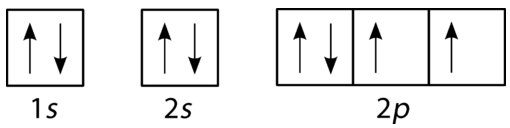


Which element is represented by this orbital notation?
carbon
nitrogen
oxygen
fluorine

Which element is represented by this orbital notation?
neon
sodium
magnesium
aluminum
How many unpaired electrons are in an element with this configuration?
4
2
8
6
Which principal energy level change by the electron of a
hydrogen atom will cause the greatest amount of energy to be absorbed?
n = 2 to n = 4
n = 2 to n = 5
n = 4 to n = 2
n = 5 to n = 2
Which occurs if an electron transitions from n = 5 to
n = 2 in a hydrogen atom?
Energy is absorbed, and visible light is emitted.
Energy is released, and visible light is emitted.
Energy is released, and visible light is not emitted.
Energy is absorbed, and visible light is not emitted.
Flame tests can be used to identify an element. Each element emits characteristic waves of light when it is heated in a flame. What describes how the light is produced?
Protons in the ground state lose energy and give off light.
Protons in the ground state gain energy and are emitted from the nucleus, giving off light.
Electrons in the ground state lose energy and move to an excited state, giving off light.
Electrons in the ground state gain energy, move to an excited state, and give off light when they return to the ground state.
Light is emitted when electrons
move from one atom to another.
collide with one another, releasing energy.
move from a lower energy level to a higher energy level.
move from a higher energy level to a lower energy level.
Which energy level change by an electron of a
an atom will have the greatest amount of energy emitted?
n = 2 to n = 4
n = 2 to n = 5
n = 4 to n = 2
n = 5 to n = 2
What color has the shortest wavelength, highest frequency, and highest energy?
yellow
blue
red
violet
Emitted light will be due to electrons
moving toward nucleus
moving away from nucleus
not moving
Absorbed light will cause electrons to
move toward nucleus
move away from nucleus
not move
Atoms can absorb energy in the form of
heat
electricity
light
ALL OF THESE
A. electron transition from n=3 to n=2
B. electron transition from n=5 to n=1
Which electron transition (A or B) will have low energy light emitted?
A
B
They both will not have any light emitted.
They both will have the same type of energy emitted.

