
Font size
 Worksheets
Year 9 Physics Term 1
Total questions: 50
Worksheet time: 50mins
Which has a greater distance between particles?
Solid
Liquid
Gas
Something that goes from liquid to gas is...
Evaporation
Melting
Freezing
Sublimation
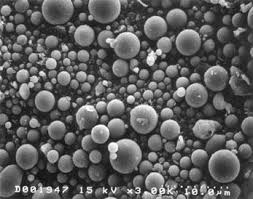
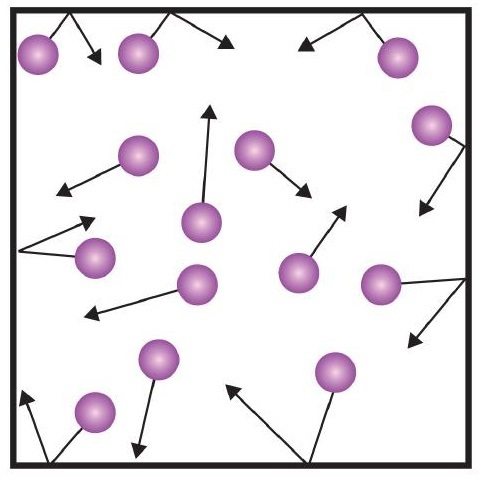
Which description best matches this particle model?
Closely packed and can't move a lot.
Particles are close together but can move a little.
Particles have lots of energy and can move randomly
Particles have little energy and can move randomly
How do the particles in a solid move?
They remain still
They vibrate from side to side
They move around
They move quickly and randomly
What is the equation for density
Density = mass x volume
Density = Volume/Mass
Density = Mass/Volume
Why are liquids more dense than gases?
The particles in a gas are closer together
The particles in a liquid are closer together
The particles in a gas can flow
The particles in a gas move randomly
What is the internal energy of a substance
The sum of the kinetic and potential energies of the particles
The kinetic energy of the particles
The potential energy of the particles
The speed of the particles

The diagram shows a heating curve. What is happening between B and C?
Melting
Evaporating
Condensing
Freezing
The diagram shows a heating curve. What is happening between D and E?
Melting
Evaporating
Condensing
Freezing
The diagram shows a heating curve. What state is the substance between E and F?
Solid
Liquid
Gas
Solid and liquid
The diagram shows a heating curve. Between which points is the internal energy of the substance greatest?
A and B
B and C
D and E
E and F

What does this measuring device measure?
Liquid
Volume
Mass
Density

What does this measuring device measure?
Liquid
Volume
Mass
Density

What does this measuring device measure?
Heat
Temperature
Mass
Density
State the units for mass
g
cm3
g/cm3
State the units for volume
g
cm3
g/cm3
State the units for density
g
cm3
g/cm3
What happens to the internal energy of a substance when it's temperature rises?
Nothing
It goes up
It goes down

What does this measuring device measure?
Heat
Volume
Distance
Density
What causes gas pressure?
Collisions between particles and the walls of the container
Too many questions about particles
Collisions between particles
Why does the temperature of a solid remain constant as it is melting?
Heat energy is being converted to kinetic energy
The energy is being absorbed by the particles
Energy is required to overcome all the bonds between the particles
Energy is required to overcome some of the bonds between the particles
State the units of specific heat capacity
J/kg/oC
J/kg
J/oC
J
What decreases when liquid changes into a gas?
The space between the particles
The speed of the particles
The energy of the particles
The number of particles per cm3
Which tend to be the most dense?
Solids
Liquids
Gases
What is the correct order for least to most internal energy?
Solid, liquid, gas
Liquid, solid, gas
Gas, liquid, solid
Gas, solid, liquid
What is the correct order for lowest to highest density?
Solid, liquid, gas
Liquid, solid, gas
Gas, liquid, solid
Gas, solid, liquid
Which of these processes happen at a constant temperature?
Boiling
Melting
Freezing
All of them, they are all changes of state
What is the change of state from gas to liquid?
Evaporation
Freezing
Melting
Condensation
What is the change of state from solid to liquid?
Evaporation
Freezing
Melting
Condensation
What is the change of state from liquid to solid?
Evaporation
Freezing
Melting
Condensation
What is the change of state from liquid to gas?
Evaporation
Freezing
Melting
Condensation
Particles are closest together in ..............
Solids
Liquids
Gases
Winter
Particles are furthest apart in ..............
Solids
Liquids
Gases
Winter
Particles travel fastest in ..............
Solids
Liquids
Gases
Winter
Particles travel slowest in ..............
Solids
Liquids
Gases
Winter
All particles in a gas move with the same speed
True
False, they have a range of speeds
What do we need to measure to calculate density?
Weight and mass
Weight and volume
Mass and volume
Mas and area
Which of these steps is needed to calculate the density of any object?
Find the mass using a mass balance
Find the volume by multiplying length by width by height
Lower the object slowly into a measuring cylinder
Measure the length of each side
Which of these steps is needed to calculate the density of an irregular shaped object?
Find the mass using a mass balance
Find the volume by multiplying length by width by height
Lower the object slowly into a measuring cylinder
Measure the length of each side
Which of these steps is needed to calculate the density of a liquid?
Find the mass using a mass balance
Find the volume using a measuring cylinder
Lower the object slowly into a measuring cylinder
Subtract the original volume from the new volume
The kinetic energy store of a substance increases when .........
Its temperature decreases
Its temperature increases
It melts
It boils
The potential energy store of a substance increases when .........
Its temperature decreases
Its temperature increases
It melts
It boils
The energy required to raise the temperature of 1kg of a substance by 1oC
Specific latent heat of fusion
Specific latent heat of vaporisation
Specific heat capacity
Boiling point

