
 Worksheets
Earth's History (Relative & Absolute Dating)
Total questions: 38
Worksheet time: 1hrs 16mins

Which statement best describes the Law of Superposition?
Each sedimentary layer of rock represents 1,000 years of Earth's age, much like the rings of a tree.
In undisturbed layers of sedimentary rocks, the upper rock layers are older than the lower rock layers.
In undisturbed layers of sedimentary rock, the lowest layers contain the older rocks.
Rocks that form near volcanoes are older than surrounding rock.

The Law of Superposition helps scientists to determine what?
The absolute age of rock layers
The age of fossils
The relative age of rock layers
the super powers of rocks

According to the law of superposition, the oldest fossils are found
At the top of the rock layers
Near the bottom of the rock layers
In the middle of the rock layers
Somewhat near the surface

States that younger rocks lie above older rocks if the layers have not been disturbed
Law of crosscutting
Law of superposition
Relative Dating
Unconformity

What is the law of superposition?
The age of sedimentary rock not found in the original layers.
Metamorphic rock is younger than the nearby igneous rock.
Sedimentary rock in it's original position is older than layers above it.
Metamorphic rock is older because it was deposited to nearby sedimentary rock.

Analyze the seashell found in the white layer. Which statement is true of the rock layer that contains this fossil?
It could also contain a fossil from the bottom layer.
It is older than the layers below it.
It is younger than the layers above it.
It is older than the layers above it.

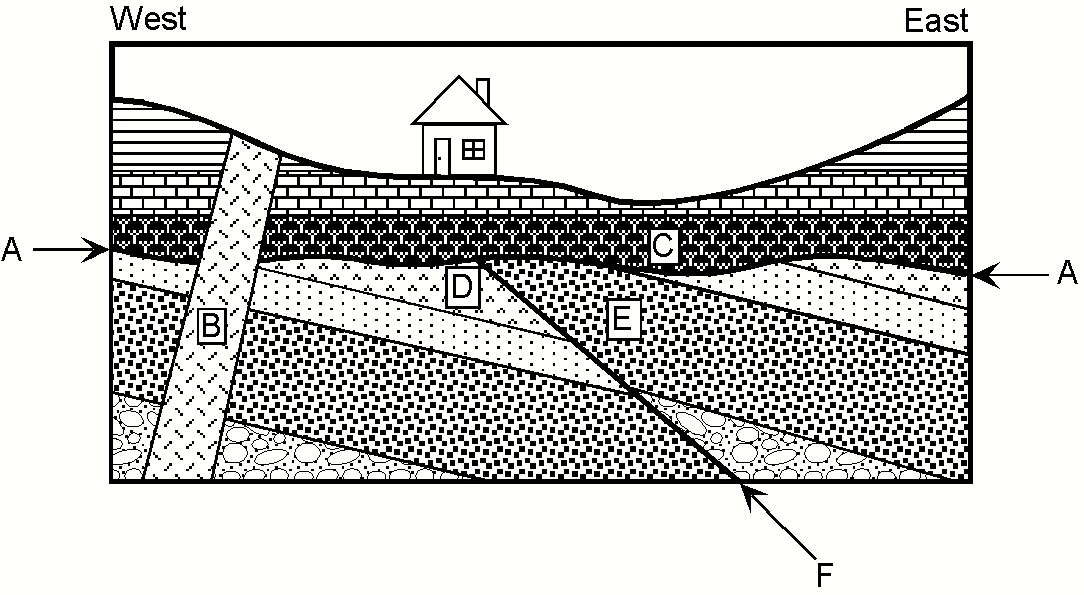
What are the relative ages of the features in order from oldest to youngest?
Limestone, Basalt, Fault, Siltstone
Siltstone, Fault, Basalt, Limestone
Limestone, Fault, Basalt, Siltstone
Limestone, Siltstone, Fault, Basalt

About how old is the Earth?
4.6 billion years
1.4 billion years
4.6 million years
6000 years

Traces or remains of organisms that lived long ago and usually found in sedimentary rock.
Fossil
Unconformity
Superposition
Column

How does the law of crosscutting explain the age of a fault?
The fault is younger than the rocks above it.
The fault is younger than the rocks it cuts through.
The fault is older than the rocks above it.
The fault is older than the rocks it cuts through.

The Geologic Time Scale is a record of what?
old geologists
sweet geology music
the known history of rocks and fossils
a list of every living thing ever

How does sedimentary rock usually form?
Vertically
Diagonally
Folding
Horizontally

The numerical age, in years, of any object.
absolute age
relative age
space age
old age

Absolute age is defined as:
The age of rock determined by radiometric dating.
The age of rock based on living animals.
The age of rock based on its location.
The age of rock determined by carbon dating.

The age of a rock compared to the ages of other rocks is the rock's
absolute age
geologic age
sedimentary age
relative age

What is the term used to identify a scientist who studies fossils?
Paleontologist
Carbon Film
Trace fossil
cast

By saying: "I am older than my sister," is an example of which type of dating used in Geology:
Relative Age/Dating
Absolute Age/Dating
Chronological Sibling Timelies
Fossil Age/Dating


A break in the geologic record that is made when rock layers are ERODED over a long period of time
superposition
relative dating
unconformity
cross-cutting

Scientists use radioactive decay to measure...
relative time
absolute time
half-lives
time of day

How does absolute age differ from relative age?
only absolute dating indicates which rock is older than another
only absolute dating finds the age in years
only relative dating finds the age in years

Radiometric dating is possible because the rates of decay of radioactive isotopes _____.
change over time
change from place to place
are constant
vary widely

The amount of time it takes for 50% of the remaining radioactive material to decay is called:
era
age
half-life
eon

The original element that undergoes radioactive decay is known as the...
daughter element
half-life
parent element
carbon-14

The element that is the product of radioactive decay is known as the...
daughter element
half-life
parent element
carbon-14

How many grams of Carbon-14 will remain after 17,100 years- C-14 has a half life 5,730 so 17,100 is about 3 half lives?
32 g
16 g
8 g
4 g

What percentage of Rubidium-87 will remain after 4 half-lives?
25%
12.5%
6.25%
3.125%


An unconformity is a break in the geologic record that is made when rock layers are eroded or when sediment is not deposited for a long period of time.
true
false

When scientists find an unconformity, they must question if the "missing layer" was simply never present or if it was removed, possibly eroded.
true
false

The shaded boxes represent the undecayed atoms for Isotope "X". If Isotope X has a half-life of 1,000 years, how old is this sample?
1,000 years
2,000 years
3,000 years
4,000 years

Unstable atoms that decay (change) and are considered radioactive
Isotope
Half-Life
Absolute Dating
Radiometric Dating

Geologists use radioactive dating to determine THE ABSOLUTE AGE OF ROCKS.
True
False

All plants and ANIMALS contain carbon.
True
False

An element that has broken down and released particles and energy is said to be _______________.
radioactive
subatomic

_______________is the method of determining the absolute ages of rocks.
radioactive dating
carbon-14 dating

