
 Worksheets
Lab Exam 2 Review
Total questions: 49
Worksheet time: 34mins


parent 1: GgBB
parent 2: ggBb
Find the gametes for parent 2.
GB, GB, gB, gB
gB, gb, gB, gb
Gg, BB, GB, GB
gg, Bb, gB, gb

The science of managing and analyzing biological data using advanced technology is
Bioinformatics
Genomics
Forensics
Heredity

Which output from a BLAST search shows the probability of getting a match with that score by random chance?
E value
bit score
percent identity
percent positives
BLASTN is used to search a
Nucleotide query against a nucleotide sequence database
Protein query against a translated nucleotide sequence database
Translated nucleotide query against a protein database
Protein query against a protein database
Translated nucleotide query against a translated nucleotide database
BLAST stands for
Basic Linear Assignment Search Tool
Basic Local Alignment Search Tool
Broad Local Alignment Search Tool
Basic Linear Alignment Search Tool

The initiation of FASTA format has ____ symbol.
a) >
b) <
c) /
d) *

Which is the longest phase of the cell cycle?
All the phases are the same length
M Phase
Interphase
Prophase

At a point in the cell cycle, chromosomes have aligned near the equator of the cell. Which sequence of events will the cell need to complete to produce two identical daughter cells?
ANAPHASE, TELOPHASE, CYTOKINESIS
ANAOHASE 2, TELOPHASE2, CYTOKINESIS
TELOPHASE, CYTOKINESIS, INTERPHASE
PROPHASE, ANAPHASE, TELOPHASE

Anaphase
Cytonkinesis
Interphase
Prophase

Cytokinesis
Interphase
Anaphase
Metaphase

Anaphase
Cytokinesis
Telophase
Metaphase

DURING WHICH PHASE DOES THE DNA REPLICATION OCCUR?
S
G2
M
G1
CELLS CAN BE DIVIDED INTO TWO TYPES...
SOMATIC CELLS
VEGETATIVE CELLS
GAMETE CELLS
UNICELLULAR CELLS
Cytokinesis usually but not always follows mitosis. if a cell completed mitosis but not cytokinesis the result would be a cell with....
two nuclei
a single large nucleus
high concentration of actin and myosin
two abnormally small nuclei

Which component of blast results tells you how many bases match exactly between the two sequences?
E Value
% identity
Score
This outcome is not possible

The pair of chromosomes that contain the same genes (but may be coded differently) and are inherited from a male and female parent are called ___.
gametes
alleles
zygote
homologous chromosomes

In sexual reproduction, chromosome reduction (to haploid) is necessary to ___.
ensure that all offspring have the correct diploid number of chromosomes
ensure that all offspring have the correct haploid number of chromosomes
ensure that all daughter cells are identical
Mitosis makes sure that all daughter cells are _____.
genetically identical, diploid
genetically identical, haploid
genetically diverse, diploid
genetically diverse, haploid

When creating a DNA profile, the purpose of PCR is to
cutting DNA
fixing mutations
amplifying DNA
reversing the charge of DNA

Which enzyme is used during PCR to pair (add) complementary bases to the template strand?
Thermonuclease
Helicase
DNA Polymerase
RNA Polymerase

STR (short tandem repeat)...
repeats of short DNA sequences (two - five base pairs) with varying numbers of repeats found among individuals
a cell structure that contains genetic information along strands of DNA
segment of DNA in a chromosome that contains information used to produce a protein or an RNA molecule
a molecule labeled with a radioactive isotope, dye, or enzyme that is used to locate a particular sequence of gene on a DNA molecule

The results of which laboratory technique are represented in the diagram?
Polymerase Chain Reaction (PCR)
manipulation of genes
genetic engineering
gel electrophoresis

A student performed a gel electrophoresis experiment. The results are represented in the diagram
below. Compared to the fragments at the top of the gel, the fragments at the lower end are
larger, and move slower
larger, and move faster
smaller, and move faster
smaller, and move slower
Why do the fragments of DNA in gel electrophoresis travel away from the negative electrode?
DNA is negatively charged and is attracted to the positive electrode
DNA is positively charged to attracted to the negative electrode
the agarose gel in negatively charged
the agarose gel is positively charged

A protein that binds to the operator and blocks the RNA polymerase
regulator
repressor
activator
corepressor

In the lac operon the inducer which turns on/ induces the expression of LacZ is
allolactose (isomer of lactose)
glucose
galactose
all of the above
The genes within the Lac operon will be expressed if:
lactose and glucose are absent in the cell
glucose is present in the cell, lactose is absent
lactose is present in the cell, glucose is absent
The lac Z gene codes for:
permease
β-galactosidase
repressor of lac operon
cAMP
What is the role of the lac operon in E. coli gene expression?
It makes the genes prokaryotes be turned on
regulation of gene activity in response to the needs of the cells
To make DNA for the gene
To make the gene turn of and off
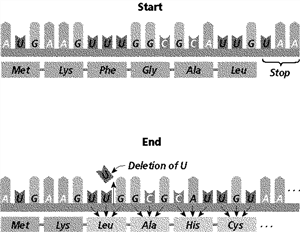

The "central dogma" states that genetic information flows from
Protein-->mRNA-->DNA
Protein-->DNA-->mRNA
mRNA-->DNA-->Protein
DNA-->mRNA-->Protein

_________________ is an evolutionary tree is a branching diagram or "tree" showing the inferred evolutionary relationships among various biological species or other entities.
Line graph
Cladistics
Phylogenetic tree
Family Tree

Who is most closely related to Taxidea taxus?
Lutra lutra
Panthera pardus
Canis latrans
Canis lupus
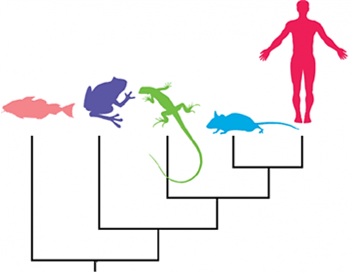
According to this phylogenetic tree, which creature is the least related out of all pictured?
Fish
Frog
Salamander
Human

According to this tree, which of these animal phyla are most closely related?
Arthropoda & Mollusca
Arthropoda & Chordata
Chordata & Mollusca

The scientific name for an organism comes from its _____.
class and phylum
family and species
kingdom and phylum
genus and species

The scientific name of a cactus is Pachycereus pringle, what is its genus?
Pachycereus
pringlei

