wayground logo

Free Printable Worksheets

NEW

Font size

S
M
L
XL
Worksheets

Muscle Anatomy

Total questions: 69

Worksheet time: 42mins

Name
Class
Date
1.
The functional unit of the muscle cell is the: 
a)
Sarcomere
b)
Osteon
c)
Myofilament
d)
Muscle fiber
2.
The thick filament is composed of: 
a)
Myosin
b)
Actin
3.
The thin filament is composed of: 
a)
Myosin
b)
Actin
4.
Fill-in-the-blank! Muscle, Fascicle, _____, Myofibril
a)
Muscle fiber
b)
Myofilament
c)
Sarcomere
d)
Actin 
5.
The ________ functions in regulation of Ca2+ levels. 
a)
Sarcoplasmic Reticulum
b)
T Tubules
c)
Mitochondria
d)
Fascicle
6.
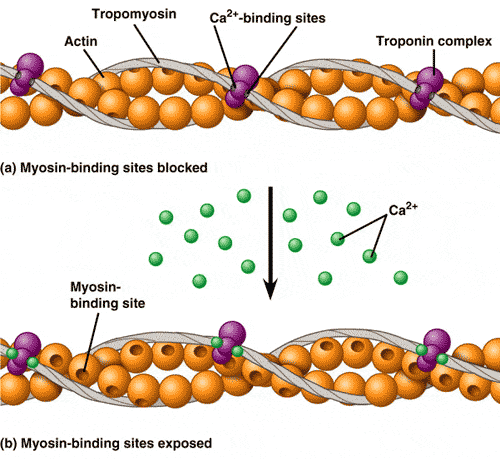
___ and ___ are regulatory proteins bound to actin. 
a)
Troponin and tropomyosin
b)
Myosin and actin
c)
Calcium and Oxygen
d)
Glycogen and hemoglobin
7.
Which of the following is NOT a function of the muscular system?
a)
Heat production
b)
Joint stability
c)
Movement
d)
Communication
8.
a)

Latissimus Dorsi

b)

Erectors

c)

Deltoids

d)

Abdominal

9.
a)
Abdominal
b)
External Oblique
c)
Erectors
d)
Satorius
10.

Skeletal muscle is:

a)

Involuntary and striated

b)

Voluntary and striated

c)

Involuntary and not striated

d)

Voluntary and not striated

11.

A "bundle" of muscle fibers is called:

a)

Perimysium

b)

Endomysium

c)

Myofibril

d)

Fascicle

12.

Which of the following muscles is the most superior?

a)

Gluteus maximus

b)

Intercostals

c)

Biceps brachii

d)

Frontalis

13.

Which of the following is found around a fascicle?

a)

Endomysium

b)

Perimysium

c)

Epimysium

d)

Myofibril

14.

The "movable" attachment site of a muscle is called: _______

a)

Insertion

b)

Origin

c)

Involuntary

d)

Striations

15.

The less movable (or non-movable) attachment site is called: _______

a)

Origin

b)

Insertion

c)

Involuntary

d)

Striation

16.

Where would intercostal muscle be found?

a)

On the sides of the skull

b)

In between the digits (fingers/toes)

c)

The lower part of the back

d)

In between the ribs

17.

Attaches muscle to bone: _______

a)

Endomysium

b)

Myofibril

c)

Tendon

d)

Ligament

18.
What muscle is the arrow pointing to? 
a)
Vastus Medialis
b)
Rectus Femoris
c)
Biceps Femoris
d)
Semimembranosus
19.
What muscle is the arrow pointing to? 
a)
Vastus Lateralis
b)
Vastus Medialis
c)
Semimembranosus
d)
Semitendinosus
20.

How many muscles make up the quadriceps?

a)

1

b)

2

c)

3

d)

4

21.
The Tibialis anterior is located in which area of the body?
a)
Head
b)
Neck
c)
Arm
d)
Leg
22.

What is the name of the protein filament that has double heads and pulls the actin towards the center of the Sarcomere?

a)

Fascicle

b)

Sarcoplasm

c)

Myosin

d)

Fascia

23.
Which of the following is the name given to the connective tissue that covers of a muscle fascicle or bundle of muscle?
a)
Endomysium
b)
Perimysium
c)
Epimysium
d)
Myofilament
24.
In the human body where would you find the Gastrocnemius?    
a)
Upper back
b)
Chest
c)
Lower leg
d)
Lower arm 
25.
A sarcomere is
a)
A protein filament or fiber
b)
The basic contractile unit of muscle contraction
c)
An organelle
d)
An organ
26.
The part of the sarcomere that A (green) refers to is the?
a)
Z Line
b)
M Line
c)
H Line
d)
A Line
27.
The part of the sarcomere that B (Orange) refers to is the?
a)
Z Line
b)
M Line
c)
H Line
d)
A Line
28.
The part of the sarcomere that D (Red) refers to is the?
a)
Actin
b)
Myosin
c)
Troponin
d)
Tropomyosin
29.
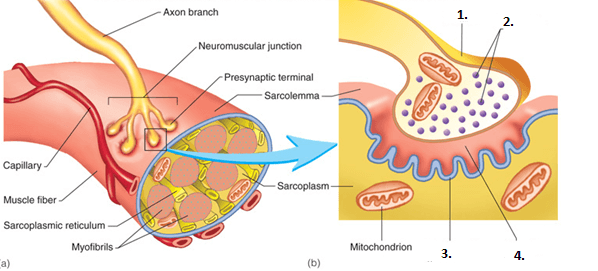
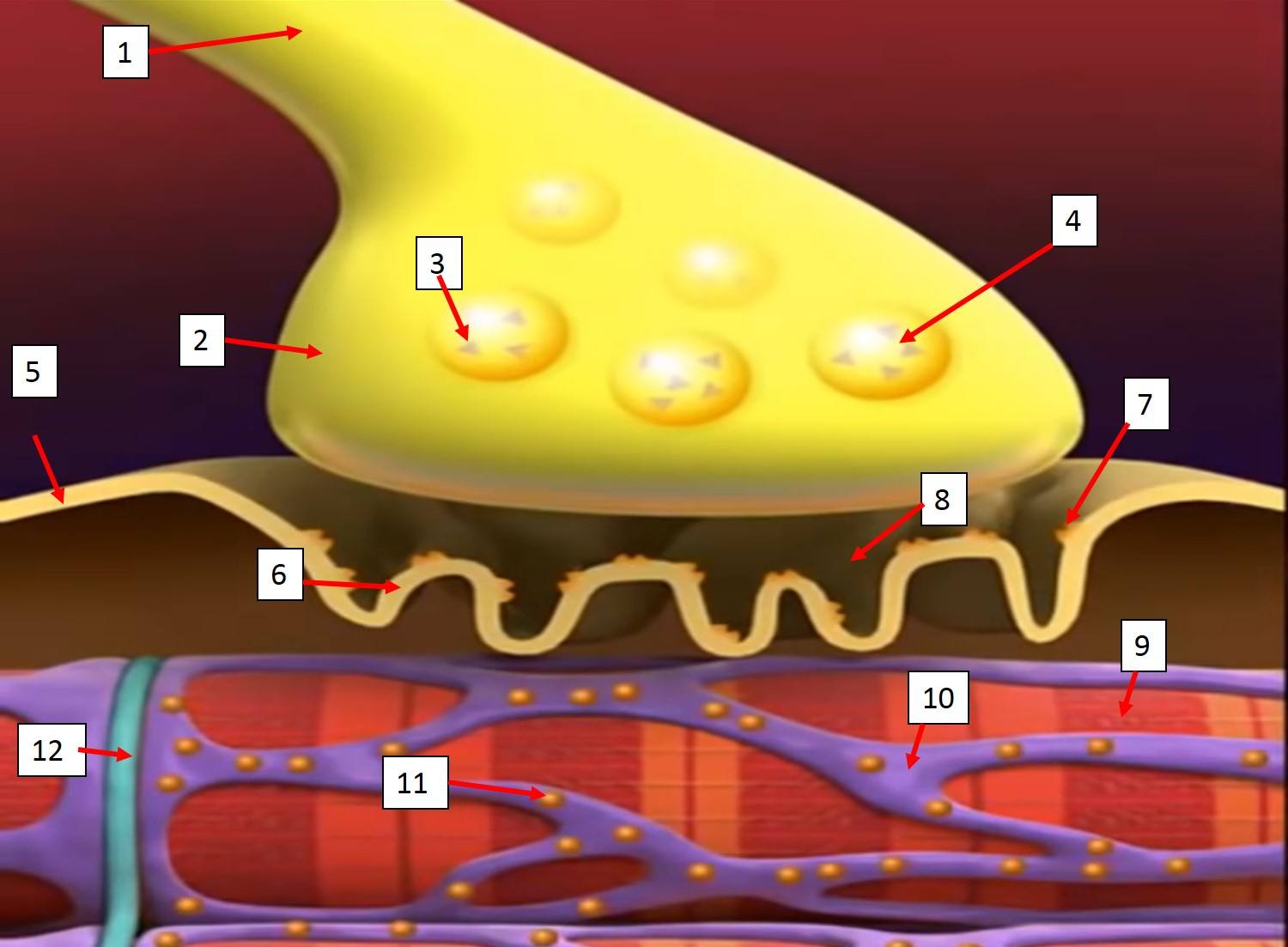
The gap between a neuron and a muscle cell: (#4 in the diagram)
a)
synaptic cleft
b)
sarcolemma
c)
vesicle
d)
Ca2+ ion
30.
The neurotransmitter stored in the axon terminal identified as #3
a)
Acetylcholine
b)
Protein Channel
c)
Calcium Ion (Ca2+)
d)
Syanptic Cleft
31.

The cell membrane of a muscle fiber is called:

a)

sarcoplasmic reticulum

b)

Axon Terminal of Motor Neuron

c)

sarcolemma

d)

sarcoplasm

32.
Another name for a muscle cell.
a)
Fiber
b)
Sacrolemma
c)
Sacromere
d)
Fascicle
33.
The plasma membrane of a skeletal muscle cell is called the:
a)
sarcomere
b)
myofilament
c)
sarcolemma
d)
sarcoplasm
34.
What two chemicals are necessary for muscle contraction to occur?
a)
Niacin and Potassium
b)
Calcium and ATP
c)
Sodium and Potassium
d)
Ach and Potassium
35.
Calcium:
a)
causes ATP binding to actin
b)
increases the action potential along the sarcolemma
c)
binds to proteins on myosin
d)
triggers the binding of myosin to actin
36.
What is a crossbridge?
a)
Where myosin binds to actin
b)
Where the calcium crosses into the cytoplasm
c)
Where calcium binds with troponin
d)
None of the answers are correct.
37.
The energy needed to perform a muscle contraction comes directly from
a)
ATP
b)
Oxygen
c)
Glucose
d)
Calcium
38.

The entire muscle is encased by connective tissue called the

a)

sacromere

b)

sarcoplasm

c)

myosin

d)

epimysium

39.

the cordlike connective tissue that attaches a muscle to a bone is called

a)

a tendon

b)

a ligament

c)

a sarcomere

d)

a fascicle

40.

the cytoplasm of a muscle cell is called the

a)

myosin

b)

actin

c)

fascia

d)

sarcoplasm

41.

Structure C is known as the thick filament of the sarcomere, it is also known as

a)

myosin

b)

actin

c)

fascia

d)

myofibrils

42.

A muscle primarily responsible fro the action (movement) is called the

a)

prime mover

b)

antagonist

c)

synergist

d)

fixator

43.

The point where the axon terminal synapses with the muscle fiber sarcolemma is called the _____________.

a)

active site

b)

membrane receptor

c)

sarcolemma junction

d)

neuromuscular junction

44.

Which of the following is found at the end of bones and keeps them from rubbing against each other?

a)

tendons

b)

cartilage

c)

ligaments

d)

bone marrow

45.
Identify the muscle.
a)
Quadriceps
b)
Bicep
c)
Pectorals
d)
Gastrocnemius
46.
Identify the muscle.
a)
Hamstring
b)
Pectorals
c)
Abdominals
d)
Quadriceps
47.
Identify the muscle.
a)
Hamstring
b)
Gastrocnemius
c)
Deltoid
d)
Latissimus Dorsi
48.
Identify the muscle.
a)
Bicep
b)
Tricep
c)
Deltoid
d)
Trapezius
49.
Identify the muscle.
a)
Obliques
b)
Trapezius
c)
Gluteus Maximus
d)
Latissimus Dorsi
50.
Identify the muscle.
a)
Biceps
b)
Triceps
c)
Abdominals
d)
Obliques
51.
Identify the muscle.
a)
Deltoids
b)
Quadriceps
c)
Triceps
d)
Trapezius
52.
Identify the muscle.
a)
Hamstrings
b)
Gastrocnemius
c)
Abdominals
d)
Pectorals
53.

This muscle flexes the trunk (4)

a)

rectus abdominus

b)

pectoralis major

c)

sartorius

d)

trapezius

54.

This muscle helps to elevate the mandible (2)

a)

frontalis

b)

occipitalis

c)

temporalis

d)

platysma

55.

This muscle adducts the shoulders (8) - helps cross arms over the anterior portion of the body.

a)

Lattisimus dorsi

b)

biceps

c)

external oblique

d)

pectoralis major

56.

This muscle puckers the lips (15)

a)

orbicularis oris

b)

orbicularis oculi

c)

zygomaticus

d)

masseter

57.

This muscle elevates the mandible (5)

a)

frontalis

b)

zygomaticus

c)

platysma

d)

masseter

58.

This muscle extends the elbow (6)

a)

triceps

b)

biceps

c)

latissimus dorsi

d)

external oblique

59.

What is the name of this muscle?

a)

Gluteus maximus

b)

Gluteus medius

c)

Gluteus minimus

d)

Piriformis

60.

What is the name of this muscle?

a)

Gracilis

b)

Adductor longus

c)

Sartorius

d)

Pectineus

61.

What is the name of this muscle?

a)

Pectoralis major

b)

Pectoralis minor

c)

Coracobrachialis

d)

Serratus anterior

62.

This muscle is part of what muscle group?

a)

Lat's little helper

b)

Pectoralis

c)

Hamstring

d)

Rotator cuff

63.

What is the name of this muscle?

a)

Latissimus dorsi

b)

Rhomboids

c)

Trapezius

d)

Thoracodorsal aponeurosis

64.

Identify this muscle

a)

buccinator

b)

levator labii superior

c)

mentalis

d)

frontalis

65.

Identify this muscle

a)

masseter

b)

sternocleidomastoid

c)

trapezius

d)

capitus

66.

Identify the muscle labeled 11

a)

external oblique

b)

rectus abdominus

c)

internal oblique

d)

serratus anterior

67.

Identify the muscle labeled B

a)

levator labii superior

b)

brachialis

c)

levator scapulae

d)

capitus

68.

Identify the muscle labeled I

a)

zygomaticus

b)

masseter

c)

platsyma

d)

temporalis

69.

What muscles make up your quadriceps?

a)

biceps femoris, semitendinosus, semimembranosus

b)

rectus femoris, vastus lateralis, vastus medialis, vastus intermedius

c)

supraspinatus, infraspinatus, subscapularis, teres minor

d)

biceps femoris, infraspinatus, teres major, subscapularis