Wayground logo

Free Printable Worksheets

Font size

S
M
L
XL
Worksheets

Matter

Total questions: 40

Worksheet time: 1hrs 22mins

Name
Class
Date
1.
What are the states of matter?
a)
solid, liquid, and juice
b)
solid and liquid
c)
solid and gas
d)
solid, liquid, and gas
2.
A description of objects that can be measured and observed.
a)
gas
b)
mustangs
c)
physical properties
d)
melting point
3.
An example of a physical property is 
a)
flammability
b)
acidic
c)
color
d)
ability to rust
4.
What causes a change in the state of matter?
a)
physical properties
b)
chemical energy
c)
temperature
5.

Which change can occur when  you add heat energy to room temperature water?

a)
The water can change from a liquid to a solid
b)
The water can change from a gas to a liquid
c)
The water can change from a liquid to a gas
d)
The water can change from a solid to a liquid
6.

Matter is anything that has mass and takes up space

a)
True
b)
False
7.
The amount of space something takes up
a)
density
b)
volume
c)
mass
d)
matter
8.
I am two or more atoms chemically bonded.
a)
atom
b)
compound
c)
molecule
d)
mixture
9.
A state of matter that has a definite volume and shape.
a)
solid
b)
liquid
c)
gas
d)
matter
10.
Solids have a definite _______________.
a)
smell
b)
shape
c)
picture
d)
sound
11.
Liquid matter takes the shape of _______.
a)
a gas
b)
water
c)
a pet
d)
Its container
12.

Air has a definite shape.

a)

True

b)

False

13.
Physical or Chemical?  Water is nonflammable
a)
Physical
b)
Chemical
c)
Neither
14.
Which liquid has the greatest density?
a)
lamp oil
b)
karo syrup
c)
water
d)
honey
15.
Molecules are closest together in a 
a)
Solid
b)
Liquid
c)
Gas
d)
plasma
16.
Which state of matter has particles arranged like this?
a)
solid
b)
liquid
c)
gas
17.
Which state of matter has particles arranged like this?
a)
solid
b)
liquid
c)
gas
18.
Which of the following statements describes a solid?
a)
It has a fixed shape
b)
It takes the shape of it's container
19.
What is the phase change of a solid to a liquid?
a)
freezing
b)
melting
c)
boiling
d)
condensation
20.
How are solids different from liquids?
a)
particles in solids are moving freely around each other.
b)
particles in solids have no motion.
c)
particles in solids are vibrating in place.
d)
particles in solids have more motion than in liquids
21.
Change from Liquid to Solid is call......
a)
fusion
b)
Freezing
c)
sublimation
d)
evaporation
22.
change from liquid to gas is called....
a)
expansion
b)
evaporation
c)
condensation
d)
sublimation
23.

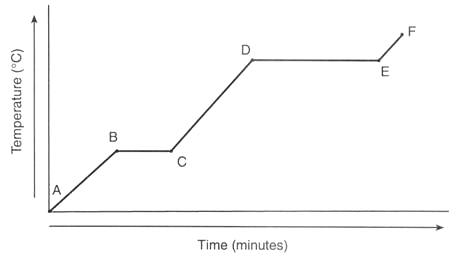
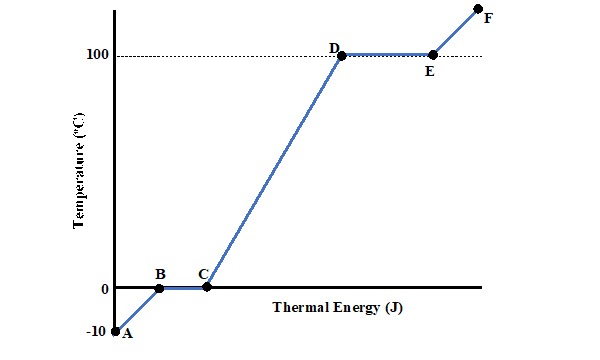
Is the substance gaining or losing energy?

a)

Gaining

b)

Losing

24.

What state/phase is the object likely from points A to B?

a)

Solid

b)

Liquid

c)

Gas

d)

Plasma

25.

What is happening to the particles in the substance between points A and B?

a)

Melting

b)

Freezing

c)

Speeding Up

d)

Slowing Down

26.

What is happening to the particles in the substance between points D and E?

a)

Melting

b)

Freezing

c)

Vaporizing

d)

Sublimating

27.

Between which two points is the gas heating up?

a)

A ----> B

b)

B <---- C

c)

C ----> D

d)

D ----> E

e)

E ----> F

28.
Between which points is the temperature of the substance remaining constant?
a)
A-B only. 
b)
A-B, C-D, E-F
c)
B-C only. 
d)
B-C, D-E
29.
What is the formula for calculating density?
a)
Mass ∗ Volume
b)
Volume ∗ Mass
c)
Mass ÷ Volume
d)
Volume ÷ Mass
30.
What is the most dense metal?
a)
Aluminum 
2.7 g/cm3
b)
Steel
7.14 g/cm3
c)
Nylon
1.2 g/cm3
d)
Copper 
8.14 g/cm3
31.

Color is what type of property?

a)

Physical

b)

Chemical

32.

Reactivity is what type of property?

a)

Physical

b)

Chemical

33.
Color, flexibility, texture and shape are examples of 
a)
physical properties
b)
solids 
c)
gases
d)
mixtures 
34.
Ability to rust is this type of property:
a)
Physical property
b)
Chemical property
35.
Which is NOT a physical property?
a)
odor
b)
reacts with bleach
c)
sinks in water
d)
density
36.
What kind of properties can only be observed when a substance changes into a different substance?
a)
physical properties
b)
chemical properties
c)
liquid properties
d)
real properties
37.
Which of the following is a chemical property?
a)
odor
b)
combustibility
c)
solubility
d)
all of the above
38.
Jack has a rock. The rock has a mass of 14g and a volume of 2cm3. What is the density of the rock?
a)
7 mL
b)
7 g/cm3
c)
28 g/cm3
d)
1/7 g/cm3
39.
If an object has a density of .6 g/mL and you put it into water, will it sink or float?  
a)
sink
b)
float
40.

Graham has an eraser. It has a mass of 4g, and a volume of 2cm3. What is its density?

a)
8 g/cm3
b)
2 g/cm3
c)
1/2 g/cm3
d)
24 g/cm3