
 Worksheets
Waves MAJOR ASSIGNMENT
Total questions: 50
Worksheet time: 2hrs 40mins

What do we call the top of the wave?
crest
trough
amplitude
frequency

What do we call the bottom of a transverse wave?
crest
trough
wavelength
amplitude

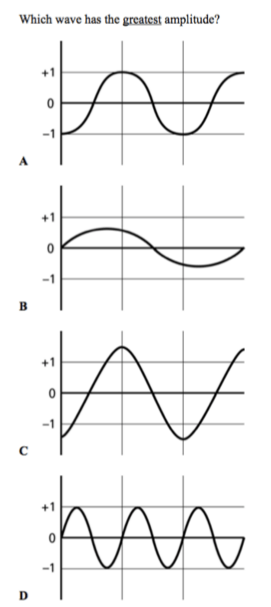
Height of a wave. Can be origin to crest. Can also be origin to trough
A. frequency
B. wavelength
C. wave speed
D. amplitude


What is another name for wave height?
Frequency
Amplitude
Wavelength
Origin
This is measured from crest to crest. It can also be measured from trough to trough
Frequency
Amplitude
Wavelength
Origin

Which wave has the longest wavelength?
Red Wave
Orange Wave
Green Wave
Purple Wave

Which wave has the shortest wavelength?
Red
Violet
Orange
Green
The number of waves that pass somewhere in a second is:
amplitude
frequency
wavelength
A _______ is a repeating pattern of motion that transfers energy from one place to another.
wavelength
wave
frequency
light

Which of these waves has the highest frequency?
1
2
3
Which of these waves has the lowest frequency?
1
2
3
Waves travel fastest through ___ because the particles are closest together
solids
liquids
gases
Waves travel slowest through ___ because the particles are farthest apart
solids
liquids
gases
Waves travel slowest through ___ because the particles are farthest apart
solids
liquids
gases
Which of these CANNOT travel in empty space?
electromagnetic waves
mechanical waves

What do we call the part of a longitudinal wave that is spread apart?
compression
rarefaction
crest
trough

What do we call the part of a longitudinal wave that is when the parts are squeezed together?
compression
rarefaction
crest
trough

What can mechanical waves travel through? (check ALL answers that apply)
liquids
empty space
solids
gases
A wave in which the particles move perpendicular to the direction the wave is traveling
A. surface wave
B. transverse wave
C. electromagnetic wave
D. longitudinal wave
A wave in which the particles move in the same direction (parallel) to the direction of the wave motion
A. mechanical wave
B. surface wave
C. longitudinal wave
D. wave
Height of a wave. Can be origin to crest. Can also be origin to trough
A. frequency
B. wavelength
C. wave speed
D. amplitude

What is Part A (the close together parts) called in this picture?
Compression
Amplituide
Rarefaction
Wavelength

What is Part B (the spread out parts) called in this picture?
Compression
Rarefaction
Amplitude
Wavelength


Sound waves are ______ waves
transverse
longitudinal
Sound waves ____ travel through empty space
can
cannot
The higher the energy of a sound wave, the ____ the volume.
louder
softer

Particles of a sound wave that are bunched together are called the ____ of wave
compressions
rarefactions
Particles of a sound wave that are spread apart are called the ____ of wave
compressions
rarefactions
The Doppler effect is when frequency of an object seems to change due to its motion.
True
False
Select the correct order of waves on the Electromagnetic Spectrum from the longest wavelength to the shortest wavelength
Radio, Microwaves, Infrared, Visible Light, Ultraviolet, X-ray, Gamma
Gamma, X-ray, Ultraviolet, Visible Light, Infrared, Microwaves, Radio
Visible Light, Microwaves, Infrared, Ultraviolet, X-ray, Gamma, Radio
Microwaves, Gamma, Radio, Visible Light, Infrared, Ultraviolet, X-ray

Example Of Radio Waves? (check all that apply)
Cellphone
Heat Lamps.
Satellite communications
TV communications
Radar
Too much ultraviolet light will not cause cancer
True.
False.
Example Of Microwaves? (check all that apply)
Wireless networks
Heat Lamps.
Satellite communications
TV communications
Radar
Uses of infrared? (check all that apply)
Night vision goggles
Heat Lamps.
Satellite communications
TV remotes
Cause skin cancer
Which of the following is true about visible light? (check all that apply)
can bend
can reflect
used for medical scans
includes ROYGBIV
Cause skin cancer
____ are the most dangerous and harmful electromagnetic waves due to having the highest frequency and energy.
X-rays
Gamma waves
Infrared waves
Ultraviolet

This picture shows an example of the:
trough of a wave
crest of a wave
Electromagnetic Spectrum
Doppler effect

