
 Worksheets
Triangle Congruence Proofs
Total questions: 30
Worksheet time: 8hrs 30mins
What does CPCTC stand for?
Congruent parts of congruent triangles are congruent
Corresponding parts of congruent triangles are congruent
Corresponding parts of corresponding triangles are corresponding
When do you use "CPCTC" in a proof?
ALWAYS at the beginning
ALWAYS at the end
It's optional
Never
When using hypotenuse leg (HL) in a proof, you must first know...
CPCTC
there are right angles
that vertical angles are congruent
the reflexive property

What is Reason B?
Definition of Congruence
Given
Reflexive Property
CPCTC
What is Reason C?
SSS
SAS
ASA
AAS
HL

What is Reason B?
Reflexive Property
Definition of Congruence
CPCTC
Given
What is Reason C?
SSS
SAS
CPCTC
HL
Prove

Which of the following is a correct statement and reason for the proof shown? Select ALL that apply
FG≅FG ; Midpoint Theorem
FG≅FG ; Reflexive
DG≅GE ; Midpoint theorem
DF≅FE ; Definition of a Bisector

Which of the following is a correct statement and reason for the proof shown?
JK≅JK ; Reflexive Property
∠M≅∠L ; Reflexive Property
MJ≅LK ; Midpoint Theorem
MK≅LJ ; Hypotenuse Congruence

Which of the following is a correct statement and reason for the proof shown?
∠P≅∠Q ; SAS
∠P≅∠Q ; CPCTC
∠P≅∠Q ; SSS
∠P≅∠Q ; SSA

Which of the following is a correct statement and reason for the proof shown?
∠GEQ≅∠NEW ; Vertical angles
WN≅GQ ; Given
∠G≅∠N ; AIA Theorem
∠W≅∠Q ; AIA Theorem

Which of the following is a correct statement and reason for the proof shown?
∠1≅∠2 ;Definition of a Bisector
∠ADC≅∠BDC ; Definition of a Bisector
∠A≅∠B ; Definition of a Bisector
AD≅DB ; Definition of a Bisector

What is Reason B?
Definition of Right Angles
Definition of Perpendicular
Definition of Given
Definition of Right Triangles
What is Reason C?
Definition of Right Angles
Definition of Perpendicular
Definition of Given
Definition of Right Triangles
What is Reason D?
Definition of Congruence
Given
Reflexive Property
Definition of Equality
What is Reason E?
SSS
SAS
ASA
AAS
HL
What is Reason F?
CPCTC
Given
HL
Definition of Perpendicular

Why would MK≅KM ?
Vertical Angles Theorem
Reflexive Property of Congruence
Alternate Interior Angles Theorem
Definition of Midpoint

Why would ∠ACB≅∠DCE
AAS
Definition of Midpoint
Vertical Angles Theorem
Definition of Parallel Lines

Why would ∠D≅∠E?
Vertical Angles Theorem
Alternate Interior Angles Theorem
Definition of Parallel Lines
Corresponding Angles Postulate

What would be the reason for the 5th statement ( BD≅BD )?
Transitive Property
Reflexive Property
Vertical Angles
SAS
What would be the reason for the 6th statement (ΔABD≅ΔCBD) ?
HL
SSA
SSS
SAS
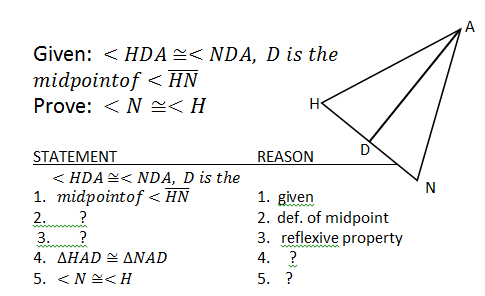
What is the "statement" for step 2 of the proof?
AD ≅AD
AD ≅DA
HD≅ND
HA ≅AN
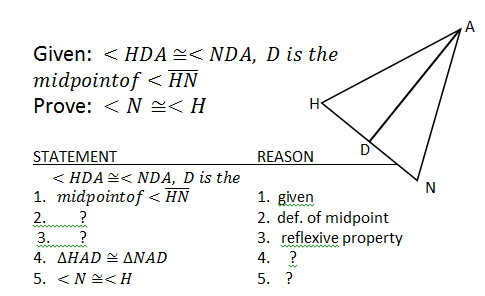
What is the "statement" for step 3 of the proof?
AD ≅DA
AN ≅AH
HD ≅ND
AH≅AD

What would be the correct "given" statements for this diagram? Select ALL that apply
T is the midpoint of BG
∡B≅∡G
∡A≅∡W
T is the midpoint of AW

What is the "statement" for step 2 of the proof?
∆BAC≅∆DAC
BC ≅DC
<B≅<D
<BAC≅<DAC
What is the "statement" for step 4 of the proof?
∆ACD≅∆ACB
BC ≅DC
<B≅<D
∆ACB≅∆DAC

Choose the correct congruence statement
∆TUV ≅ ∆EUV
∆VUT ≅ ∆UVE
∆TUV ≅ ∆UEV
∆UTV ≅ ∆EUV

≅ thrm


