wayground logo

Free Printable Worksheets

Font size

S
M
L
XL
Worksheets

Solutions M2

Total questions: 45

Worksheet time: 52mins

Name
Class
Date
1.
What is it about the water molecule that makes it a great solvent?
a)
water demonstrates polarity; a partial charge on each side of the molecule
b)
due to its molecular formula
c)
it has a liner molecular shape
d)
due to it's non-polar molecular structure
2.
Which of the following would result in being able to dissolve a greater amount of gas in a
solution?
a)
Heat the gas and solution
b)
Decrease the pressure of the solution
c)
Make the gas an electrolyte
d)
Cool the gas and solution
3.
Students are asked to make statements about the solubility graph above. Which student does
the best job of communicating the general features of the graph?
a)
Most salts require 100 grams of water in order to dissolve completely.
b)
Table salt has the average solubility of all salts.
c)
The solubility of most salts increases with increasing temperature.
d)
Most curves show a decreasing slope as the temperature rises.
4.
Which of the following would decrease the rate of solution when dissolving a solid in water?
a)
Raise the temperature of the solution
b)
Crush the solid before mixing
c)
Stir the solution after mixing
d)
Use a single cube of solid
5.
Which of the following is the best way to determine if an aqueous solution  is supersaturated?
a)
add more solvent
b)
measure the temperature
c)
filter out excess solute
d)
add a seed crystal
6.

Concentration is

a)

the amount of solute in the solvent

b)

the amount of solvent in the solute

c)

density

d)

particle size

7.

In order to dilute a solution, you need to

a)

add more of the solid

b)

add more water

c)

find the mass

d)

find the volume

8.

Which solution is more diluted?

Solution 1:

1000 mL of water

60g of salt


Solution 2:

500 mL of water

60 g of salt

a)

Not enough information to tell

b)

Solution 1

c)

Solution 2

d)

They are equally diluted

9.

Calculate the mass percent of solution, if there is 100 g of sugar and 400 g of water

a)

30

b)

25

c)

20

d)

15

10.
The ___ is the thing being dissolved
a)
solute
b)
solvent
11.
What does it mean if a mixture is heterogeneous?
a)
you can see the different parts
b)
cannot tell one part from another
c)
very well blended
d)
made of elements
12.
What does it mean if a mixture is homogeneous?
a)
you can see the different parts
b)
cannot tell one part from another
c)
chunks of particles
d)
made of elements
13.
Solvent is best defined as-
a)
a mixture in which the substances are spread out evenly between one another and cannot be told apart
b)
the ability of a substance to dissolve in another substance
c)
a substance that dissolves in another substance
d)
a substance into which another substance dissolves
14.
A solution that can hold more solute  is called
a)
saturated
b)
supersaturated
c)
unsaturated
d)
insoluble
15.
You can make a solution more concentrated by adding more __________.
a)
solute
b)
solvent
c)
water
16.
Contains the maximum amount of dissolved solute
a)
unsaturated solution
b)
supersaturated solution
c)
saturated solution
17.
Which technique could increase or speed up the rate of dissolving?
a)
Allowing the mixture to settle
b)
Stirring the mixture
c)
Adding more powder
d)
Adding more water
18.
If we are making Kool-aid with sugar, Kool-aid powder, and water, which part is the solvent?
a)
water
b)
powder
c)
sugar
d)
powder and sugar
19.
What is the concentration, in percent by volume, of 15.3 mL of solute in 2.65 L of solution?
a)
0.58%
b)
0.0058%
c)
5.8%
20.
How do you separate iron filings from sand?
a)
You can use a filter.
b)
You can use a fagnet.
c)
You can use a magnet.
d)
You can use all of the methods!
21.
What is the process of separating at which the components move at different rates?
a)
centrifugation
b)
chromatography
c)
heating
d)
decantation
22.
Separating particles based on size.
a)
chromatography
b)
decantation
c)
distillation
d)
Filtration
23.
Separating mixtures based on boiling points.
a)
Desalination
b)
Distillation
c)
Decantation
d)
Condensation
24.
What is decantation?
a)
Distillation
b)
Desalination
c)
Separating particles by careful pouring.
d)
Measuring boiling points.
25.

Paper filters are used to separate certain mixtures. Which of these mixtures is most likely to be separated by a paper filter?

a)

Sugar and salt

b)

Sand and water

c)

Sugar and water

d)

Sand and salt

26.

A student is given a beaker containing a mixture of salt and water. The salt is fully dissolved in the water. The student is instructed to separate the salt from the water. What should the student do to separate this mixture?

a)

Evaporate the water to collect the salt

b)

Pour the mixture through a paper filter

c)

Use electrical energy to separate the salt from the water

d)

Separate the salt and water with tweezers

27.

A teacher gives a group of students a mixture of sugar and sand. The sugar grains are the same size as the grains of sand. What is the easiest way for the students to separate the sand from the sugar?

a)

Use tweezers to remove every grain of sand

b)

Put the mixture in water and filter the sand out of the water

c)

Pour the mixture through a wire screen to remove the sand

d)

Run a strong magnet through the mixture to attract the salt

28.

A cup is filled with a mixture of water and gravel. Which method listed below could NOT be used to separate this mixture?

a)

Allow the water to evaporate

b)

Pour the mixture through a paper filter

c)

Pour the mixture through a wire strainer

d)

Run a magnet through the mixture

29.

A group of students writes a procedure for separating a mixture of sand and salt. The first two steps of the procedure are shown. Which step should be added to this procedure to finish collecting the salt and the sand?

a)

Pour the mixture through a wire mesh to collect the salt

b)

Run a magnet through the mixture to attract the salt

c)

Boil the solution to remove the water from the salt

d)

Skim the salt off of the surface of the water
30.
What is the relationship between mixtures and solutions?
a)
All mixtures are solutions.
b)
Mixtures and solutions are the same.
c)
Mixtures must be solid and solutions must be liquid.
d)
All solutions are mixtures
31.
Which of the following pairs of substances may best be separated through distillation
a)
 sand and soil
b)
water and soil
c)
salt and sand
d)
 water and alcohol
32.

In a coffee machine, the ground coffee is separated from the coffee solution by using..

a)

sand paper

b)

filter paper

c)

toilet paper

d)

tissue paper

33.

Dyes in water soluble markers may be separated by means of..

a)

crystallization

b)

sublimation

c)

chromatography

d)

sedimentation

34.
Water and alcohol are easily separated by distillation because of their
a)
 different melting points
b)
different colours
c)
different densities
d)
different boiling points
35.

50g of salt is added to 150g of water. What is the concentration?

(a)  

36.

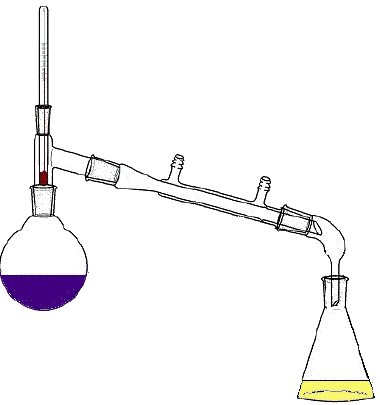
What was the first substance to distill out from the Pepsi in the experiment?

(a)  

37.

60g of iron is found in a 300g rock. What percent purity is the ore sample?

(a)  

38.

A homogeneous mixture is the same thing as...

a)

a solution

b)

a heterogeneous mixture

c)

a compound

d)

an element

39.

The prefix hetero means...

a)

same

b)

different

c)

together

d)

awesome

40.

When 40 grams of NaCl is dissolved in 100 grams of water at 90 ºC, the solution can be correctly described as:

a)

supersaturated

b)

saturated

c)

unsaturated

41.

Which of the following is most likely to dissolve styrofoam?

a)

Water

b)

Ethyl Alcohol

c)

Acetone

d)

Lacquer

42.

Which solvent is best for organic acids like benzoic or oxalic acid?

a)

Water

b)

Ethyl alcohol

c)

Acetone

d)

Hexane

43.

What method of separation do we use to get the flavor or essential oils from plants?

a)

Filtration

b)

distillation

c)

evaporation

d)

concatenation

44.

What mass of solute is needed to make 100.0 g of a 3.4% solution?

a)

3.4 g

b)

34 g

c)

2941 g

d)

0.34 g

45.

A student makes a garden salad by stirring lettuce, tomatoes, carrots, and croutons together in a bowl. Why is the garden salad a mixture?

a)

the student cut the vegetables into equally sized pieces

b)

the vegetables are combined by maintain their physical properties

c)

the croutons cannot be taken out of the salad

d)

the salad grew from a garden