Wayground logo

Free Printable Worksheets

Font size

S
M
L
XL
Worksheets

iGCSE Water Cycle and Drainage Basins

Total questions: 20

Worksheet time: 29mins

Name
Class
Date
1.

A ………………………………. is the area of land drained by a river system ( a river and its tributaries).

a)

Watershed

b)

Drainage Basin

c)

Confluence

d)

Water table

2.

Drainage basins are separated by ………………………….

a)

Watersheds

b)

Water tables

c)

Walls

d)

Communities

3.

The section labelled A is known as the

a)

watershed

b)

source

c)

tributary

d)

mouth

4.

The section labelled D is known as the

a)

river valley

b)

main stream

c)

tributary

d)

spring

5.

What is the name of the area labelled C?

(a)  

6.

What is the name of the area labelled B?

(a)  

7.

What is the hydrological cycle?

a)

The total amount of water on the planet measured in cubic meters.

b)

The movement of water around and around from sea to atmosphere to land.

c)

The daily evaporation, condensation and precipitation of water in the atmosphere.

d)

When an area is fully saturated with water and can absorb no more.

8.

Which of the following is an input in the hydrological cycle

a)

Precipitation

b)

Condensation

c)

Percolation

d)

Stem flow

9.
What is the energy source for the water cycle?
a)
the sun
b)
the earth
c)
water
d)
the moon
10.
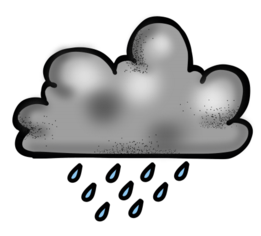
What part of the water cycle does this picture show?
a)
condensation
b)
precipitation
c)
evaporation
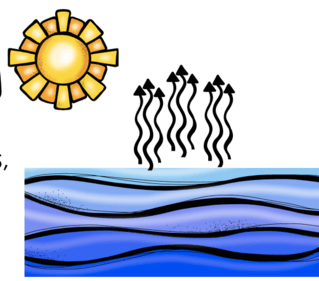
11.
What part of the water cycle does this picture show?
a)
condensation
b)
precipitation
c)
evaporation
12.
What is evaporation?
a)
The part of the water cycle when the sun heats up water, turning it from a liquid into water vapor or steam. It rises from the ground into the air.
b)
The part of the water cycle when the water vapor in the air gets cold. The water turns back into a liquid and forms clouds.
c)
The part of the water cycle when clouds get heavy and can no longer hold the liquid water. This causes the water to fall from the sky to the earth as rain, snow, sleet, or hail.
13.
What is condensation?
a)
The part of the water cycle when the sun heats up water, turning it from a liquid into water vapor or steam. It rises from the ground into the air.
b)
The part of the water cycle when the water vapor in the air gets cold. The water turns back into a liquid and forms clouds.
c)
The part of the water cycle when clouds get heavy and can no longer hold the liquid water. This causes the water to fall from the sky to the earth as rain, snow, sleet, or hail.
14.
What is it called when plants give off water vapor as a waste product?
a)
condensation
b)
evaporation
c)
sublimation
d)
transpiration
15.
Condensation is when...
a)
A liquid turns to gas.
b)
A gas turns to liquid.
c)
A liquid turns to ice.
d)
All of the answers.
16.
Precipitation is...
a)
Any form of water that falls from a cloud to the Earth.
b)
Drinkable water that collects underground
c)
Water that turns to a gas.
d)
None of the answers.
17.
Evaporation is...
a)
When water changes from a solid to a liquid.
b)
When water changes from a gas to a liquid.
c)
When water changes from a liquid to a gas.
d)
None of the answers.
18.

As a part of the water cycle, water from Earth's surface enters the clouds and finally falls back to the ground in the form of rain. What is the correct sequence of processes water undergoes?

a)

Evaporation, Condensation, Precipitation

b)

Precipitation, Condensation, Evaporation

c)

Condensation, Evaporation, Precipitation

d)

Evaporation, Precipitation, Condensation

19.

What is it called when water flows vertically through cracks and joints in the bedrock?

a)

groundwater flow

b)

percolation

c)

through flow

d)

infiltration

20.

What is called when water flows vertically down into pores and percolines in the soil?

a)

infiltration

b)

stemflow

c)

percolation

d)

interception