NEW
Font size
 Worksheets
Kepler's Laws of Planetary Motion
Total questions: 25
Worksheet time: 25mins

Planets orbit the Sun in a shape called a(n)
circle
ellipse
focus
perihelion

An ellipse is drawn around two points called:

What has an eccentricity of zero?
#1: A perfect circle
#2: A slightly elliptical path
#3: A very elliptical path
All elliptical paths
What has the greatest eccentricity of its orbital path?
#1: A perfect circle
#2: A slightly elliptical path
#3: A very elliptical path
All elliptical paths have eccentricities of zero (e = 0)
The value of eccentricity can range from ________ to ________.
0.1 to 0.9
-1 to 0
0 to 100
0 to 1
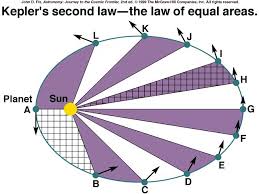

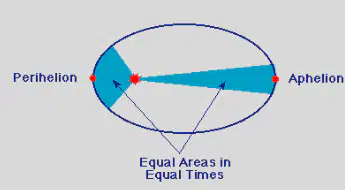
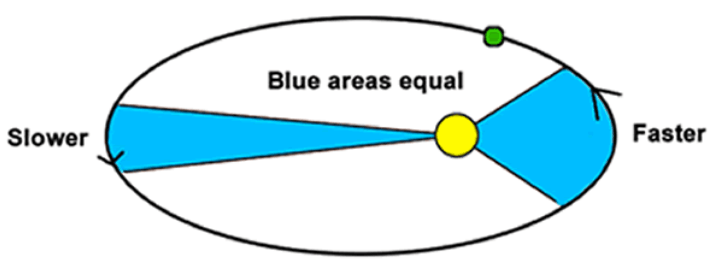
Kepler's 2nd Law deals with:


The diagram below shows a moon revolving around a planet in an elliptical orbit. At which position is the moon traveling fastest?
location 1
location 2
location 3
location 4

The diagram below shows a moon revolving around a planet in an elliptical orbit. At which position is the moon traveling slowest?
location 1
location 2
location 3
location 4
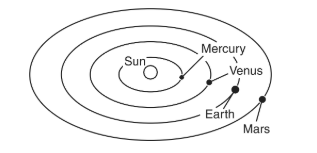
Which planet will take the least amount of time to revolve around the Sun?
Mercury
Venus
Earth
Mars

Which planet will take the most amount of time to revolve around the Sun?
Mercury
Venus
Earth
Mars

Which statement best describes Kepler’s 2nd Law of Planetary Motion?
Planets revolve around the sun over equal areas in equal time intervals.
Planetary orbits are in the shape of an ellipse.
A planet’s orbital period is proportionate to its distance from the sun.

Kepler’s 2nd Law states that the area swept out by a planet’s motion will be the same regardless of where it is in its orbit. A comet moves much faster when it is closer to the Sun than when it is further out from the Sun. What is the primary cause in the change of the comet’s orbital velocity?
Jupiter's gravitational field.
The sun's solar wind.
The sun's gravitational field.
Saturn's magnetic field.
According to Kepler's 3rd law, the square of the time it takes for an object to orbit, T, is directly related to the cube of the distance, r, between the object and what it is orbiting.
What this means is that if a satellite moves away from what it is orbiting,
the area it covers during its orbit is changing per unit of time
it must be speeding up in its linear speed
it is slowing down as its radius (distance) is increasing
Kepler's 3rd law tell us that __ would be dependent on __.
orbital period ; distance
distance ; orbital period
Kepler’s 3rd law states the square of the orbital period is proportional to the cube of the orbital radius. (T2=D3)
If a planet's orbital radius is doubled, what happens to the length of a year on that planet?
SOLVE USING Kepler’s 3rd Law: (T2=D3)
A planet orbits the Sun (or any star) in 4.4 Earth years. What is its distance from the Sun (star) in AU?
2.1 AU
2.7 AU
3.2 AU
3.9 AU
SOLVE USING Kepler’s 3rd Law: (T2=D3) *Same problem as prior...
A planet orbits the Sun (or any star) in 4.4 Earth years. What is its distance from the Sun (star) in MILES?
1.9 x 10⁸ miles
2.2 x 10⁸ miles
2.5 x 10⁸ miles
2.9 x 10⁸ miles
SOLVE USING Kepler’s 3rd Law: (T2=D3) *Same problem as prior...
A planet orbits the Sun at a distance of 7.8 AU. What is its orbital period (time) in Earth YEARS?
21.8 Earth Years
20.2 Earth Years
18.8 Earth Years
11.4 Earth Years