
 Worksheets
Minerals and Rocks
Total questions: 41
Worksheet time: 21mins
Name
Class
Date
1.

Rocks are made of...
a)
minerals
b)
ice
c)
dirt
d)
carbon
2.
The process by which water, wind, ice, and changes in temperature break down rock into fragments called sediments.
a)
Deposition
b)
Erosion
c)
Weathering
d)
Igneous Rock
3.
Rock that forms when minerals form from solutions or sediment from older rocks get pressed and cemented together.
a)
Sedimentary Rock
b)
Metamorphic Rock
c)
Igneous Rock
4.
Rock that forms when pressure, temperature, or chemical processes change existing rock.
a)
Igneous Rock
b)
Sedimentary Rock
c)
Metamorphic Rock
d)
Rock Cycle
5.
The solid, geometric form of a mineral produced by a repeating pattern of atoms
a)
crystal
b)
density
c)
element
d)
fracture
6.
The process by which igneous rocks are formed...
a)
heat and pressure
b)
melting and cooling
c)
compaction and cementation
7.
A metamorphic rock can become ______.
a)
igneous
b)
metamorphic
c)
sedimentary
d)
all of these
8.
An igneous rock can become ______.
a)
metamorphic
b)
sedimentary
c)
igneous
d)
all of these
9.
A naturally occurring, inorganic solid with a crystal structure and a definite chemical composition is referring to
a)
density
b)
streak
c)
mineral
d)
non silicate mineral
10.
The name rock is given when it is broken down into smaller pieces.
a)
texture
b)
weathering
c)
sediment
d)
erosion
11.
How do you test the hardness of a mineral?
a)
Throw it against a wall
b)
Step on it
c)
Scratch Test
d)
Kick it until it breaks
12.
What does it mean for a rock to be extrusive
a)
Have layers
b)
Have Rounded Edges
c)
Form from Lava
d)
Form By Sediment
13.

This rock cooled on the outside of a volcano and contained air bubbles when it was forming. What type of rock is this?
a)
Sedimentary
b)
Igneous
c)
Metamorphic
14.
The process by which sediment is moved from one place to another. Can be caused by water, wind, ice, and gravity.
a)
Rock Cycle
b)
Uplift
c)
Deposition
d)
Erosion
15.

This rock was formed by lots of fossils that settled on top of each other over time. What type of rock is this?
a)
Sedimentary
b)
Igneous
c)
Metamorphic
16.

A mineral breaks into pieces like are shown in the picture. How would you describe its breakage?
a)
Fracture
b)
Cleavage
c)
Glassy
d)
Waxy
17.

This rock was another type of rock that was heated and compressed over time. What type of rock is this?
a)
Sedimentary
b)
Igneous
c)
Metamorphic
18.
If a metamorphic rock has layers, what is it?
a)
foliated
b)
nonfoliated
19.

By definition, a mineral has which of the following characteristic(s)?
a)
definite chemical composition
b)
crystal structure
c)
naturally occuring
d)
all of the above
20.

This rock started as molten magma. What type of rock is this?
a)
Sedimentary
b)
Igneous
c)
Metamorphic
21.

According to the diagram, what process is shown by letter A?
a)
extrusion
b)
erosion
c)
crystallization
d)
intrusion
22.
Limestone is a sedimentary rock. During the rock cycle, limestone is changed into marble, a metamorphic rock. The processes that act on limestone and change it into marble are
a)
weather and erosion
b)
heat and pressure
c)
compacting and cementing
d)
melting, cooling, and hardening
23.

True or False: Rocks can transform into different types of rocks.
a)
True
b)
False
24.
Sedimentary rock type made from bits of minerals and other Earth material that were weathered and moved is _?_ sedimentary rock.
a)
clastic
b)
chemical
c)
organic
25.

What are the two kinds of crust that the Earth has?
a)
Oceanic and Crustatious Crust
b)
Oceanic and Continental Crust
c)
Optic and Continental Crust
26.
Why is coal not a mineral?
a)
It's not a solid
b)
It is man-made
c)
It is not inorganic
d)
It is made of carbon
27.
the dropping of sediments in layers.
a)
compaction
b)
deposition
c)
erosion
d)
weathering
28.
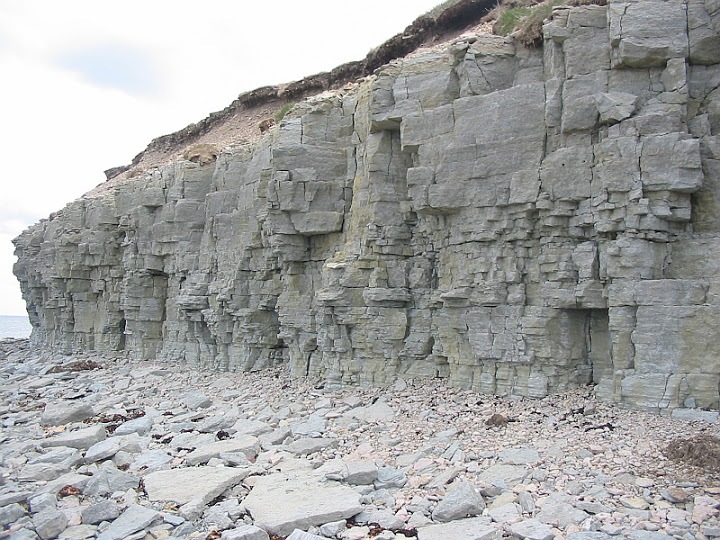
What factors can lead to the formation of a sedimentary rock?
a)
evaporation and precipitation
b)
melting and solidification
c)
extreme heat and pressure
29.
Metamorphic rocks form from ___.
a)
igneous rocks
b)
other metamorphic rocks
c)
sedimentary rocks
d)
all types of rocks
30.
Granite forms what type of metamorphic rock?
a)
slate
b)
marble
c)
gneiss
d)
quartzite
31.
Where is magma found?
a)
inside Earth
b)
on the surface of the Earth
32.
Igneous Rocks form by what process?
a)
Weathering
b)
Metamorphism
c)
Crystallization
d)
Evaporation
33.

Which layer of Earth would have the greatest density?
a)
upper mantle
b)
lower mantle
c)
inner core
d)
outer core
34.
Temperature _____________________ as you go deeper into the earth.
a)
increases
b)
decreases
c)
goes up and down depending on the layer
d)
stays the same
35.
Pressure ______________________ as you go deeper into the Earth
a)
increases
b)
decreases
c)
goes up or down depending on the layer
d)
stays the same
36.
The color of a mineral in powder form is called the mineral's
a)
hardness
b)
specific gravity
c)
luster
d)
streak
37.
How light reflects off of a mineral is called the mineral's
a)
luster
b)
streak
c)
cleavage
d)
fracture
38.

The mineral in the picture has a ____________ luster.
a)
Nonmetallic
b)
Metallic
c)
Pearly
d)
Earthy
39.

A mineral breaks into pieces like are shown in the picture. How would you describe its breakage?
a)
Fracture
b)
Cleavage
c)
Glassy
d)
Waxy
40.
Scientists test for the hardness of a mineral by doing which of the following?
a)
Measuring the mass of the mineral, and comparing it against other minerals
b)
Observing how light reflects off the mineral and how the mineral looks as a result
c)
Observing the color of a mineral and comparing it against other minerals
d)
Scratching the mineral against other substances of known hardness
41.
The process by which metamorphic rocks are formed...
a)
heat and pressure
b)
compaction and cementation
c)
melting and cooling
100 %

