
NEW
Font size
 Worksheets
PS ch 9 waves
Total questions: 50
Worksheet time: 48mins
The highest part of a transverse wave is
the crest
the trough
the wave point
the hotel transylvania
The lowest part of a transverse wave are the
crests
troughs
wave points
low nodules
The distance between two corresponding parts of a wave is its
amplitude
frequency
wavelength
velocity
The height of the wave from its resting point is called its
wavelength
amplitude
velocity
frequency
A wave that needs a medium to travel is called a(n)
electromagnetic wave
mechanical wave
ocean wave
any way can do this
A wave that can travel with or without a medium is called a(n)
electromagnetic wave
mechanical wave
surface wave
all waves can travel in any way
Longitudinal waves have:
crests and troughs
crests and compressions
compressions and rarefactions
troughs and rarefactions
Transverse waves have:
crests and troughs
troughs and rarefactions
compressions and contractions
rarefactions and crests
How often a wave occurs is the wave's
frequency
amplitude
wavelength
velocity
Transverse waves move mediums
at a right angle
in a circle
and matter too
at an acute angle
Longitudinal waves move:
at a right angle compared to the direction the wave is traveling
in a circle compared to the direction the wave is traveling
matter
in the same direction as the wave is traveling

What is the amplitude of this wave?
3
-3
6
4

What is the wavelength of this wave?
3
10
4
8
What would happen to the wavelength if the frequency was doubled?
the wavelength would be halved
the wavelength would be doubled
the wavelength would stay the same
frequency does not affect wavelength
What would happen to the frequency is the wavelength was tripled?
the frequency would be a third of what it was
the frequency would be 3 times larger
the frequency would stay the same
the wavelength does not affect the frequency of a wave
What is the amplitude of this wave?
3
-3
6
4
What is the wavelength of this wave?
3
8
10
4
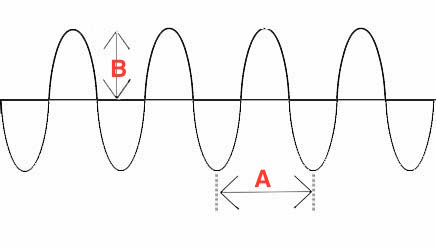
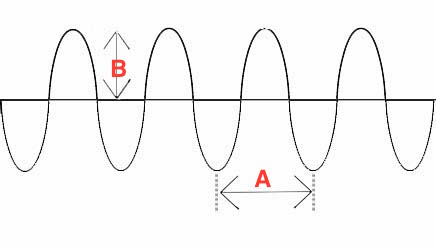
What property of this wave is represented by the letter "A"
amplitude
crest
trough
wavelength
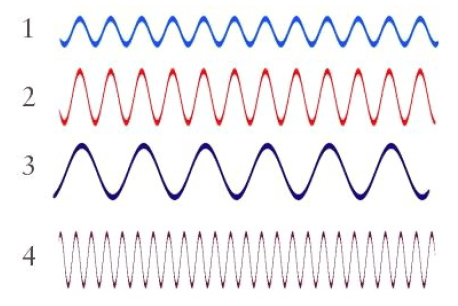
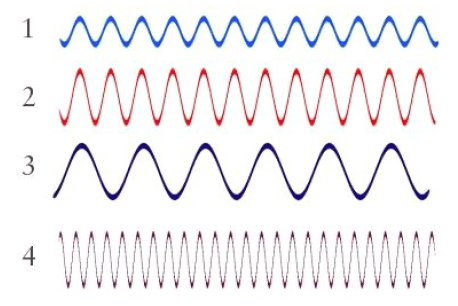
What is transferred by a wave?
energy
matter
particles
mass

A wavelength is the distance between which 2 points?
B and G
A and C
C and F
A and H

The displacement marked in the diagram by a red arrow is known as the ____ of the wave.
time
speed
frequency
amplitude

Which image represents a longitudinal wave?
A
B
Sound waves are which type of waves?
transverse
seismic
longitudinal
frequency
a measure of the size of the disturbance of a wave, related to the energy that it carries
amplitude
crest
period
wavelength
denser region of a longitudinal wave
compression
crest
diffraction
rarefaction
bending of waves around an obstacle; can also occur when waves pass through a narrow opening
diffraction
rarefaction
refraction
resonance
number of wavelengths that pass a fixed point each second
frequency
period
wavelength
amplitude
process of two or more waves overlapping and combining to form a new wave
interference
resonance
standing wave
mechanical wave
wave in which the matter in the medium moves back and forth along the direction that the wave travels
longitudinal wave
mechanical wave
standing wave
transverse wave
matter through which a wave travels
medium
node
wave
trough
point in a standing wave at which the interfering waves always cancel
node
interference
crest
period
amount of time it takes one wavelength to pass a fixed point
period
frequency
wavelength
interference
the less dense region of a longitudinal wave
rarefaction
refraction
compression
diffraction
bending of a wave caused by changes in its speed as it travels from one medium to another
refraction
diffraction
interference
rarefaction
the process by which an object is made to vibrate by absorbing energy at its natural frequencies
resonance
refraction
standing wave
interference
a wave pattern that forms when waves of equal wavelength and amplitude, but traveling in opposite direction, continuously interfere with each other
standing wave
longitudinal wave
transverse wave
interference



