
 Worksheets
AP Biology - Enzyme Catalysis
Total questions: 23
Worksheet time: 14mins
Which of these is NOT true?
Enzymes can denature (change shape) when the temperature gets too high.
Enzymes can only be used once in a chemical reaction.
Extreme pH and salinity can denature enzymes.
Enzymes speed up chemical reactions.
Which of the following is directly responsible for the shape of an enzyme/protein?
The amino acid sequence of the protein and the properties of the amino acids that make up the protein.
The temperature of the surrounding environment.
The pH of the surrounding environment.
The amount of substrate present.
If a mutation occurs in a DNA sequence that codes for an enzyme, what is the most likely result?
There will likely be no change in the shape and function of the enzyme.
The enzyme will most likely fold in a way that makes its shape incompatible with the substrate and the enzyme will not function correctly.
The enzyme will not be produced at all.
The enzyme will have an enhanced ability to bind with the substrate.
Archaebacteria are metabolically active in hot springs because ____________
their enzymes are insensitive to temperature
they use molecules other than proteins as their main catalysts
their enzymes have high optimal temperatures
they are able to maintain an internal temperature much cooler than that of the surrounding water
Each enzyme only has 1 substrate that will fit its active site. What is this called?
reusability
catalysis
specificity
fragility

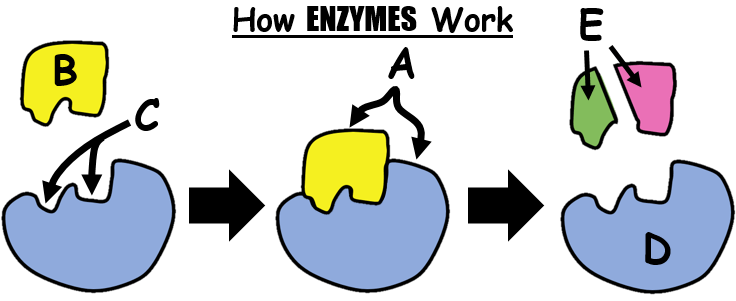
A molecule that is so similar to the normal substrate that it can occupy the active site of the enzyme
Allosteric Inhibition
Competitive Inhibition
Noncompetitive Inhibition
Feedback Inhibition
A molecule that binds to the enzyme at a site other than the active site, causing the enzyme to change shape and be unable to bind substrate
Allosteric Inhibition
Feedback Inhibition
Competitive Inhibition
Noncompetitive Inhibition
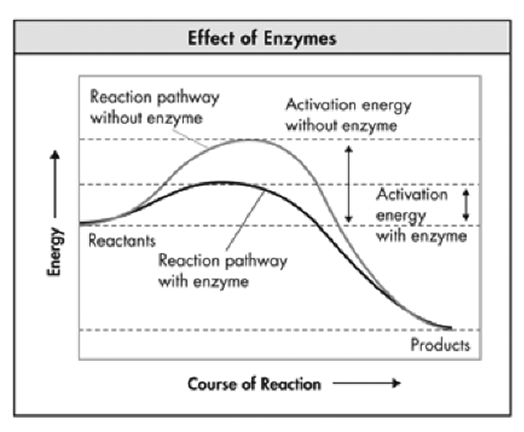
In order to increase the rate of reaction using an enzyme a scientist could.... (Choose all that apply)
Increase the amount of substrate
Decrease the temperature
Increase the temperartue
Introduce a competitive inhibitor
The rate of a chemical reaction in a cell is the measure of how
often the reaction occurs.
quickly the substrates are converted to product.
much energy must be added for the reaction to occur.
much activation energy is required for the reaction to occur.
easily the reaction is inhibited.
A particular enzyme catalyzes the conversion of substrate A into product B. If you wished to use this enzyme in a different reaction, the substrate with the best chance of working would be a molecule with the same
charge as A.
molecular weight as A.
atomic composition but different structure as A.
number of carbons as A.
three-dimensional shape and charge distribution as A.
With the addition of the enzyme alcohol dehydrogenase, the rate of reduction of acetaldehyde to ethanol increases as the concentration of acetaldehyde is increased. Eventually, the rate of the reaction reaches a maximum, at which point further increases in the concentration of acetaldehyde have no effect. Why?
All the alcohol dehydrogenase molecules are bound to acetaldehyde molecules.
At high concentrations of acetaldehyde, the activation energy of the reaction increases.
At high concentrations of acetaldehyde, the activation energy of the reaction decreases.
The enzyme is no longer specific for acetaldehyde.
At high concentrations of acetaldehyde, the change in free energy of the reaction decreases.

ATP synthase directly uses _____________ to spin in order to connect phosphate onto ADP
diffusion from a proton gradient
diffusion from an electron gradient
active transport of a proton gradient
active transport of an electron gradient
The alteration of the active site allowing the enzyme and it’s substrate to fit together better
denature
induced fit
activation energy
peptide bond

