wayground logo

Free Printable Worksheets

Font size

S
M
L
XL
Worksheets

UNIT 1 PHYSICS

Total questions: 60

Worksheet time: 1hrs 21mins

Name
Class
Date
1.
Force = Mass x Acceleration
a)
Newton's 1st Law
b)
Newton's 2nd Law
c)
Newton's 3rd Law
d)
Newton's 4th Law
2.
"An object in motion (or at rest) will to stay in motion (or at rest) until an outside force acts upon it."
a)
Newton's 1st Law
b)
Newton's 2nd Law
c)
Newton's 3rd Law
d)
Newton's 4th Law
3.
The tendency of an object to resist changes in its motion is...
a)
inertia
b)
force
c)
acceleration
d)
velocity
4.
Any push or pull on an object.
a)
force
b)
velocity 
c)
inertia
d)
momentum
5.
The force that opposes motion between two surfaces in contact with each other.
a)
inertia
b)
friction
c)
momentum
d)
gravity
6.
If these teams are pulling with the same amount of force what will happen?
a)
The boy in blue will win.
b)
They will not move at all.
c)
The boy in red will win.
d)
Both will fall down.
7.
What is the net force?
a)
400 N Up
b)
400 N Down
c)
- 400 N Down
d)
800 N Down
8.
What is gravitational force?
a)
It makes objects at rest start moving.
b)
It makes objects that are moving stop.
c)
The force of attraction between two objects.
d)
It pulls you into space.
9.
What does the strength of gravity between two objects depend upon?
a)
Mass & distance
b)
Mass & weight
c)
Gravity & inertia
d)
Inertia & mass
10.
What is the net force acting on the block?
a)
4 lbs to the right
b)
6 lbs to the right
c)
14 lbs to the right
d)
40 lbs to the right
11.
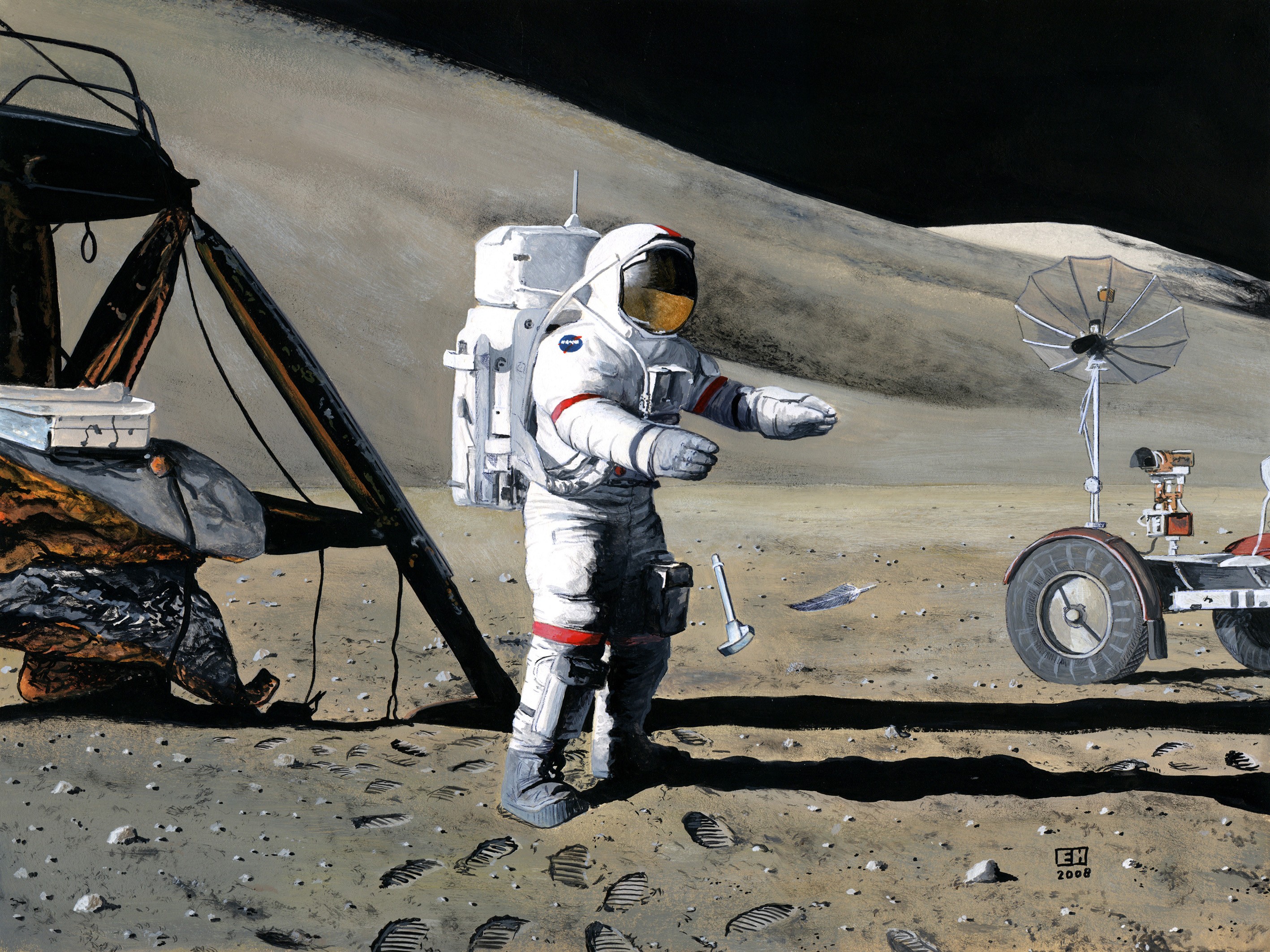
If a feather and a hammer are dropped at the same time on the moon, where there is no atmosphere, which one will hit the ground first?
a)
Neither, there is no gravity on the moon.
b)
hammer because it has more mass
c)
feather because it has less mass
d)
both will hit at the same time
12.
If I double the mass of one object, but don't change anything else... WHat happens to the gravitational force between two objects?
a)
Doubles
b)
Quadruples
c)
Cut in Half
d)
4x Smaller
13.
A car travels 90 meters due north in 15 seconds. Then the car turns around and travels 40 meters due south.  What is the magnitude and direction  of the car's resultant displacement?  
a)
40 metres, South
b)
50 metres, South
c)
50 metres, North
d)
40 metres, North 
14.
Which statement describes a vector?
a)
It has magnitude but no direction
b)
It has direction but no magnitude
c)
It has both direction and magnitude
d)
It has constant magnitude but no
 direction
15.
Is this a scalar quantity or a vector quantity?
Wind blowing at 20 knots
a)
Scalar
b)
Vector
16.
If a boomerang is thrown 20 m in a straight line and returns exactly to the spot it was thrown what is its displacement?
a)
20m
b)
40m
c)
0m
d)
-20m
17.
If a car moves 12 km North, 19 km East, and 12 km South, what is its displacement?
a)
12 km
b)
19 km, East
c)
31 km
d)
43 km, East
18.

A 5 N force is applied to a 3 kg ball to change its velocity from +9 m/s to +3 m/s. The impulse on the ball is ______ N s.

a)

-2.5

b)

-10

c)

-18

d)

-45

19.
A 0.250 kg cart moving at 0.400 m/s has how much momentum?
a)
0.1 kg-m/s
b)
1 kg-m/s
c)
10 kg-m/s
d)
100 kg-m/s
20.
Softer landings tend to
a)
increase impact force
b)
increase force
c)
increase collision time
d)
increase change in momentum
21.
The difference between a car hitting a wall vs. a car hitting a hay stack is
a)
the Impulse on the car hitting the wall is greater
b)
the change in momentum of the car hitting the wall is greater
c)
the force on the car hitting the hay stack is greater
d)
the collision time of the car hitting the hay stack is greater
22.
A runner has a momentum of 670 kg m/s and is travelling at a velocity of 9 m/s. What is his mass?
a)
6030 kg
b)
0.0134 kg
c)
74.4 kg
d)
80 kg
23.

In an isolated system, the net ____ on that system is zero.

a)

external force

b)

internal force

c)

time interval

d)

displacement

24.
Unit of force.
a)
Meter
b)
Centimeter
c)
Newton
25.
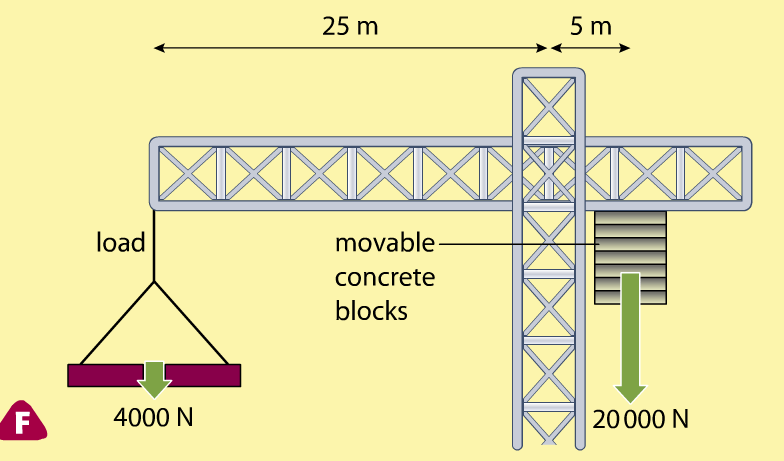
What is the anticlockwise moment acting on this crane?
a)
80,000Nm
b)
100,000Nm
c)
120,000Nm
d)
140,000Nm
26.
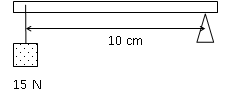
What is the moment produced by the 15 N?
a)
15 Nm (clockwise)
b)
150 Nm (anti - clockwise)
c)
1.5 Nm (anti - clockwise)
d)
0.15 Nm (clockwise)
27.
A seesaw is unbalanced with two people of different masses sitting equal distances from the center. Which of the following will result in equilibrium?
a)
The larger person moving further away from the center.
b)
Moving the smaller person closer to the center.
c)
Moving the smaller person further from the center.
d)
Making the larger person do nothing.
28.

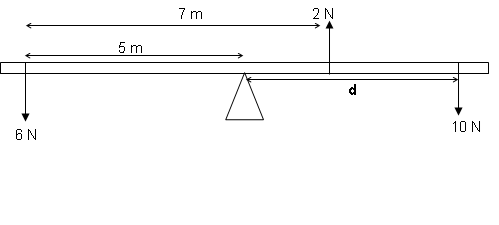
Assuming the system is in equilibrium, calculate the missing distance d

a)

3.4 m

b)

2.8 m

c)

4.4 m

d)

1.6 m

29.

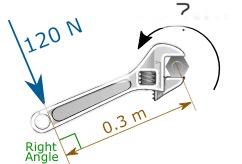
What is the size of the moment shown by the black arrow?

a)

30 Nm

b)

36 Nm

c)

40 Nm

d)

60 Nm

30.

A moment is...

a)

a force measured in Newtons

b)

a turning force measured in newton metres

c)

a distance measured in metres

d)

a time intervals measured in clicks

31.

What are the units for Moment?

a)

N

b)

kgm/s

c)

kN

d)

Nm

32.

What is the resultant turning moment and direction?

a)

20 Nm anticlockwise

b)

30 Nm anticlockwise

c)

10 m clockwise

d)

130N clockwise

33.

State the principle of moments.

a)

When a system is in equilibrium, the sum of the total clockwise moment is equal to the sum of the total anti-clockwise moment about the same pivot.

b)

When a system is in equilibrium, the sum of the total clockwise moment is greater the sum of the total anti-clockwise moment about the same pivot.

c)

When a system is in equilibrium, the sum of the total clockwise moment is less than the sum of the total anti-clockwise moment about the same pivot.

d)

When a system is in equilibrium, the sum of the total clockwise moment is equal to the sum of the total anti-clockwise moment about the different pivot.

34.
Equilibrium means _________
a)
being at rest
b)
traveling at light speed
c)
balance
d)
pushing or pulling
35.
Describe the motion at point a. on the graph.
a)
constant speed
b)
accelerating
c)
decelerating
d)
stationary
36.

When a parachute canopy is opened more drag is created because:

a)

It has a large mass

b)

It has a large surface area

c)

It is travelling at terminal speed

d)

The person is now vertical

37.

Identify true statements:

a)

The parachutist has just left the plane

b)

Weight is increasing

c)

There is no drag

d)

Weight is constant

e)

Deceleration

38.

The graph shows the vertical speed of a parachutist. At which point did they open the parachute?

a)

A

b)

B

c)

C

d)

D

39.

John, of 68kg dives out of an aeroplane

a) What is John's weight

b) What happens to John's weight as he falls?

a)

a) 0.68N

b) stays the same

b)

a) 680N

b) stays the same

c)

a) 680N

b) increases

d)

a) 0.68N

b) decreases

40.

Explain why the skydiver will eventually stop accelerating

a)

The air resistance continues to increase as long as the velocity increases. When the air resistance reaches the same value as the weight there will be no resultant force, hence no acceleration (F=ma)

b)

The air resistance continues to decrease as long as the velocity increases. When the air resistance is larger than the weight there will be no resultant force, hence no acceleration (F=ma)

c)

The air resistance stays the same so the velocity increases. There will be no resultant force, hence no acceleration (F=ma)

d)

The air resistance continues to increase as long as the velocity increases. When the air resistance reaches the same value as the weight there will be an increase in acceleration

41.

Select the description of motion from A - B.

a)

Slowing down away from the origin

b)

Speeding up away from the origin

c)

Constant velocity away from the origin

d)

Constant velocity towards the origin

42.

What segment of the graph shows no motion, or standing still?

a)

A - B

b)

B - C

c)

C - D

d)

None

43.

Describe the motion from B - C.

a)

Standing still

b)

Constant velocity of 60 m/min

c)

Constant velocity of 0 m/min

d)

Accelerating

44.

What kind of line on a P-T graph would create the segment B - C on this V-T graph?

a)

Straight, linear line

b)

Horizontal line

c)

Curved line

d)

Wouldn't happen

45.

What does a horizontal line (not on the x-axis) mean on a V-T graph?

a)

No movement

b)

Constant velocity

c)

Changing velocity

d)

Change in direction

46.
What is the velocity?
a)
positive
b)
negative
c)
decreasing
d)
increasing
47.
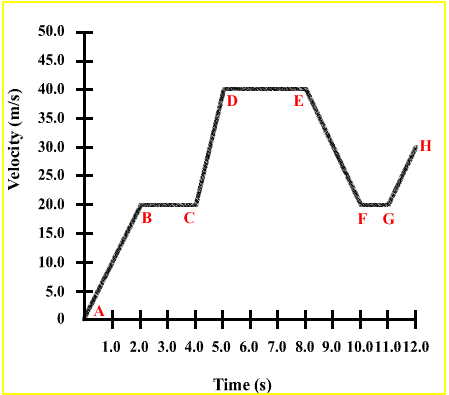
Which section of the graph shows decreasing velocity?
a)
CD
b)
DE
c)
EF
d)
GH
48.
Which section of the graph shows deceleration?
a)
AB
b)
BC
c)
EF
d)
GH
49.
Which section of the graph shows acceleration?
a)
AB
b)
BC
c)
EF
d)
FG
50.

This position vs. time graph shows an object...

a)

not moving

b)

moving with constant velocity

c)

moving with changing velocity

51.

This position vs. time graph shows an object...

a)

not moving

b)

moving with constant velocity

c)

moving with changing velocity

52.

This position vs. time graph shows an object...

a)

not moving

b)

moving with constant velocity

c)

moving with changing velocity

53.

Which of these position vs. time graphs shows an object changing direction?

a)
b)
c)
d)
54.
Hooke's Law describes the behaviour of which kind of material under tension?
a)
plastic
b)
metals only
c)
elastic
d)
non-metals only
55.
If F is force, k is spring constant and x is extension, Hooke's Law tells us that:
a)
F=k/x
b)
x=Fk
c)
k=Fx
d)
F=kx
56.
A graph of extension against force for an elastic material is:
a)
A downward curve
b)
An upward curve
c)
A straight line from any point on the x and y axis
d)
A straight line from the origin
57.
A spring has a spring constant of 5N/cm.  What is its extension when loaded with 15N?
a)
4cm
b)
5cm
c)
3m
d)
3cm
58.
If extension = Stretched length - original length. What is the extension of spring D.
a)
1mm
b)
2mm
c)
3mm
d)
0mm
59.

What is the best description of the relationship shown in this graph?

a)

In this graph, the relationship between force and extension is linear.

b)

In this graph, the relationship between force and extension is non-linear.

c)

In this graph, the relationship between force and extension is directly proportional.

d)

In this graph, there is no relationship between force and extension.

60.

An unstretched spring becomes longer when a force is applied to it. Which word describes the additional length of the spring gains?

a)

Expansion

b)

Extension

c)

Stretched