
 Worksheets
Organization of the Periodic Table and Periodic Trends
Total questions: 55
Worksheet time: 41mins
Vertical columns on the periodic table are called ___?
groups
periods
rows
trends

Which color on the image of the periodic table corresponds with the halogens.
red
black
blue
orange
Which color on the image of the periodic table corresponds with the lanthanides.
red
black
blue
orange
Which color on the image of the periodic table corresponds with the noble gases.
red
black
blue
orange
Which color on the image of the periodic table corresponds with the transition metals.
red
black
blue
orange
Which color on the image of the periodic table corresponds with the metalloids.
bright yellow
gold
teal
light blue
Which color on the image of the periodic table corresponds with the alkaline earth metals.
yellow
black
red
teal
Mendeleev first ordered the periodic table of elements by increasing
atomic number
atomic mass
atomic symbol
atomic weight
Horizontal rows on the periodic table are called ___?
groups
periods
rows
families
Which family of elements reacts violently with water and exposure to oxygen?
alkali metals
alkaline earth metals
lanthanides
actanides
transition metals
Which two families of elements are soft and silvery and have low densities? Choose two answers.
alkali metals
alkaline earth metals
lanthanides
actanides
transition metals
The periodic table is mostly comprised of what type of element?
Metals
Nonmetals
Metalloids
What is the most reactive nonmetal?
Fluorine
Iodine
Chlorine
Bromine
When a halogen such as Chlorine, combines with an alkali metal such as Sodium, NaCl is produced. NaCl is a ______.
base
salt
mineral
acid
Which family of elements does not combine with other elements unless under special conditions in a laboratory?
Noble gases
Halogens
Metalloids
Alkaline earth metals
Actinides
Elements which are shiny, conduct electricity and heat are called
metals
nonmetals
metalloids
noble gases
Which of the following elements is NOT a metal?
Na
Re
Al
B
Which of the following elements is a halogen?
Helium
Chlorine
Oxygen
Silicon
Which of the following elements is an alkali metal?
Magnesium
Iron
Sodium
Europium
Elements in the same ..................have similar chemical properties.
period
group
row
_________________ are found in the outermost shell of an atom and are involved in the formation of chemical bonds.
quarks
neutrons
protons
valence electrons


In the modern periodic table the elements are arranged by:
atomic mass
atomic number
valence electrons
number of isotopes
What are the three main groups of the periodic table? Choose 3 answers!
groups
metal
nonmetals
metalloids
periods
What do the vertical columns (groups/families) on the periodic table tell us?
The number of orbitals/shells
The number of valence electrons (electrons in the outer most shell)
What do the horizontal rows (periods) on the periodic table tell us?
The number of orbitals/shells
The number of valence electrons (the electrons on the outer most shell)

What group and period would this element be found in on the periodic table?
period 1 and group 3
period 3 and group 1
period 2 and group 3
period 3 and group 2

How many valence electrons does this element have?
1
2
3
4

How many orbitals/shells does Nickel have?
3
4
5
10
How many valence electrons and energy levels does (Pb) lead have?
4 valence electrons and 6 energy levels (orbitals)
6 valence electrons and 4 energy levels (orbitals)
5 valence electrons and 5 energy levels (orbitals)
5 valence electrons and 10 energy levels (orbitals)

Which of the following elements has the most similar physical and chemical properties to the element Sulfur (S)?
Carbon (C)
Phosphorous (P)
Oxygen (O)
Neon (Ne

What of the following elements has the most similar physical and chemical properties to the element Bromine (Br)?
Fluorine (F)
Carbon (C)
Krypton (Kr)
Selenium (Se)
What do you call the one or two letter abbreviation derived from the element's English or Latin name?
Atomic Number
Atomic Mass
Chemical Symbol
Atomic Structure
Use your periodic table to find the element that has 5 protons.
Lithium
Calcium
Boron
Neon
How many elements on the periodic table are in the liquid state at room temperature?
1
2
12
28
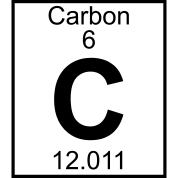
What does the 6 above the symbol C represent?
atomic mass
atomic number
element name
chemical symbol
Which element in Period 2 has the largest atomic radius?
Be
C
Na
Li
Which of the group 13 elements has the largest atomic radius?
B
Tl
Fr
Ga
Of the halogens, which has the smallest atomic radius?
F
Br
He
At
Of the halogens, which has the smallest electronegativity?
F
Cl
At
Ne
Which alkali metal is the least reactive?
Li
Na
H
Fr

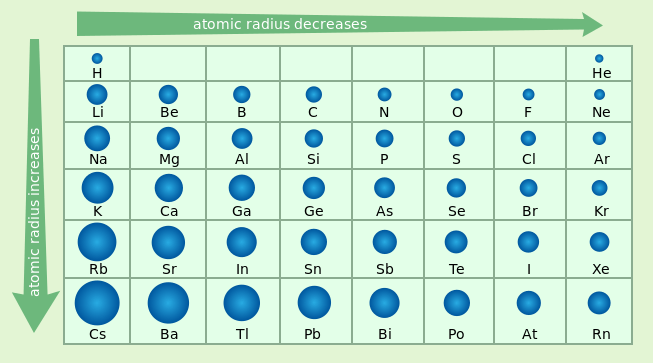

The atom with the largest atomic radius in Group 18 is ____.
Ar
He
Kr
Rn
Ionization energy is...
the energy required to add an electron to a specific atom
the amount of energy required to remove an electron from an atom
the energy required to shield the outer electrons from the nucleus
a measure of the ability of an atom to attract electrons

Which of the following elements has a lower ionization energy than Scandium (Sc)?
Helium (He)
Titanium (Ti)
Calcium (Ca)
Magnesium (Mg)
Electronegativity is...
the ability of atom in a chemical compound to attract electrons
the ability of an atom in a chemical compound to lose electrons
the energy required to remove an electron from a specific atom
the size of the atom

Which of the following elements has a higher electronegativity than arsenic (As)?
Chlorine (Cl)
Neon (Ne)
Antimony (Sb)
Germanium (Ge)
Which statement correctly and completely identifies a trend found on the periodic table?
Atomic radius decreases across a period and increases down a group.
Electronegativity decreases across a period and decreases down a group.
Ionization energy increases across a period and increases down a group.
Ionic radius increases across a period and increases down a group.
Electronegativity __________ from left to right within a period and __________ from top to bottom within a group.
decreases, increases
increases, increases
increases, decreases
stays the same, increases

