
 Worksheets
ESS Exam
Total questions: 210
Worksheet time: 4hrs 14mins
Events such as clearing of land for farming, fires and tornadoes are linked to ________________.
primary primary succession
secondary succession
old field
ecosystem


Which experiences the least change over time?
Pioneer Species
Primary Succession
Aquatic Succession
Climax Community
Which of the following best describes primary succession?
Volcano wipes out ecosystem that gradually grows back from ash covered soil
Volcano creates a new island of rock that must break down to form an ecosystem
Forest fire burns down forest that must bounce back over time
Tornado destroys a crop that must slowly grow back over time.


At which trophic level can you find an herbivore?
1st Level
2nd Level
3rd Level
4th Level


Which of the following processes removes carbon from the atmosphere?
Plant Respiration
Auto and factory emissions
Photosynthesis
Animal Respiration

Which biome covers most of the land mass near Earth's equator?
Desert
Grassland
Tropical rainforest
Temperate forest

The rain forest soil is
poor and rocky
frozen soil
thick and nutrient rich
thin and nutrient poor

__________ primary productivity is the total amount of energy that producers convert to chemical energy in organic molecules per unit of time.
Net
Total
Gross
Secondary
During the process of ecological succession the changes that take place in communities are
Orderly and sequential
Random
Very quick
Not influenced by the physical environment
Which of the following statements is correct?
Tropical rainforests are hot and wet because they are permanently under the influence of the rising limb of the Hadley cell.
Deserts are always dry because they are under the falling limb of the Hadley cell.
Polar regions are always cold because they receive little solar radiation.
All the statements are correct.
Which of the following statements about the tri-cellular model is correct?
The Hadley cell and the Ferrel cell are thermally driven.
Only the Hadley cell is thermally driven.
The Hadley cell and the Polar cell are thermally driven.
Only the Polar cell is thermally driven.

Which of the three stations, A, B, or C is most likely to be a desert location?
A
B
C
Which statement describes the impact(s) of climate change on biome distribution?
Biomes move to lower latitudes.
Mangrove swamps will expand.
Biomes move to higher altitude.
Corals reefs will benefit from warmer water.
Species richness is
the number of species in a population
the number of species in a community
the function of the number of species and their relative abundance
the frequency of the number of species
What converts nitrogen gas into a usable form for plants and animals?
bacteria
rain
fungi
car exhaust
How is nitrogen "fixed" into a usable form for plants?
Through action of bacteria only
Through lightning only
Through action of bacteria and lightning
Through photosynthesis
How do animals get the nitrogen they need?
From the air they breathe
From the water they drink
From the food they eat
From the sun
Gas that makes up 78% of our atmosphere.
Oxygen
Nitrogen
Hydrogen
Carbon Dioxide
What is the process of combining nitrogen gas with other elements to make nitrogen into usable compounds?
nitrogen composition
nitrogen fixation
ammonia
denitrification
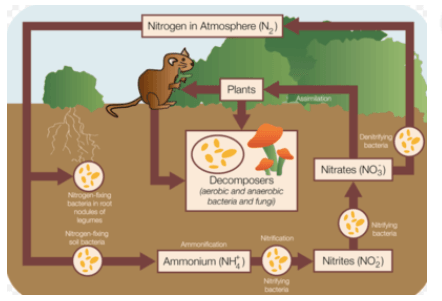
A correct path that nitrogen could take would be
air -> animals -> plants -> bacteria
animals -> air -> bacteria -> plants
bacteria -> air -> plants -> animals
air -> bacteria -> plants -> animals
In the carbon cycle, animals can release carbon back into the cycle through __________ or through __________.
burning . . . photosynthesis
fixation . . . decomposition
decomposition . . . photosynthesis
respiration . . . decomposition
respiration . . . photosynthesis
Which of the following is an example of human impact on the carbon cycle?
The increased production of methane gases from cattle farms
The burning of fossil fuels
The cutting down of trees for lumber
Driving automobiles
All of the above
An organism that tends to have a low life expectancy and increased birth rate is known as a
k-strategist.
r-strategist.
An organism that tends to have a high life expectancy and takes care of their offspring longer is known as a
k-strategist.
r-strategist.
_____ have a high reproductive rates, short-life spans, and do not care for their offspring.
R-strategists
K-strategists
B strategists
Z-Strategists
Species that are able to in survive hostile environments. Usually autotrophs, these species are the first to colonize areas. Their niche is to create new ecological niches for other species.
pioneer
self-perpetuating
intermediate
community
These organisms typically live in unstable, unpredictable environments & are able to reproduce rapidly (exponentially). They do not take care of their young & are subject to predation.
k-strategist
r-strategist
m-strategist
s-strategist

Look at this image- What is the carrying capacity of this population?
21
5000
2000
1000

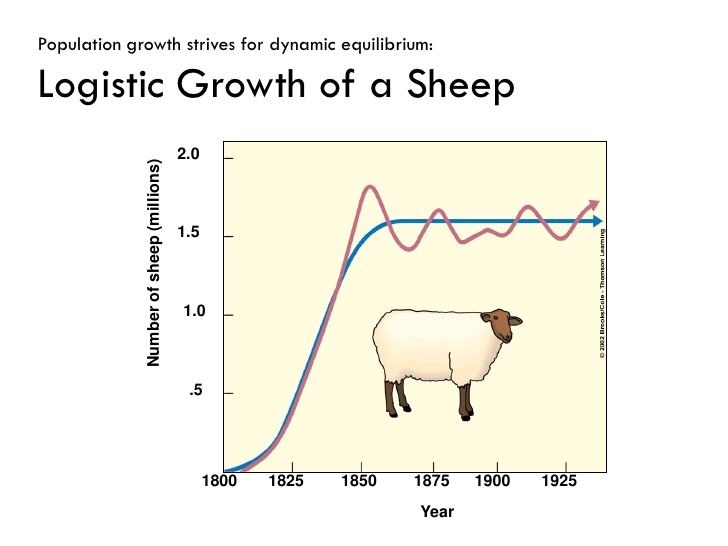

Exponential population growth can be described as
growth when resources are limited
a j-shaped curve
a s-shaped curve
growth that reaches carrying capacity


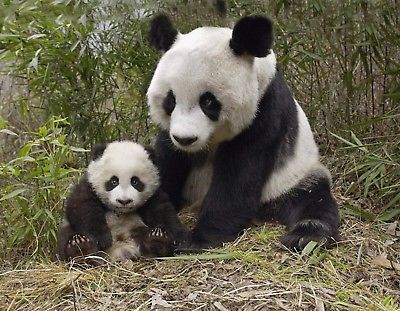
Animals such as pandas are long lived, mature slowly, and generally produce fewer offspring during their life spans but place a greater investment in each. What term is applied to this type of reproductive strategy?
K-strategy
r-strategy
As a population of a species increases within a territory, which of the following most likely also increases?
Immigration
Food supply
Carrying capacity
Competition

Predator population lags behind prey population because......
Increase in predators leads to decrease in prey
Increase in predators leads to increase in prey
Increase in predators leads to decrease in producers
Increase in producers leads to increase in prey
Two organisms that are so similar they can interbreed in nature and produce fertile offspring.
biotic factor
herbivore
ecosystem
species
A cuckoo and a warbler are both birds. A cuckoo will find the nest of warbler instead of building her own, and she harms the warbler by knocking a warbler egg out of nest and laying her own. When the warbler mother returns, she isn’t aware of the switch. The warbler will then raise the baby cuckoo bird instead of her own baby. Which term best describes this relationship?
Predation
Parasitism
Commensalism
Mutualism

The ecological role an organism performs in their specific environment is considered the organism's...
Habitat
Population
Biome
Niche
a relationship between two species in which both species compete for limited resources such that both species are negatively affected by the relationship
Symbiosis
interspecific competition
species richness
species-area effect
A relationship in which two different organisms live in close association with each other
interspecific competition
Mutualism
Symbiosis
Commensalism
the differentiation of niches that enables similar species to coexist in a community
character displacement
climax community
resource partitioning
pioneer species


Which animal is the top of this food web?
mosquito
alligator
frog
raccoon
Only about ten percent of the energy stored in an organism can be passed on to the next trophic level. Of the remaining energy, some is used for the organism’s life processes, and the rest is typically...
used in reproduction
stored as body fat
stored as body tissues
converted to heat and lost

Changes in a community along a factor such as altitude
Succession
Zonation
Insolation
Latitude
The progressive increase in the amount of a chemical or substance in an organism
biomass
bioaccumulation
biomagnification
eutrophication
The concentrating of pollutants at successive levels of the food chain
photosynthesis
eutrophication
bioaccumulation
biomagnification
DDT, PBB, Mercury all accumulate and bio-magnify without deteriorating in the environment over time. These are called....
PCBs
Dioxins
Persistent Organic Pollutants
DOT's
Which substance originally designed to eliminate mosquitos was banned as a result of the death of many birds?
Nuclear Waste
DDT
CFCs
Plastic
Which are common environmental value systems? Select all that apply
Concentric
Anthropocentric
Heliocentric
Ecocentric
What are some of the things that influence an individuals EVS?
The cost of fuel
Religious beliefs
Family influence
What kind of house you own
Which term means that matter or energy move around without changing?
Transfer
Transformation
Which system most closely represents real systems
Closed system
Isolated system
Idealised system
Open system
Which tool is used to assess sustainability?
Simpson's Index
Ecological Footprint
Zonation patterns
Carbon use
What is the Ecological footprint?
Hypothetical area of land that a human uses every day
Hypothetical area of land to support waste assimilation and food production
The hypothetical area of land required to support each person's resource needs
The hypothetical area of land l to support their resource needs and assimilate all waste
Which environmental disaster released Methyl Mercury into the water system?
Bhopal
Chernobyl
Minimata
Fukushima
A set of interrelated parts working together to make a complex whole is called ____.
the surroundings
the system
inputs
outputs

Letter A represents a(n) ___.
output
input
process
store
___ only exchange energy with their surroundings.
Open systems
Closed systems
Isolated systems
A ________________ feedback loop makes a system more stable.
Positive
Neutral
Negative
Circular
A _________________ feedback loop moves a system to an extreme.
Positive
Neutral
Circular
Negative
Polar Ice Caps are melting due to an increase in Earth's temperature. This lowers the albedo of Earth, which in turn increases Earth's temperature. This is an example of what type of feedback?
Negative
Neutral
Positive
Ecosystem
Which countries will tend to have a lower ecological footprint?
MEDCs
LEDCs
When does an ecological footprint show unsustainability?
When the ecological footprint is greater than the area available to the population.
An ecological footprint cannot show unsustainability.
When the ecological footprint is smaller than the area available to the population.
When the value of the ecological footprint is greater than 50.
An Environmental Impact Assessment (EIA) is a detailed study undertaken prior to a development project. What does an EIA include?
An assessment of environmental, social and economic impacts of the development project, as well as proposals for mitigation of the possible negative effects.
A valuation of the development project providing guidance on budget planning to the contractors.
An assessment of the environmental impact of the development project with particular emphasis on the possible losses of biodiversity in the given area.
An outline of the positive effects that the development project can have for the local community.
What is natural capital?
A store of natural resources that can produce a sustainable source of goods and services.
Goods or services obtained by proper management of the Earth’s natural resources.
Total area of land required to maintain food production for the growing human population.
Total area of land required to assimilate waste produced by the growing human population.
With the rapidly growing human population and constant new pressures on the environment it gradually becomes more difficult to maintain sustainability. Choose the sentence which best explains what sustainability is.
The exploitation of resources at such rate which allows for their natural replenishment and the recovery of the ecosystem affected by their use.
The maximum population size that an area can support without detrimental effects.
Engaging in the prevention of negative effects of human activities on the Earth’s resources through localised actions (recycling of waste, reduction in electricity consumption etc.).
The area of land needed to provide all of the resources for a person’s lifestyle and to dispose of all their wastes.

_______ happens when fertilizers, animal waste, sewage or other substances rich in nitrogen and phosphorus are lost into waterways causing excessive algae growth.
Eutrophication
Introduced species
Biological Augmentation
Nonrenewable Resource

Species that are only found in a specific geographic area are _______.
Introduced species
Local species
Endemic
Biodiversity hot spot


the breaking of habitats into smaller pieces is called...
habitat division
habitat pollution
habitat corruption
habitat fragmentation

The Convention on International Trade in Endangered Species of Wild Fauna and Flora (CITES) and the Convention on Biological Diversity are examples of
organizations that promote poaching.
international organisation on climate change.
international treaties to protect biodiversity.
laws to increase the number of species

Biologists put extra effort into protecting these because they contain ~60% of the world's species
National parks
Biodiversity Hotspots
Tropical rainforests
Conservation stations

The species that plays a critical role in maintaining the ecosystem structure is?
Flagship species
Umbrella species
Keystone Species
Leading species

Which term refers to the process by which individuals that are better suited to the environment survive and reproduce therefore passing down their genes to their offspring?
Evolution
Variation
Adaptation
Natural Selection

The 3 different types of biodiversity (in IB ESS) are;
Genes, Species, Habitats
Genes, Species, Ecosystems
Species, Habitats, Communities
Biosphere, Genes, Habitats

What is the name of a common biodiversity index?
Living
Carr
Elton
Simpson

What is THE most major cause of extinction today?
habitat destruction by humans
poaching
disease
hunting

Costa Rica set aside over ¼ of its land area for national parks and biological preserves. What method of preserving biodiversity does this best illustrate?
Botanical Gardens and Seed Banks
Habitat Approach
Biodiversity Hotspot Focus
Captive Breeding
Which of the following makes a species prone to extinction?
Select ALL that apply
Narrow geographical range,
Narrow niche, specific requirements for habitat
Large gene pool
large body, small population size
Why do regions of high geographic relief (elevation differences) often also have higher biodiversity than flat areas?
There are more places to hide
More available sunlight
They often comprise more than one type of habitat
From the base of a mountain to the peak, it generally is a pioneer community
Intergovernmental organizations are...
funded privately
responsible for local conservation
are single country based with business and non profits funding it
international organizations
Identify some of the beneficial traits of an Non-Governmental Organization. (Select all that apply.)
Can act fast, do not require votes and legislation
Advertise on popular media through donations
Funded by the national budget through everyone's taxes
Implement international treaties
What major impact can fragmentation of habitat have on an endangered species?
It tends to make food resources scarce for the existing population
It results in large migrations of organisms out of their typical habitat
It tends to increase the likelihood of invasive species due to lack of space
It tends to lead to a lower genetic diversity due to isolation
Which of the following represents an ecosystem with high species abundance, but low species diversity?
An island with many rare birds and insects
An old growth forest and its inhabitants
A farm field with thousands of sunflowers
A grassland with various grasses and flowers

Look at the diagram about two possible shapes of protected areas. Which one is better?
A
B

Using the graph below which statement is correct.
Swamps and marshes, estuaries and tropical rainforests have an NPP of 9,000 kilocalories m-2 yr-1.
Boreal and deciduous temperate forests have a NPP range of 3,500 - 6,000 kilocalories m-2 yr-1.
Grasslands have an NPP of 2,000 kilocalories m-2 yr-1.
All of the responses are correct.
If gross primary productivity in a wetland is 3 kg C/m^2/year and respiration is 1.5 kg C/m^2/year, what is the net primary productivity of the wetland?
Impossible to determine from the given information
3 kg C/m^2/year
1.5 kg C/m^2/year
2 kg C/m^2/year
4.5 kg C/m^2/year
The average efficiency of energy transfer between trophic levels is approximately
1 percent
4 percent
40 percent
50 percent
10 percent
What is an example of an area that is likely to undergo primary succession?
Glaciers melt and leave exposed rock
Plants die from drought and decompose
Land is bulldozed and soil remains
Which of the following is the correct order of ecological succession?
grass - shrubs - lichens - trees
lichens - shrubs - grasses - trees
lichens - grasses - shrubs - trees
grasses - lichens - shrubs - trees

In general, as you move from the equator to the poles, what happens to biodiversity>
Increases
Decreases
Remains the same

Why is biodiversity in an ecosystem so important?
Because it can help humans where to determine good places to increase development of natural income.
Because places that have a healthy biodiversity are unaffected by major disturbances.
High biodiversity increases resilience to withstand major changes and tipping points
Because having a high biodiversity allows for fewer opportunities of competition for similar resources.
When energy or matter flows and changes location but does NOT change its state (matter) or type (energy), this is called a(n) ____.
transfer
transformation
process
output
The majority of all systems in nature are ___.
open systems
closed systems
isolated systems
stores
___ exchange matter and energy with their surroundings.
Open systems
Closed systems
Isolated systems
Who wrote the book Silent Spring, considered by many to have been key in the banning of DDT and the formation of the US Environmental Protection Agency?
(a)
What term would be used to denote the value something has because it exists, rather than due to what it does or how it can be used by humans?
(a)
Which EVS would argue that humans must sustainably manage the global system through taxes, regulation and legislation.
(a)
Which EVS would prioritise biorights and emphasise local level solutions based on self-restraint and education.
(a)
Which of the following positions could be consistent with an ecocentric worldview?
Deep ecologists
Cornucopian
Biocentrists
Stewardship
Self-sufficiency
The use of genetically modified organisms in agriculture would suggest which viewpoint?
Technocentric
Ecocentric
Anthropocentric
Educational campaigning to reduce meat consumption would suggest which viewpoint?
Technocentric
Ecocentric
Anthropocentric
Legislation to impose fishing quotas would suggest which viewpoint?
Technocentric
Ecocentric
Anthropocentric
Density-dependent factors, such as contagious disease or parasites, act as a ____________ feedback mechanism by bringing the population size back to equilibrium.
Positive
Negative
Neutral
Approximately how much of the solar energy that falls on the leaves of a plant is converted to chemical energy by photosynthesis?
Less than 1%
2-10%
30%
50%

What is this picture describing?
It is describing how two organisms cannot occupy the same niche in the same place at the same time through the competitive exclusion principle.
It is illustrating the intercompetitive inclusion principle.
It is describing the amount of time it takes for bacteria to reach exponential growth.
It is illustrating the mutualistic relationship between two organisms when they live in the same niche.
Which law of thermodynamics explains the shape of an ecological pyramid of energy?
1st law
2nd law
3rd law
Select the inputs to photosynthesis.
CO2
H2O
Glucose
O2
Sunlight

Which of the following is the correct formula for respiration?
R=NPP + GPP
R=NPP-GPP
R=GPP-NPP
R=GPP/NPP
The GPP of a certain producer is 5,000 gC/m2yr and the NPP is 4,000 gC/m2yr. What is the repsiratory energy needed by the autotrophs?
cannot be determined from the information given
1,000 gC/m2yr
9,000 gC/m2yr
-1,000 gC/m2yr
Which of the following are stores in the Carbon Cycle?
soil
oceans
organisms
fossil fuels
atmosphere

In some developing countries poverty causes illness and contributes to poor standards of education. In the absence of knowledge of family planning methods and hygiene, this contributes to population growth and illness, adding further to the causes of poverty; “a vicious circle of poverty.”
Positive Feedback
Negative Feedback

What is the best description for this image
static equilibrium
steady state equilibrium
tipping point
unstable equilibrium

A tipping point is part of a system that kick starts self-perpetuating positive feedback loops that push the systems to a new state of equilibrium. If tipping points are reached in the natural environment, which one of the following could happen?
The climate may become unsuitable for human existence.
Land and seas’ food production capacity could be compromised as coral reefs disappear
Complete community changes in the Arctic
All of the above are possible impacts if tipping points are reached in the natural environment

After random sampling, 200 penguins are captured, tagged and released. A month later, 180 untagged and 20 tagged penguins are captured. Use the Lincoln Index to estimate the total penguin population.
200
1000
1500
2000

After random sampling, 500 piranha are captured, tagged and released from an aquarium. A month later, 10 piranha of which 2 are tagged are captured. Use the Lincoln Index to estimate the total population of piranhas.
4500
3000
2500
1500

Calculate the Diversity Index Number
Species #
A 40
B 20
C 15
D 8
E 22
.5
1.5
4.09
5.1
GPP - R
This formula calculates what?
Trophic Levels- how many species can be found at each
NPP- overall efficiency of the plants in the ecosystem (energy passed on)
Amount of energy available to all Apex Predators and Decomposers
None of the above

According to the graph, what is causing the deer population to decrease
They got sick
The wolf population is decreasing
The wolf population increased
They ran out of food
in 1995 Wolves were reintroduced to Yellowstone National Park. Which answer below most accurately describes a possible trophic cascade the could result from the reintroduction of wolves?
wolves reintroduced-> deer population increased -> tree and vegetation cover decreased
wolves reintroduced-> beaver population decreased -> tree and vegetation cover increased
wolves reintroduced-> deer population decreased -> tree and vegetation cover increased -> beaver population increased
wolves reintroduced-> deer population decreased -> beaver population decreased -> songbird population increased

Which is true of the location above?
It has low species richness
It has low species evenness
It has high species evenness
It has both low species evenness and richness
None of these

the portion of niche fulfilled due to competition or other species interactions
realized niche
fundamental niche
ecological niche
niche niche
pizza pizza
An example of a K-strategist (-selected) species is
a cockroach
a housefly
a rabbit
an elephant
none of these
An example of a r-strategist (-selected) species is
an elephant
a human
a whale
an eagle
a dandelion

This community has
low species richness
high species evenness
an unequal distribution of species
no biodiversity
none of these

full potential range of conditions if there were no competition
realized niche
fundamental niche
ecological niche
niche niche
pizza pizza
What biome has grasses and scattered trees, lions, hyenas, giraffes, and zebras, hot, rainy summers, and cool, dry winters?
Desert
Temperate forest
Tropical rainforest
Savanna

Estimate the carrying capacity.
100 deer
80 deer
60 deer
40 deer
What does the term carrying capacity describe?
The maximum number of birth rates for a population.
The ability of a population to accept new immigrants.
The ratio of birth rates to death rates in a population.
The population size that the environment can sustain.
There is strong evidence that two species of
cliff-dwelling birds have nested in the same
environment and fed in the same water for
thousands of years, with each having stable
population sizes. Based on this information,
which of the following statements is the best
conclusion?
The two birds compete for food.
One species will displace the other.
The two birds have different ecological niches that allow coexistence.
One species eats a more diverse diet than the other does.

According to biologists, what percentage of species have become or are expected to become extinct between 1900 and 2100?
1%
10%
25%
60%

Students in a science class visited four local ecosystems. The students observed the species present in each ecosystem and recorded their observations in the table.
Based on these observations, which ecosystem is likely to be the LEAST sustainable?
A. Ecosystem 1, because it has the fewest species.
B. Ecosystem 2, because it includes both aquatic and terrestrial species.
C. Ecosystem 3, because it has few predators.
D. Ecosystem 4, because it supports many animals.
Primary succession occurs when pioneer species move into an area that has no plants. Which organisms are common pioneer species?
A. Conifer trees and tall grasses with roots that loosen the soil
B. Mosses and lichens that can grow on rocky surfaces.
C. Grasses and weeds that arrive as seeds carried by the wind and then germinate in rich soil.
D. Vines and shrubs that help prevent the erosion of shallow soil.


According to this diagram, plants use nitrogen to make ________
bacteria
proteins
animals
decomposers
Which nitrogen cycle process is occurring when plant roots absorb ammonium ions and nitrate ions for use in making molecules such as DNA, amino acids, and proteins?
nitrogen fixation
nitrification
denitrification
ammonification
assimilation
Which nitrogen cycle process is occurring when bacteria convert ammonium to nitrite and then into nitrate?
nitrogen fixation
nitrification
denitrification
ammonification
assimilation
Which of these nitrogen cycle processes converts atmospheric nitrogen to a soil form of nitrogen that is usable by plants?
nitrogen fixation
nitrification
denitrification
ammonification
assimilation


What is the main reservoir of nitrogen?
Water bodies
Plants
Atmosphere
Soil

The climatograph in the picture provided most likely belongs to which of the following biomes
temperate deciduous forest
tundra
taiga
tropical rain forest
Ecological Footprint is measured in:
Kilowatts
Carbon Units
Global Hectares
Square Miles
The capacity of ecosystems to regenerate what people demand from those surfaces.
Sustainability
Ecological Footprint
Global Hectares
Biocapacity
If a country has a Ecological Reserve, that means it
has a Higher Ecological Footprint than Biocapacity
is not living sustainably within its country's limits
Has a higher Biocapacity than Ecological Footprint
Also has an Ecological Deficit
If a country has an Ecological Deficit that mean it
is living sustainably
Has lots of forests
has a higher Biocapacity than Ecological Footprint
has a higher Ecological Footprint than Biodiversity
All the available resources and services that are available in the environment.
Natural Capital
Renewable Resources
Environmental Capacity
Carrying Capacity
What is a biodiversity hotspot?
an area with high biodiversity, and low Simpson scale index scores
an area with low biodiversity, extinction rate & endemism
an area with low biodiversity, but high endemism
an area with high biodiversity and large numbers of endemic species, yet is threatened
Which of the following examples would result in an inversion of a pyramid of numbers?
a tree with thousands of spiders
a forest of trees with a small herd of deer
a tree with a spotted owl
a forest of trees with a pack of wolves
What is biomass?
the total dry weight of organisms in an ecosystem
the total weight of organisms in an ecosystem
the total dry weight of producers in an ecosystem
the total weight of animals in an ecosystem
If only 10% of an organism's energy is available for the next trophic level, what happens with the other 90% of the energy?
It is destroyed after it is used up
It is used for life processes like movement, creating offspring producing waste or lost as body heat
It is used to grow plants
It is lost completely as body heat
When you consume an organism, you only receive 10% of the energy, but how much of the toxins do you receive?
All of the toxins
10% toxins
1% toxins
None of the toxins
Which of the following statements defines a pyramid of productivity?
A graphical representation of the amount of energy that is generated and available as food for the next trophic level. Expressed as a whole number.
A graphical representation of the amount of energy that is generated and available as food for the next trophic level. Expressed as J m-2 yr-1.
A graphical representation of the amount of energy that is generated and available as food for the next trophic level. Expressed as J m-2.
All of the statements given here can be used to define a pyramid of productivity.
What do you call the process in which there is an increase in the concentration of a pollutant in an organism as it absorbs or ingests it from its environment.
Bioaccumulation
Biology
Biomagnification
Biodiversity
What do you call the increase in the concentration of the pollutant as it moves up through the food chain
Bioaccumulation
Biology
Biomagnification
Biodiversity
Which of the following statement(s) is an accurate fact about DDT?
DDT is a POP.
It is fat soluble and therefore does not leave the body through urination or sweating.
Was and is sometimes still used for malaria control
All these statements are facts about DDT.

