Wayground logo

Free Printable Worksheets

Font size

S
M
L
XL
Worksheets

Intro to Waves Quiz

Total questions: 40

Worksheet time: 2hrs 0mins

Name
Class
Date
1.

Mei knows the wavelength and the frequency of a wave. How will she use this information to calculate the speed of the wave?

a)

Add frequency and wavelength.

b)

Divide frequency by wavelength.

c)

Divide wavelength by frequency.

d)

Multiply wavelength and frequency.

2.

All mechanical waves have which of the following in common?

a)

Mechanical waves are transverse.

b)

Mechanical waves are longitudinal.

c)

Mechanical waves do not require a medium to move.

d)

Mechanical waves must progress through a medium.

3.

A loud motorcycle passes by the front of Bill's house. What medium does the sound wave travel through to get from the motorcycle to Bill's ears?

a)

air

b)

energy

c)

a vacuum

d)

large vibrations

4.

Which of the following statements applies to a longitudinal wave?

a)

The motion of the medium is random.

b)

The motion of the medium is in a circular pattern.

c)

The motion of the medium is parallel to the motion of the wave.

d)

The motion of the medium is perpendicular to the motion of the wave.
5.
The highest point on a wave is:
a)
the crest
b)
the trough
c)
the top
d)
the coast 
6.
The lowest point on a wave is the:
a)
Amplitude
b)
Crest
c)
Trough
d)
Wavelength
7.
The number of wavelengths that pass a point each per second is:
a)
frequency
b)
period
c)
longitudinal 
d)
transverse wave 
8.
The type of waves that require medium to pass:
a)
Mechanical Waves
b)
Electromagnetic Waves
9.
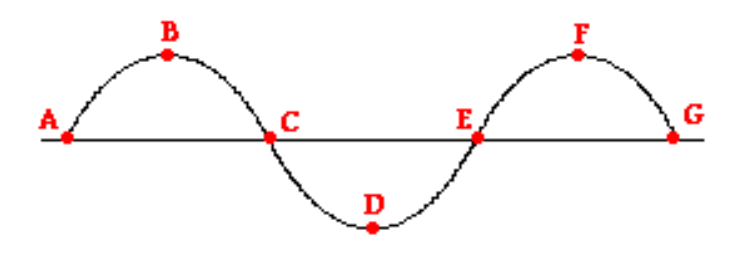
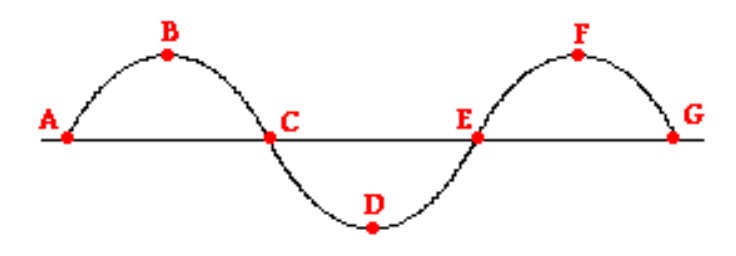
Which letter(s) represent the trough of the wave?
a)
A
b)
B & D
c)
D
d)
C & G
10.

Which letter(s) represent the crest of the wave?

a)

A

b)

B & D

c)

B & F

d)

F

11.
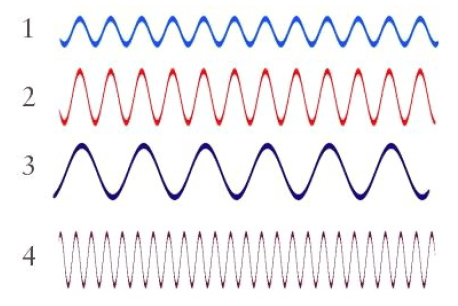
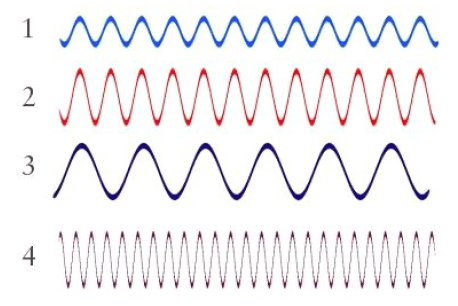
Which wave in the diagram has the greatest frequency?
a)
1
b)
2
c)
3
d)
4
12.
Which wave in the diagram has the greatest wavelength?
a)
1
b)
2
c)
3
d)
4
13.
In a longitudinal wave, the particles move...?
a)
back and forth
b)
up and down
c)
not at all
d)
at a 90 degree angle
14.
The units for frequency are measured in _____________.
a)
hertz
b)
seconds
c)
m/s
d)
grams
15.
Waves that require a medium are called 
a)
mechanical waves
b)
transverse waves
c)
light waves
d)
gamma rays
16.
What kind of wave moves at right angles to the direction of the wave?
a)
compressional waves
b)
mechanical waves
c)
transverse waves
d)
ultraviolet rays
17.

What do we call the part of a longitudinal (aka, compressional) wave that is when the waves are squeezed together?

a)

compression

b)

rarefaction

c)

crest

d)

trough

18.

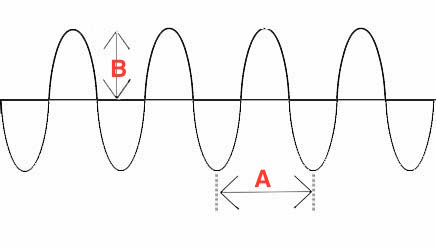
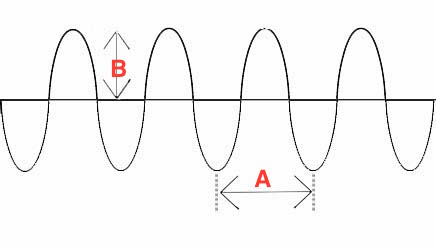
What property of this wave is represented by the letter "A"

a)

amplitude

b)

crest

c)

trough

d)

wavelength

19.
What property of the wave is represented by the letter "B"?
a)
amplitude
b)
crest
c)
trough
d)
wavelength
20.
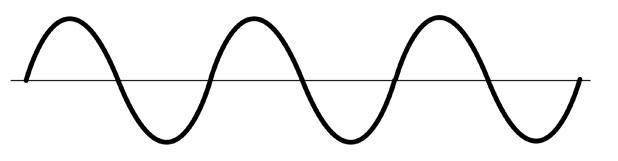
Which wave has a greater frequency?
a)
A
b)
B
21.
Energy of motion is which type of energy?
a)
Potential
b)
Kinetic
c)
Sound
d)
Gravitational
22.

True or False: Sound can travel through a vacuum (space).

a)

True

b)

False

23.
True or False: Sound travels better through solids than through liquids
a)
True 
b)
False
24.
How does a sound wave interact with a human ear?
a)
vibrates the ear drum
b)
bounces off the ear canal
c)
rotates the ear drum
d)
vibrates the ear canal
25.
______________ is the amount of energy in a sound wave.
a)
Amplitude
b)
Echo
c)
Volume
d)
Vibration
26.

Why does sound travel faster in solids than in liquids or gases.

a)

They are harder.

b)

The particles are closer together.

c)

Solids have more energy.

d)

Gases fill their container.

27.
Matter that carries sound waves is called a _________
a)
low
b)
high
c)
medium
d)
surface
28.

The ______ of a sound depends on the medium through which it's moving.

a)

pitch

b)

vibration

c)

speed

d)

loudness

29.

Amplitude affects which characteristic of sound waves?

a)

frequency

b)

pitch

c)

loudness

d)

wave speed

30.
What is vibration?
a)
how loud a sound is
b)
the back and forth movement of matter
c)
how high or low a sound is
d)
the loudness or softness of a sound
31.
What is frequency?
a)
the number of vibrations per second
b)
how high or low a sound is
c)
the loudness or softness of a sound
d)
the back and forth movement of matter
32.
Area of a longitudinal wave where particles are CLOSE together.
a)
Compression
b)
Rarefaction
33.
Area of a longitudinal wave where particles are APART. 
a)
Compression
b)
Rarefaction
34.

A wave has a wavelength of 25 m and a frequency of 2 Hz. What is the speed of the wave? (V = λf)

a)

4 m/s

b)

10 m/s

c)

50 m/s

d)

100 m/s

35.

The unit for frequency is the ___________.

a)

Hertz (Hz)

b)

meter (m)

c)

meter per second (m/s)

36.

The unit for velocity (speed) is ________.

a)

Hertz (Hz)

b)

meters per second (m/s)

c)

Meter (m)

37.

λ is the symbol for what?

a)

velocity

b)

wavelength

c)

distance

d)

IHOP

38.

The two main types of waves are ____________________ waves and ____________________ waves.

(a)  

39.

Check all boxes that apply. The two types of MECHANICAL waves we've discussed are __________________ and ___________________ .

a)

Transverse waves

b)

Longitudinal waves

c)

Waves in Hair

d)

Light waves

40.

The ____________________ determines the speed of a wave.

a)

medium

b)

amplitude

c)

frequency

d)

wavelength