
 Worksheets
AS level Biology Paper 1
Total questions: 40
Worksheet time: 1hrs 20mins

Which statements about the effect of all enzyme inhibitors are correct?
1, 2, and 3
1 and 2 only
1 and 3 only
3 only

The graphs show the rate of reaction of an enzyme-catalyzed reaction.
Which graph shows the effect of increasing the concentration of the substrate at two different concentrations of a competitive inhibitor?


Which statements are true about the optimum temperature of all enzymes?
1, 2 and 3
2 and 3 only
1 only
3 only

Some inhibitors of enzyme reactions bind to the enzyme-substrate complex.
Which statements about this type of inhibition are correct?
2, 3 and 4
1 and 2
1 and 3
2 and 3 only
The enzyme DNA polymerase is used in DNA replication. This enzyme was extracted from bacteria living in natural hot water springs where the water temperature is between 85 °C and 95 °C.
Which graph would represent the relationship between temperature and the rate of DNA replication when catalyzed by the enzyme from these bacteria?


Which row about competitive inhibitors of enzymes is correct?
A
B
C
D

In two investigations, the rate of an enzyme-catalysed reaction was measured in the presence of
either a competitive inhibitor or a non-competitive inhibitor.
What could be the effect of increasing the substrate concentration on each rate of reaction?
A
B
C
D
Two enzymes, X and Y, were used in an experiment. Enzyme X was from bacteria that live in rivers and lakes at temperatures from 5 °C to 20 °C. Enzyme Y was from bacteria that live in hot water springs at temperatures from 40 °C to 85 °C.
The experiment measured the concentration of product produced by each enzyme at temperatures between 0 °C and 100 °C after 5 minutes.
Which graph shows the results?


Which statement is only true for the induced fit theory of enzyme action?
A few amino acids give the active site a specific shape.
An enzyme has a substrate with a specific shape.
The enzyme changes shape in the presence of the substrate.
The substrate molecules are complementary to the active site.

The effect of substrate concentration on an enzyme-catalyzed reaction was measured in three different conditions:
● with no inhibitor
● with inhibitor X
● with inhibitor Y.
The graph shows the results.
Which statement is correct?
X is a competitive inhibitor which binds away from the active site of the enzyme.
X is a non-competitive inhibitor which has a similar shape to the substrate.
Y is a competitive inhibitor which has a similar shape to the substrate.
Y is a non-competitive inhibitor which binds away from the active site of the enzyme.
How is the Michaelis-Menten constant (Km) used?
to assess the efficiency of an enzyme in catalysing a reaction
to compare the affinity of enzymes for their substrate
to find the maximum velocity of an enzyme (Vmax)
to find the rate at which substrate is loaded by an enzyme

The graph shows energy changes in a chemical reaction.
What is the activation energy when an enzyme is added?
1 + 2
2 only
3 - 2
4

The graph compares the effect of temperature on the activity of the protease enzyme, papain, when in solution (free) and when immobilized in alginate beads.
Which statement about the effect of immobilization of papain is correct?
It alters the shape of papain’s active site at higher temperatures.
It decreases the activity of papain at higher temperatures.
It increases the stability of papain at higher temperatures.
It reduces the number of collisions of papain with the substrate.
A student investigated the hydrolysis of the lipid in high-fat milk, using the enzyme lipase.
1 cm3 of enzyme solution was added to 10 cm3 of high-fat milk. The temperature was kept constant. The pH of the reaction mixture was recorded at time 0 minutes and every minute for 20 minutes.
Which statement could be supported by the results of the investigation?
Less product is made as time proceeds because the substrate is decreasing.
The pH of the reaction mixture changes less rapidly in the first few minutes and then changes more rapidly.
More product is made as time proceeds because the substrate is decreasing.
The pH of the reaction mixture changes at a constant rate.

A student carried out an investigation into the effect of temperature on the rate of an enzyme-catalyzed reaction.
At each temperature, the substrate concentration was measured after 10 minutes. All the other variables were kept constant.
The student obtains the graph shown.
What is plotted on the y-axis?
substrate concentration
product concentration
enzyme concentration
inhibitor concentration

The graph shows how the rate of an enzyme-catalyzed reaction depends on the concentration of substrate.
What is the Michaelis-Menten constant (Km) for this enzyme under these conditions?
0.19 mmol dm–3
0.38 mmol dm–3
1.5 mmol dm–3
5.0 mmol dm–3
Catechol is a chemical found in a number of fruits. Catechol can be oxidized to a quinone by the enzyme catechol oxidase.
Catechol oxidase is inhibited by parahyroxybenzoic acid (PHBA) which is structurally similar to catechol.
Catechol oxidase is also inhibited by phenylthiourea (PTU) which binds to a copper atom in the enzyme.
How do both these inhibitors reduce the enzyme activity?
altering the specificity of the enzyme
competing with substrates for the active site
decreasing the Vmax of the reaction
decreasing the km of the reaction

Four students investigated the effect of catalase on hydrogen peroxide. Each started a digital clock at the beginning of the experiment and stopped the clock after 25 bubbles had been counted.
The time recorded on the digital clock is shown.
Which of the times recorded by the students is appropriate for this experiment?
1.34 minutes
1 minute, 33.54 seconds
94 seconds
93.54 seconds
What is the effect of an enzyme in an enzyme-catalysed reaction?
decreases the activation energy and decreases the energy yield
decreases the activation energy and has no effect on the energy yield
increases the activation energy and increases the energy yield
increases the energy yield and decreases the activation energy
What is the definition of the Michaelis-Menten constant, Km, for an enzyme?
Vmax
half Vmax
the substrate concentration that gives Vmax
the substrate concentration that gives half Vmax

Which two curves have the same km? Tick two.
X
Y
Z
Competitive enzyme inhibitors limit the formation of enzyme-substrate complexes. True or false?
True
False
In the presence of a non-competitive inhibitor, Vmax is overcome by increasing the substrate concentration. True or false?
True
False
When the substrate is not competing with the inhibitor for the active site...
...the affinity is the same
...the affinity increases
What can be used to find the rate of an enzyme-catalyzed reaction? Tick two.
increase in product concentration
decrease in substrate concentration
Michaelis-menten constant
When the value of km increases...
...the enzyme's affinity to its substrate decreases.
...the enzyme's affinity to its substrate increases.
...the enzyme's affinity to its product decreases.
...the enzyme's affinity to its product increases.

The image shows alginate beads containing an enzyme. Which of the following is CORRECT?
the enzyme affinity is decreased
the enzyme is fixed in position
the enzyme is suspended in solution
the enzyme's Vmax is lower

The diagram shows how lactase can be immobilized to modify milk.
What is the purpose of this set-up? Tick all that apply.
hydrolyse the lactose into glucose and galactose
produce lactose-free milk
help prevent the product from being contaminated
make lactase less stable
keep the enzyme for future use
Which statements states the significance of Vmax and km? Tick all that apply.
Enables scientists to make computer models of cells.
Enzyme activity can be more accurately predicted.
Design better catalysts for genetic engineering.
Calculations can be applied to antibody-antigen binding.
Determine an enzyme's optimum pH and temperature

A fixed volume of the enzyme catalase was added to a fixed volume of hydrogen peroxide solution. The diagram shows how the concentration of product changed over the course of the reaction.
What explains the shape of this graph?
The products become saturated.
The enzyme was denatured.
The hydrogen peroxide inhibited the reaction.
The substrate molecules were used up.

When a molecule can occupy the same active site as the substrate, a situation called __________________ can result.
competitive inhibition
end-product inhibition
non-competitive inhibition
feedback inhibition

The graph shows the rate of reaction of two enzymes, A and B, at different pH levels.
Which of the following can be concluded? Tick all that apply.
Optimum pH of enzyme A is 2.
Optimum pH of enzyme B is 8.
Enzyme A only works in a basic solution
At optimum pH, enzyme B is more efficient than enzyme A.

Which explains the shape of the graph?
active sites malfunction as more substrates are added
active sites denature as more substrates are added
active sites become full as more substrates are added
active sites collide less as more substrates are added
Biological washing powders contain protein-digesting enzymes. Why are these powders recommended for use at low washing temperatures?
Many protein-digesting enzymes have an optimum temperature of 40∘C.
Many protein-digesting enzymes have an optimum pH of 7.
Many protein-digesting enzymes are most efficient at high temperatures.
Many protein-digesting enzymes are most efficient in basic solutions.
Most enzyme inhibitions are reversible. What does this mean?
permanent
temporary
lethal
can turn products into substrates
Which of the following examples makes use of competitive inhibition?
regulation of metabolic processes
control in the production of serine
preventing respiration thru cyanide poisoning
treatment of antifreeze poisoning
What does the symbol vmax mean?
maximum reaction rate
maximum inhibition rate
maximum substrate concentration
maximum enzyme concentration
Why do scientists measure the initial reaction rate instead of the average reaction rate?
Substrate concentration changes with time
Amount of enzymes changes with time
vmax changes with time
Enzyme activity only occurs in the first few seconds
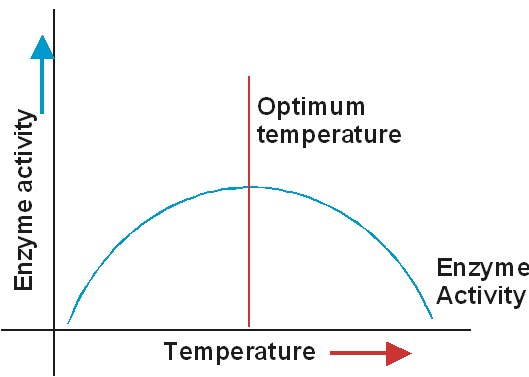
Why does enzyme activity decline at high temperatures?
denaturation
decreased kinetic motion
increase H-bonding
active sites become full

Study the table. Which statements are CORRECT? Tick all that apply.
Carbonic anhydrase has the greatest Vmax.
Carbonic anhydrase has the greatest affinity to its substrate.
Lysozyme has the greatest Vmax.
Lysozyme has the greatest affinity to its substrate.

