
 Worksheets
Simple Harmonic Motion
Total questions: 25
Worksheet time: 45mins
Which of the following equation represent the displacement of SHM:
x= A tan ωt
x= A sin ωt
x= A sin ωt cos kx
x= A sin (ωt ± kx)
A simple harmonic motion is defined as motion where
a∝x
a∝−x
v∝x
v∝−x
Which of the following statements is FALSE about SHM?
Magnitude of acceleration is inversely proportional to displacement
Vertical spring oscillation up and down is example of SHM
Maximum velocity of object in SHM can be determine by using vmax = Aω
Velocity of an object in SHM at maximum displacement is zero
When is a pendulum in simple harmonic motion?
Never
All the time
only at large angles
only at small angles
If a simple harmonic oscillator has a displacement of 0.02 m and acceleration equal to 2.00 m s-2, the angular frequency is equal to:
10.0 rad s-1
0.10 rad s-1
100 rad s-1
1.00 rad s-1
When is the pendulum at 0 velocity
At its lowest point
At its highest point
It moves at a constant velocity
It is at rest
When is the pendulum at maximum velocity
At its lowest point
At its highest point
It moves at a constant velocity
It is at rest

At which position is the acceleration of an oscillating object equal to zero?
A
B
C
D
At which position is the kinetic energy of an oscillating object maximum?
A
B
C
D
The amplitude and period in a SHM is 0.5 m and 0.4 s respectively. The equation of SHM will be:
x=0.5 sin 5πt
x=0.5 sin 4πt
x=0.5 sin 2.5πt
x=0.5 sin 0.8πt

What is the period for this waveform?
2 s
1 s
4 s
0.75 s
The frequency of a body moving with simple harmonic motion is doubled. If the amplitude remains the same, which one of the following is also doubled?
the time period
the total energy
the maximum velocity
the maximum acceleration

The motion graph shown is for
displacement
velocity
acceleration
any of the above
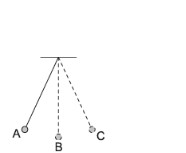
A pendulum oscillates as shown. At which of the following positions is the potential energy equal to the total energy?
A
B
C
Not enough information
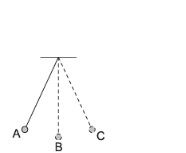
A pendulum oscillates as shown. At which of the following positions is the kinetic energy equal to the total energy?
A
B
C
Not enough information given.


1. Which of the following graphs shows the kinetic energy K of the particle as a function of its displacement x?


Which of the following graphs correctly represents the total mechanical energy of this spring-mass system? Assume no damping.


Which of the following graphs correctly represents the relationship between the kinetic energy Ek and the displacement (d) from point of release of a swinging pendulum bob?



