Worksheets
Density on the Conventional Radiograph
Total questions: 25
Worksheet time: 1hrs 15mins
Overall amount of blackening on the radiographic image (X-ray film) is known as ____________
density
contrast
resolution
Optimum density value is ___________
< 0.25 OD
0.25 - 2.5 OD
> 2.5 OD
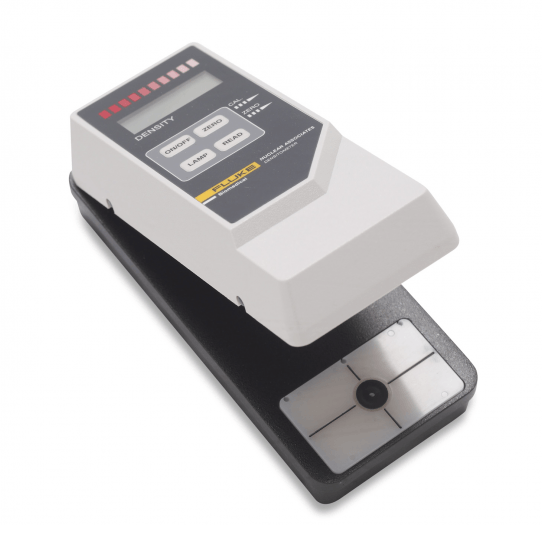
A tool used to measure density on an x-ray film is called _____________
sensitometer
film processor
densitometer
The most important factor that influence the density of an x-ray film is ___________
kV
mAs
SID
If you increase the mAs, the density will ________ (proportionally)
increase
decrease
static (no changes)
Any combination of milliampere (mA) and time (s) that will produce a given mAs will produce identical density on the X-ray film. This is ____________
reciprocity law
15% rule
inverse square law
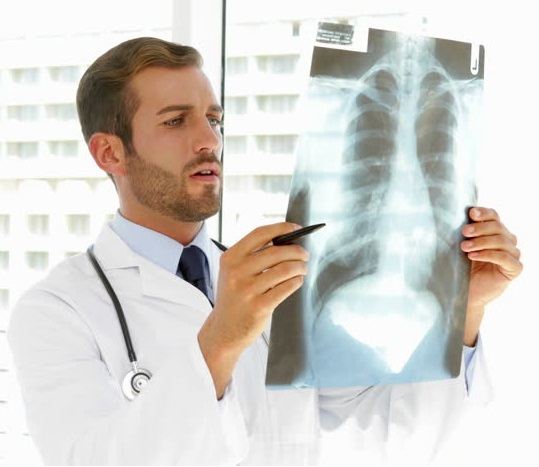
Human eyes can detect at least _____ % change of density on the x-ray film.
10
20
30
A radiographer set 15 mAs on a control panel to produce abdomen x-ray film. However, the x-ray film produce is insufficient and low density. If the radiographer want to re-do the abdomen x-ray with double the density from previous film, suggest the new mAs?
7.5 mAs
20 mAs
30 mAs
Kilovoltage (kV) also effect the density of x-ray film. If you increase the the kV, the density will ___________ (but not proportional).
increase
decrease
static (no changes)
if kV increase by 15%, the density will double & if the kV reduce by 15%, the density will reduce to half. This explain the ___________
reciprocity law
15% rule
inverse square law
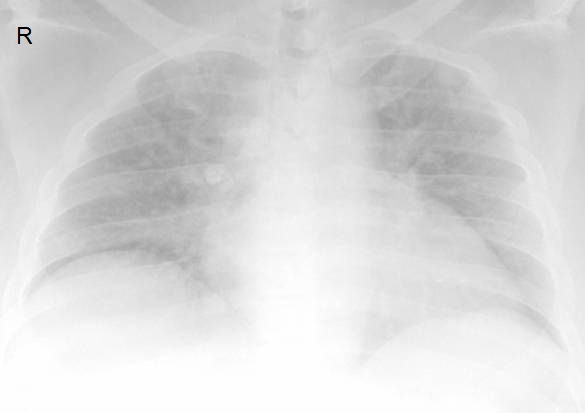
The exposure factor used to produce this not optimum and low density chest x-ray film is 60 kV and 5 mAs. If radiographer need to re-do this chest x-ray using a similar 5 mAs but want to produce a new chest x-ray film that have double the density, how much kV must be set?
9 kV
30 kV
69 kV
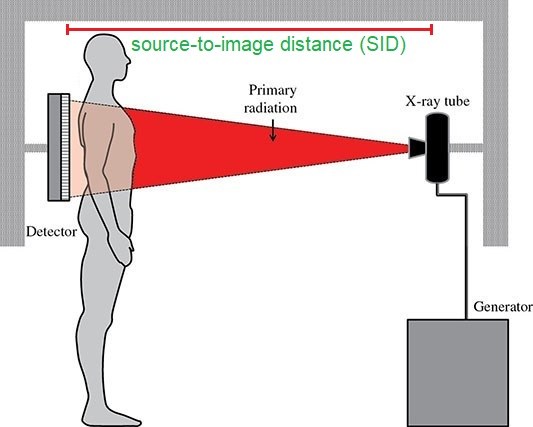
The other factor that influence the density of x-ray film is source-to-image distance (SID). If SID increase, the density will _________
increase
decrease
static (no changes)
The effect of SID on the density of x-ray film is follow the _______________
reciprocity law
15% rule
inverse square law
Which of the following SID will produce darker (high density) image? (assume kV, mAs and body part are constant).
100 cm
150 cm
180 cm
A standard SID used in most of the radiography procedure is ____________ cm
100
150
180
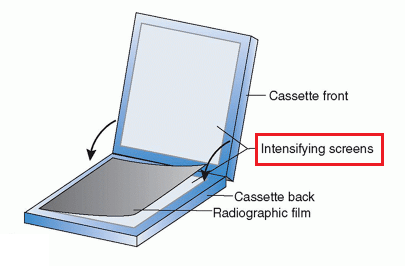
The diagram shows intensifying screen located inside the x-ray cassette. The function of intensifying screen is to convert the x-ray to light. Every intensifying screen has different "speed" on how fast to change the x-ray into light.
High speed of intensifying screen will ___________ the density of the image.
increase
decrease
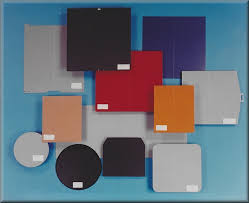
This is the example of grid. The function of grid is to absorb the _________________ radiation. Thus, it will decrease the overall image density.
Grid normally used when performing x-ray at the body part that more than 10 cm thick (abdomen and pelvis).
primary
scattered
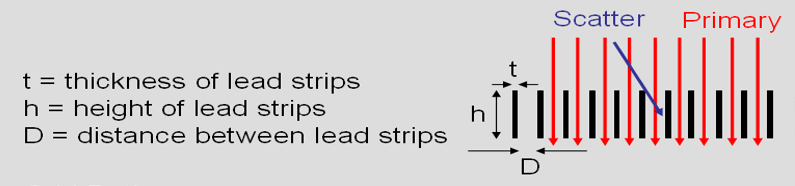
This is a cross section of a grid where the primary x-ray passing through and the scattered x-ray absorbed. Different grid has different special characteristics known as "grid ratio".
Grid ratio measured by _____________
h/D
D/h
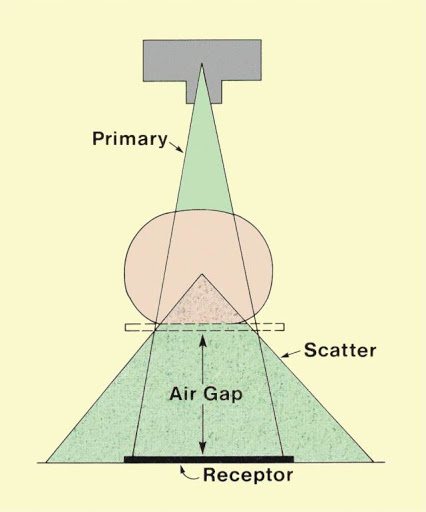
This technique is performed by provide some space/empty space/gap between body part and the receptor (film). This technique has similar effect as grid which will absorb scattered radiation. This technique is known as _____________ technique.
air-gap
anode-heel effect
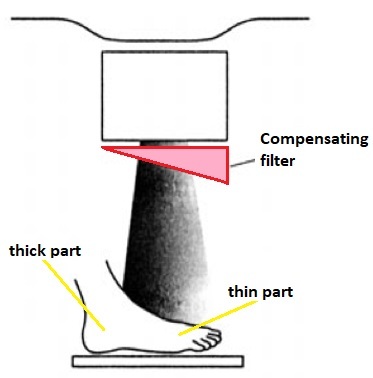
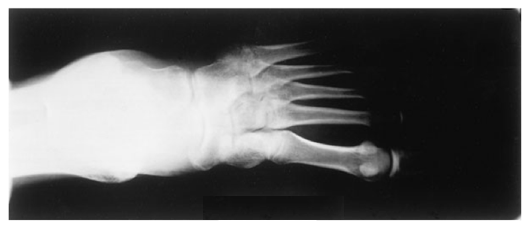
The diagram shows the application of filter along foot that have different end-to-end thickness. The purpose of this filter to produce more uniform density (visible of fingers). Which foot x-ray image produced?
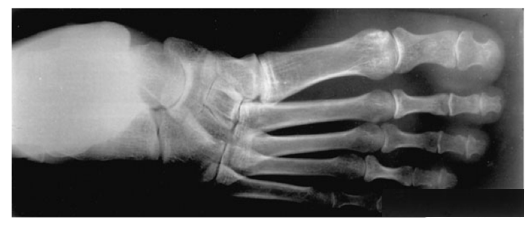
In general, bigger body habitus (hyperstenic) will produce ________ density as compare to smaller body habitus because less x-ray penetrated & hit the film.
low
high
Three-phase generator X-ray tube voltage never drop to zero, produce more high-energy X-ray photons, more efficient. Thus produce ________ density to X-ray film.
less
more
When small collimation apply, it will reduce volume of tissue irradiated, reduce scattered radiation, and consequently __________ radiographic density.
Moreover, radiographer must always use small collimation to reduce patient dose.
increase
decrease
A proper (small) collimation for chest x-ray is just include apex of lung, costophrenic angles and lateral ribs. Which chest x-ray using small (appropriate) collimation?
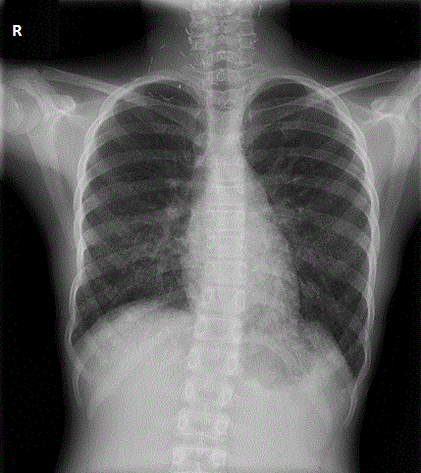
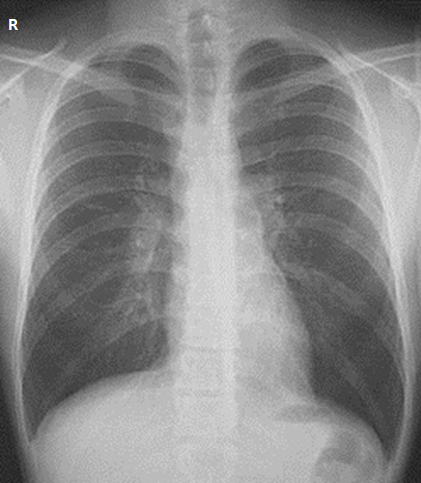
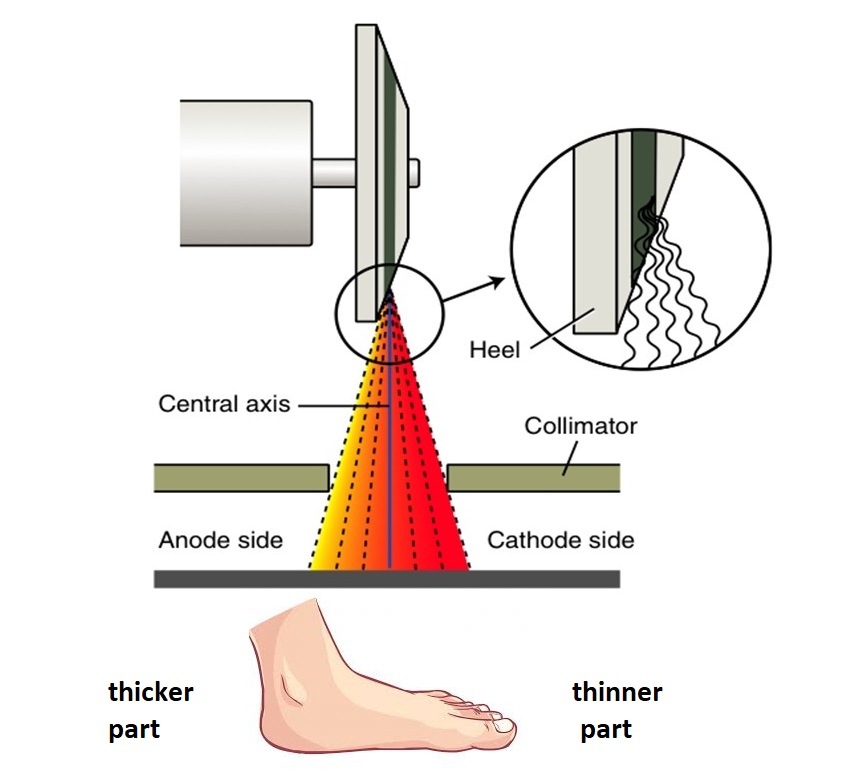
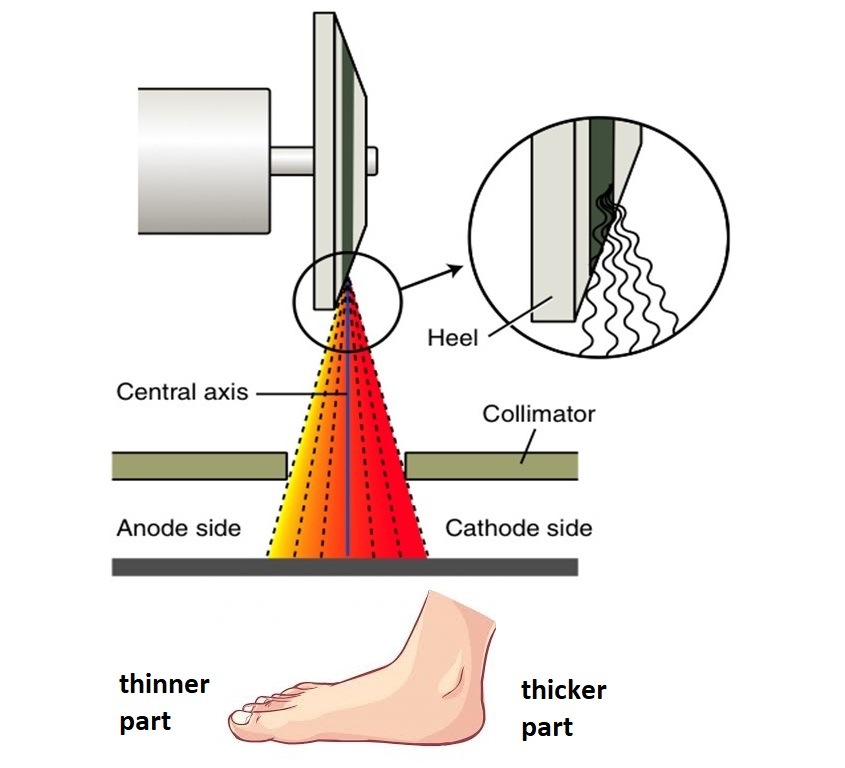
Which positioning technique will produce better uniform density of the foot x-ray image?
Thicker part toward anode or toward cathode?