
 Worksheets
MIDTERM EXAM CHGO15, CHEM1A
Total questions: 60
Worksheet time: 50mins
What branch of science deals with the study of matter and how matter changes?
anatomy
chemistry
paleontology
physics
What is the basic particle that makes up an element?
atom
cell
molecules
particles
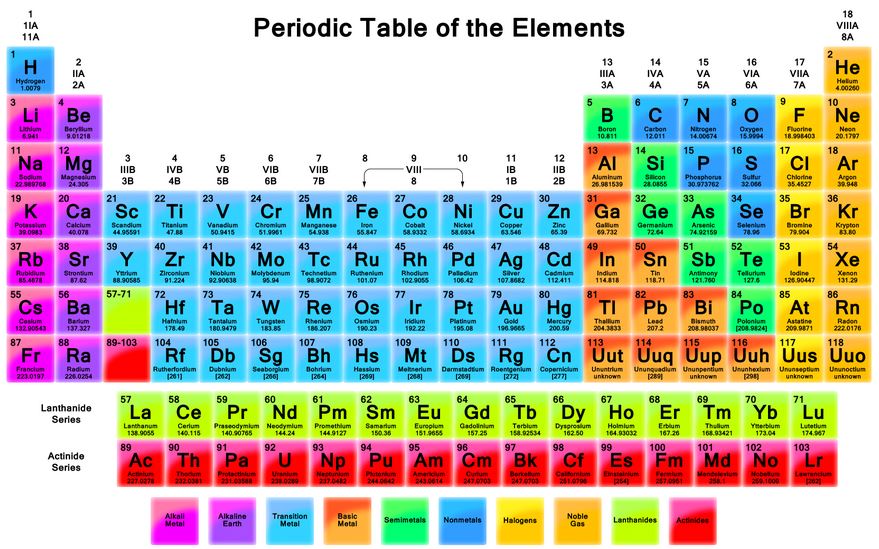
What science resource lists all the elements?
balance sheet
microscope guide
periodic table
A scientist is working in the lab, with compounds containing carbon. She is most likely working in the field of?
analytical
biochemistry
organic
physical
atomic number
gas at room temperature, low boiling point
a subatomic particle that has a negative charge
number or protons and neutrons
the number of protons in the nucleus of an atom
period
Elements that occur in vertical columns on the periodic table.
A horizontal row of elements in the periodic table
Found in group two of the periodic table; highly reactive
A subatomic particle that has a negative charge
found in group one of the periodic table; highly reactive
Non-metals
Transition Metals (Groups 3-12)
alkali metals (group 1)
metalloids (semimetals)
neutron
A subatomic particle that has a positive charge and that is found in the nucleus of an atom
not able to conduct heat or electricity, little to no metallic luster
A subatomic particle that has a negative charge
A small particle in the nucleus of the atom, with no electrical charge
A subatomic particle that has a positive charge and that is found in the nucleus of an atom
Proton
elecrtron
groups
neutrons
A subatomic particle that has a negative charge
nobles gases
protons
electrons
neutrons
not able to conduct heat or electricity, little to no metallic luster
Non-metals
noble gases
atomic mass
Neutron
Found in group two of the periodic table; highly reactive
period
Alkali Earth Metals (Group 2)
metalloids (semimetals)
alkali metals (group 1)
The electrons in the outermost shell (main energy level) of an atom; these are the electrons involved in forming bonds
alkali metals (group 1)
Halogens (Group 17)
atomic number
valence electrons
Halogens (Group 17)
gas at room temperature, low boiling point.
most reactive nonmetals
The electrons in the outermost shell (main energy level) of an atom; these are the electrons involved in forming bonds
Number of protons and neutrons
Number of protons and neutrons
atomic number
atomic mass
noble gases
Non-metals
Elements that occur in vertical columns on the periodic table.
Neutron
metalloids (semimetals)
groups
Proton
good thermal conductors, shiny, electric conductors, higher density and melting points than group
alkali metals (group 1)
Transition Metals (Groups 3-12)
Non-metals
metalloids (semimetals)
gas at room temperature, low boiling point.
atomic mass
atomic number
Non-metals
noble gases
metalloids (semimetals)
Elements that occur in vertical columns on the periodic table.
an element that has both metallic and nonmetallic properties
not able to conduct heat or electricity, little to no metallic luster
found in group one of the periodic table; highly reactive
1s22s22p63s23p64s23d10
1s22s22p63s2

1s22s22p63s2
What molecular geometry would PH3 have?
Trigonal Pyramidal
Trigonal Bipyramidal
Bent
Linear

Electrons that have not been excited are said to be at:
high level
base line
set state
ground state
There may be a maximum of ____ p orbitals at a given energy level.
2
6
3
8

This shape is that of a...
s orbital
d orbital
p orbital
f orbital
The spin of an electron is represented by this variable:
n
m
L
s, ms

This is a ____ orbital
s
d
p
d
The principle quantum number, n, represents the:
spin value
suborbital value
energy level
magnetic value
Orbital sublevels, or L, represents:
orbital color
orbital shape
electron spin
energy level
The proper pair of the L value with the orbital shape.
0; f
3; p
1; s
2; d
With each higher energy level, the electrons are
lower in energy
more stable
weaker
farther from the nucleus
How many electrons total are found in the f orbital?
2
6
10
14

