
 Worksheets
Chemical Kinetics
Total questions: 72
Worksheet time: 1hrs 26mins
Which of the following plots will show a linear relationship for a second order reaction?
[A] vs time
1/[A] vs time
ln[A] vs time
[A]2 vs time

The following data were measured for the reaction
BF3(g) + NH3(g) ⟶ F3BNH3(g)
What is the rate law for the reaction?
rate = k[NH3]
rate = k[BF3]2[NH3]
rate = k[BF3][NH3]
rate = k[BF3][NH3]2
A reaction is found to be second order with respect to carbon monoxide. If the concentration of carbon monoxide is doubled, the rate of reaction __________.
doubles
remains unchanged
increases by a factor of 4
is reduced by a factor of 2
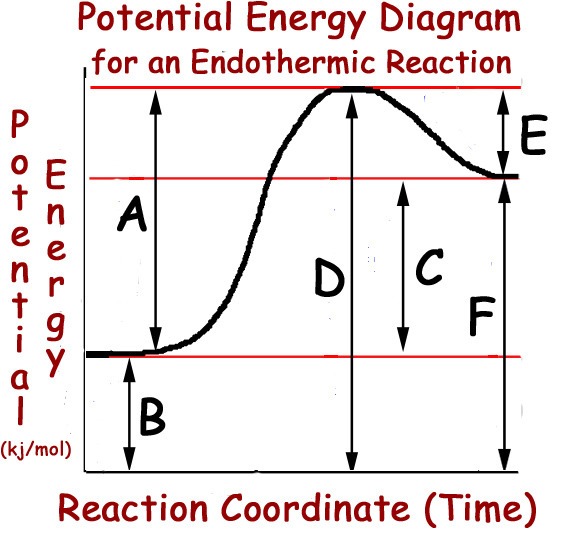
What letter represents the activation energy?
A
B
C
D
Given the following rate law,
rate = k[A]2[B]
if [A] were doubled, what must happen to [B] to keep the rate constant?
[B] must quadruple
[B] must double
[B] must be havled
[B] must be quartered
rate = k[A]
The rate constant in the rate law above is 0.5 L/mol·s. If the initial concentration of A is 0.1 M, how long will it take for [A] to drop to 0.025 M?
0.7 s
1.4 s
2.8 s
There is not enough information given.

What is the rate law for this mechanism?
rate = k[A][B]2
rate = [B][X]
rate = [A]0.5[B]1.5
rate = [W][Y][Z]

The addition of a catalyst to this reaction would cause a change in which of the indicated energy differences?
I
II
III
I and II
Which factors increase the rate of a reaction?
increasing temperature
increasing concentration
increasing surface area
all of the above
For second order reaction, the initial concentration of reactant A is 0.24 M. If the rate constant is 8.1 x 10⁻² M-1 s-1, what is the concentration of A after 29 seconds?
0.02 M
0.15 M
0.30 M
0.45 M
Given the following balanced equation :
2NO(g) + Cl2(g) → 2NOCl(g)
If the rate of disappearance of Cl2 is 4.84 x 10⁻² Ms-1, what is the rate of disappearance of NO?
1.45 x 10⁻² Ms-1
2.42 x 10⁻² Ms-1
3.67 x 10⁻² Ms-1
9.68 x 10⁻² Ms-1
The first order rate constant for the decomposition of 0.5 M compound A at 100oC is 0.03 min-1. Calculate the half-life of A.
1.5 min
8.3 min
23.1 min
66.7 min
How are the exponents n and m determined?
Reaction rates can change with
Temperature
The addition of catalyst
Reactant concentration
All of these above
The quantity of K in rate law expression
Independent of concentration
Is called the Arrhenius constant
Is dimensionless
Is independent of temperature
As the temperature of the reaction increased, the rate of the reaction increases because
Reactant molecule collide with greater energy
Reactant molecules collide with less frequently
Reactant molecules collide with less frequently and with greater energy
Activation energy is lowered
In a series of reaction, which is the rate determining step
The simplest reaction
The slowest reaction
The fastest reaction
The main reaction involving the major reactant
Rate law for chemical reactions are determined
By experiment
By examining the coefficient in balanced chemical equation
From equilibrium constant
From the rates of forward and reverse reactions of the system in equilibrium
According to Arrhenius equation rate constant k is equal to A e^–Ea /RT . Which of the following options represents the graph of ln k vs 1/ T ?


A reaction is found to be second order with respect to carbon monoxide. If the concentration of carbon monoxide is doubled, the rate of reaction __________.
doubles
remains unchanged
increases by a factor of 4
is reduced by a factor of 2
The catalyst alters the rate of a chemical reaction by,
providing an alternative pathway with a lower Ea
changing the products formed in the direction of the reaction
providing a surface on which the molecules react
increasing the frequencies of collisions between molecules
Which of the following are true of reaction rates?
I. The overall rate law is determined by the fastest step of a reaction
II. The presence of a catalyst will increase the number of molecules entering the transition state
III. An increase in temperature will increase the rate of a reaction
IV. Increasing the concentration of reactants will increase the rate at which products yield
II+III+IV
I+IV
II + III
I+II+III
What is the rate law for this mechanism?
rate = k[A][B]2
rate = [B][X]
rate = [A]0.5[B]1.5
rate = [W][Y][Z]


Using the following data, which is the correct rate law of the sample reaction?
A + 5B + 6C → 3D + 3E


In the chemical reaction, the successful formation of products depends on the following factors EXCEPT:
The collisions between reacting molecules must be effective
The colliding molecules must approach each other in the right orientation
The energy of colliding molecules must be equal to or more than activation energy
A collision between molecules must produce sufficient energy to overcome the activation energy
The reaction A + 2B → products was found to have the rate law, k = k[A][B]2. Predict by what factor the rate of reaction will increase when the concentration of B is doubled and the concentration of A remained uncanged
2
4
6
8
The overall order for the reaction,
2A + B → C
is one and with respect to B the order is zero. Which of the following statements is true?
The rate law of the reaction is rate =k[A]2[B]
The formation of C is double the appearance of A
The rate of reaction would increase with increasing concentration B
The half-life of the reaction is independent on the concentration of the reactants
What is activation energy?
The maximum amount of energy used
The minimum amount of energy required for a reaction to start
The energy of the reactants
The energy possessed by the products

What is the activation energy?
100 kJ
250 kJ
50 kJ
200 kJ


The rate of an elementary reaction: A(g) + B(g) → C(g) + D(g) has been studied as a function of temperature between 5000 and 10000 K. Calculate the activation energy for the reaction if k1 is 5.49 x 10^6 and k2 is 9.86 x 10^8
25.9 kJ/mol
52.0 kJ/mol
359 kJ/mol
432 kJ/mol
Arrhenius equation is
k = AeEa/RT
k = Ae-Ea/RT
k = AeRT/Ea
k = Ae-RT/Ea
For an elementary reaction 2A + B →C + D, the molecularity is
zero
one
two
three
If we plot log k Vs 1/T, by Arrhenius equation, the slope is
-Ea/R
+Ea/R
-Ea/2.303R
+Ea/2.303R
Fora reaction,A+B —> Product; the rate law is given by, r =k [ A]1/2 [B]2. What is the order of the reaction?
1
1.5
2
2.5
For which order reaction units of rate constant and rate of reaction are same
First order
Zero order
Second order
None of the above
The reaction which takes place in a single step
Elementary reaction
Complex reaction
Neutral reaction
None of the above
The time taken for 10% completion of a first order reaction is 20 mins .Then for 19% completion ,the reaction will take
50 mins
30 mins
40 mins
60 mins
Identify the order from the following rate constant : k =9.3×10⁻³ L mol-1s-1
second order
first order
zero order
third order
Given the chemical equation, Haber Prosess
N2(g) + 3H2 (g) --> 2NH3 (g)
Based on this reaction, first order for concentration N2 and zero order for concentration H2.
Write rate law:
Rate = K [N2]1 [H2]1
Rate = K [N2]1
Rate = K [H2]0
Rate = K [N2]1 [H2]3
What happened to the rate of reaction, if concentration of reactant is 'zero order'.
rate of reaction will become double
rate of reaction will become triple
rate of reaction will become quadrapel
No affect to the rate of reaction
Which statement will be increase the rate of reaction
Temperature must be lowered
Dilute concentration
Lower pressure
Smaller size particles
Which of the graph refer for this chemical reaction:
2Q (g) ---> R (g)


The graph the rate of reaction below, refer to the:
zero order
first order
second order
third order
Which of the graph, half life for zero order


In a zero-order reaction for every 10° rise of temperature, the rate is doubled. If the temperature is increased from 10°C to 100°C, the rate of the reaction will become
64 time
128 times
256 times
512 times
The time required for 100% completion of a zero order reaction is
[R0]/2k
[R0]k
2k/[R0]
[R0]/k
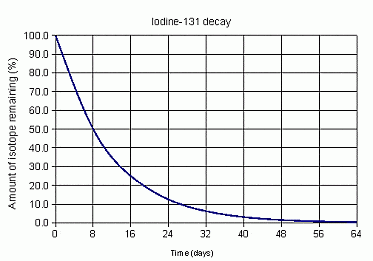
Radioactivity of a sample (z = 22) decreases 90% after 10 years. What will be the half-life of the sample?
5 years
2 years
3 years
10 years
In a reaction, A + B → Product, rate is doubled when the concentration of B is doubled, and rate increases by a factor of 8 when the concentrations of both the reactants (Aand B) are doubled, rate law for the reaction can be written as
Rate = k[A] [B]
Rate = k[A]2[B]
Rate = k[A][B]2
Rate = k[A]2[B]2
Which of these changes with time for a first-order reaction?
A. Rate of reaction
B. Rate constant
C. Half-life
A only
B only
A & C only
A & B only
The time for half life period of a certain reaction A → Products is 1 h. When the initial concentration of the reactant 'A' is 2.0 mol L–1, how much time does it take for its concentration to come from 0.50 to 0.25 mol L–1, if it is a zero order reaction?
0.25 h
1 h
4 h
0.5 h
For a chemical reaction A → B, the rate of the reaction is
2 × 10⁻³ mol dm–3 s–1 when the initial concentration is 0.05 mol dm–3. The rate of the same reaction is 1.6 × 10⁻²mol dm–3 s–1 when the initial concentration is 0.1 mol dm–3. The order of the reaction is
0
3
1
2
For a first order reaction A → P, the temperature (T) dependent rate constant (k) was found to follow the equation
log k = –(2000) /T + 6.0.
The pre–exponential factor A and the activation energy Ea, respectively, are
1.0 × 10⁶ s−1 and 9.2 kJmol−1
6.0 s−1 and 16.6 kJmol−1
1.0 × 10⁶ s−1 and 16.6 kJmol−1
1.0 × 10⁶ s−1 and 38.3 kJmol−1
Which of these does not influence the rate of reaction?
Nature of the reactants
Concentration of the reactants
Temperature of the reaction
Molecularity of the reaction
Which of the following statements is correct?
The rate of a reaction decreases with passage of time as the concentration of reactants dereases.
The rate of a reaction is same at any time during the reaction.
The rate of a reaction is independent of temperature change.
The rate of a reaction decreases with increase in concentration of
reactant(s).
Which of the following statements is not correct about order of a reaction.
The order of a reaction can be a fractional number.
Order of a reaction is experimentally determined quantity.
The order of a reaction is always equal to the sum of the stoichiometric coefficients of reactants in the balanced chemical equation for a reaction.
The order of a reaction is the sum of the powers of molar concentration of the reactants in the rate law expression.
reaction rate constant also known as
specific reaction rate
reaction rate
rate reaction
none
if the order of a reaction with respect to a reactant, A, is zero order, this means that
A is a catalyst
A is not involved in the overall reaction
the value of the rate constant does not depend on A
the rate of reaction is not affected by a change in the concentration of A
an equation to show the relationship between two temperature


none
During a chemical reaction catalyzed by an enzyme, the enzyme is consumed to form the product from the substrate and the enzyme?
True
False

This equation is used to describe the kinetics of an enzymatic reaction. The equation is called the
Inhibitor Equation
Activation energy equation
Velocity equation
Michaelis-Menten equation
Double-reciprocal plot
Enzymes DO NOT affect Keq
True
False

