
 Worksheets
Atomic and Nuclear Physics
Total questions: 50
Worksheet time: 50mins
Under the standard model, what are protons and neutrons composed of?
electrons
quarks
atoms
neutrons
What is the name of the particles of light?
protons
photons
atomic particles
infrared
How do binding forces in atomic nuclei affect the amount of energy in nuclear fission versus nuclear fusion?
There is a larger difference in binding forces in nuclear fission.
There is a larger difference in binding forces in nuclear fusion
The products have a greater mass than the reactants in fission
Binding forces do have an effect on nuclear reactions
In nuclear fission, some mass is converted to energy. This causes -
final mass to be less than initial mass
final mas to be more than initial mass
final mass to be equal to initial mass
How does a star form?
Contraction of a large amount of gas into heavier element by way of nuclear fusion
Contraction of a large amount of gas into heavier element by way of nuclear fission
Expansion of large amount of gas by nuclear fission
Expansion of large amount of gas by nuclear fusion
What is a beta particle made of?
One proton
A helium particle
One electron
One proton and one neutron
Which of these processes describes a nuclear fusion reaction?
A nucleus absorbs energy to produce lighter nuclei.
A nucleus splits to produce energy and lighter nuclei
Two nuclei bind together to produce energy and heavier nuclei.
Two nuclei bind together to produce energy and a lighter nuclei.
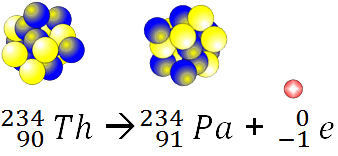
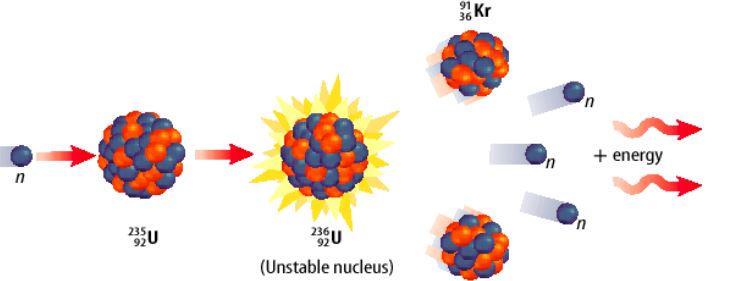

If there are 146 neutrons in 238U, how many neutrons
are found in the nucleus of 235U?
141
143
145
147
Which of these are FALSE about nucleons?
Nucleons are subatomic particles.
Nucleons are located in the nucleus of an atom.
Protons or neutrons are nucleons.
Nucleons are has negative electric charge.
What force that keep the protons and neutrons together and stable in the nucleus?
Columbic Force
Gravitational Force
Centripetal Force
Nuclear force.
What makes something radioactive?
an unstable nucleus
contaminated sewage
elements with an atomic number above 81
it decays over time
Which type of nuclear reaction takes place at a nuclear power plant when uranium nuclei are split to produce heat?
fission
fusion
Takes two small nuclei and combines them into a larger nucleus
fission
fusion
How do nuclear power plants work?
Fusion
Half-Life
Fission
Fusion & Fisson
Which atoms combine together during fusion reaction on the sun?
Helium and Hydrogen atoms
Hydrogen atoms
Hydrogen and Lithium atoms
Hydrogen and Carbon atoms
One disadvantage of nuclear energy is _______.
it is a fossil fuel
it emits large amounts of pollution into the atmosphere
it leaves behind radioactive waste
there are not disadvantages
Some advantages of nuclear physics are _______.
nuclear plants don't emit as many greenhouse gases as coal plants
cancer treatment
medical diagnostics
there is very little dangerous waste with nuclear energy
When nuclei decay, massive amounts of _______ is released.
energy
protons
neutrons
chaos
___________ starts the fission of a uranium atom.
Energy
Protons
One Neutron
All of the above

X = Hadrons, Y = electrons and neutrino, Z = neutrons and protons
X = Hadrons, Y =neutrons and protons, Z = electrons and neutrino
X = neutrons and protons, Y = electrons and neutrino; Z = Hadrons
X = electrons and neutrino; Y = Hadrons; Z = neutrons and protons

Which diagram represents the structure of an antineutron?
A
B
C
D

A
B
C
D
These are light, elementary particles that are not made up of quarks.
Gluons
Electrons
Leptons
Baryon
All baryons are assigned a baryon number of ___, all anti-baryons are assigned ___, and all non-baryons are ___
-1, +1, 0
-1, 0, +1
+1, -1, 0
0, -1, +1
There are three families of leptons;
electron, muon, and pi.
electron, muon, and tau.
electron, pi and tau.
electron, pi and neutrino.
The main three conservation laws used in particle physics are:
Conservation of charge, baryon and lepton numbers.
Conservation of gravity, charge and lepton numbers.
Conservation of momentum, hadron and lepton numbers.
Conservation of charge, hadron and lepton numbers.
Which quarks form a neutron?
up, up, down
down, down, down
up, up, up
up, down, down

When an atom emits a photon, which of the following happen? (Check all that apply)
The energy of the photon is the same as the difference between energy levels
An electron goes from a higher excited level to a lower energy level
An electron goes from a lower energy state to an excited state
We call this radioactive decay

The Sun converts mass to energy at such a rate that it produces 3.9x1026 J every single second. How much mass is converted every second to produce this much energy?
1.3 x 10¹⁸ kg
1.17 x 1035 kg
3.51 x 1043 kg
4.33 x 10⁹ kg
These are the category of hadrons that contain three quarks. This distinguishes them from mesons, which contain two (1 quark and 1 antiquark).
Gluons
Electrons
Leptons
Baryons
a hadron with one quark and one antiquark
neutron
baryon
hadron
meson
an electron with a positive charge
neutrino
gauge boson
positron
gluon
this is the other fundamental boson along with the force carriers
Higgs
positron
gauge boson
W and Z
a particle of the same mass and opposite charge
antiparticle
Higgs
positron
gauge boson

