
Font size
S
M
L
XL
 Worksheets
Age of Jackson
Total questions: 38
Worksheet time: 32mins
Name
Class
Date
1.
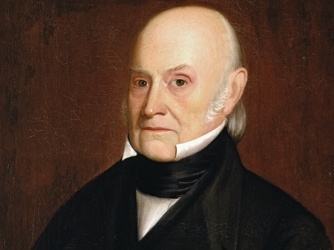
Who became president in the election of 1824?
a)
John Quincy Adams
b)
Henry Clay
c)
John C. Calhoun
d)
Andrew Jackson
2.
Andrew Jackson's election victory in 1828 depended on support from
a)
the rich and well-born.
b)
Native Americans.
c)
the common people.
d)
states' rights supporters.
3.
Why did the election of 1828 include many first-time voters?
a)
Southern states gave voting rights to women.
b)
African Americans were voting for the first time.
c)
New states gave voting rights to all white men.
d)
A new federal law required all men and women to vote.
4.
What is Jacksonian Democracy?
a)
the idea that the common people should control their government
b)
the political party that supported Jackson in the election of 1828
c)
the notion that the rich and upper class should have the most power
d)
the nickname Andrew Jackson earned in the War of 1812
5.
How was President Jackson different from other Presidents?
a)
He served more than two terms
b)
He owned slaves
c)
He came from a poor family
d)
He was a military general
6.
Jackson's election as president was a victory for -
a)
ordinary working Americans.
b)
American Indians.
c)
upper class Americans.
d)
Republicans.
7.
Jackson's election as president was a victory for -
a)
ordinary working Americans.
b)
American Indians.
c)
upper class Americans.
d)
Republicans.
8.
The spoils system gave jobs to who?
a)
The most qualified people
b)
Jackson's Friends
c)
Republicans
d)
Native Americans
9.
Jackson wanted to open up jobs in _______to average citizens.
a)
government
b)
Banks
c)
Judgeships
d)
corporate America
10.
Passed in 1830, this authorized the removal of Native Americans who lived east of the Mississippi River to lands in the West.
a)
Indian Removal Act
b)
Worcester v. Georgia
c)
Bureau of Indian Affairs
d)
Trail of Tears
11.
What was the harsh journey of the Cherokee from their homeland to Indian Territory called?
a)
spoils system
b)
Trail of Tears
c)
Indian Removal Act
d)
Whig Party
12.
Which of the following would most likely be a Jackson supporter?
a)
a Republican
b)
a wealthy banker
c)
a rich property owner
d)
a western farmer
13.

What is a tariff a tax on?
a)
Income
b)
Slaves
c)
Imported Goods
d)
Crops
14.
Why did Jackson oppose the National Bank?
a)
He thought it only helped the wealthy
b)
He thought it only helped the poor
c)
He thought it only helped South Carolina
d)
He thought it was unconstitutional
15.

How did Jackson get rid of the National Bank?
a)
He signed a law
b)
He created a new bank
c)
He vetoed its charter
d)
He nullified it
16.
The Nullification Crisis was triggered by strong opposition to the -
a)
Force Bill.
b)
Indian Removal Act.
c)
Tariff of Abominations.
d)
Bank of the United States.
17.

Which state threatened to secede during the Nullification Crisis?
a)
South Carolina
b)
Texas
c)
Rhode Island
d)
Georgia
18.

Why was Jackson called 'King Jackson I'?
a)
He wore a crown to all the meetings
b)
He used his force and authority without regard for Constitution
c)
He wanted to be called emperor instead of president
d)
He was from England
19.
What is the main criticism of the spoils system?
a)
It rewards political loyalty
b)
It is based on merit
c)
It often leads to unqualified people getting jobs
d)
It promotes diversity
20.

This map shows the results of the -
a)
Indian Removal Act
b)
Tariff of Abominations
c)
Election of 1824
d)
War of 1812
21.
Native Americans were forced to relocate to what present day state?
a)
Missouri
b)
Iowa
c)
Texas
d)
Oklahoma
22.
One limitation to democracy during the Jackson era was that -
a)
there were only two political parties.
b)
the number of voters was decreasing.
c)
Native Americans could not appeal to the Supreme Court.
d)
women, Native Americans, and most African Americans could not vote.
23.
Andrew Jackson's election victory in 1828 depended on support from
a)
the rich and well-born.
b)
Native Americans.
c)
the common people.
d)
states' rights supporters.
24.
Jackson's practice of rewarding political supporters with government jobs became known as
a)
the spoils system.
b)
Jacksonian democracy.
c)
mudslinging.
d)
a corrupt bargain.
25.
The Nullification Crisis was triggered by strong opposition to the
a)
Force Bill.
b)
Indian Removal Act.
c)
Tariff of Abominations.
d)
Bank of the United States.
26.
Which group was most hurt by Jackson's removal policy?
a)
the rich and well-born
b)
Native Americans
c)
the common people
d)
states' rights supporters
27.
The Trail of Tears refers to
a)
Jackson’s angry negotiations with the Five Civilized Tribes.
b)
the movement of Seminole Indians from the West to Florida.
c)
government workers who lost their jobs due to Jackson’s spoils system.
d)
the removal of Cherokee Indians from Georgia to Indian Territory.
28.
The Trail of Tears refers to
a)
Jackson’s angry negotiations with the Five Civilized Tribes.
b)
the movement of Seminole Indians from the West to Florida.
c)
government workers who lost their jobs due to Jackson’s spoils system.
d)
the removal of Cherokee Indians from Georgia to Indian Territory.
29.
Why did Jackson oppose the Bank of the United States?
a)
He thought its president was inexperienced and poorly educated.
b)
He thought it loaned too much money to farmers and workers.
c)
He thought it was unconstitutional and that it favored the rich.
d)
He thought it benefited western business owners over those in the east.
30.
Andrew Jackson ran on the support of the "common man". Which is the best description of what this means?
a)
He made himself relatable to the average American.
b)
He limited the amount of voters by increasing property requirements
c)
He supported transportation growth
d)
He came from a wealthy family in the upper class
31.

Who were a big supporters of Andrew Jackson?
a)
wealthy business owners
b)
farmers & factory workers
32.
Jackson wanted to open up jobs in _______________________to average citizens
a)
government
b)
Banks
c)
Judgeships
d)
corporate America
33.
What is Jacksonian Democracy?
a)
the idea that the common people should control their government
b)
the political party that supported Jackson in the election of 1828
c)
the notion that the rich and upper class should have the most power
d)
the nickname Andrew Jackson earned in the War of 1812
34.
Why did Jackson oppose the Bank of the United States?
a)
He thought its president was inexperienced and poorly educated.
b)
He thought it loaned too much money to farmers and workers.
c)
He thought it was unconstitutional and that it favored the rich.
d)
He thought it benefited western business owners over those in the east.
35.

Many of his opponents would have agreed with the cartoon’s portrayal of Jackson Because it suggests that ---
a)
he was not really the common man that many people thought him to be
b)
he has used the spoils system to gain wealth and influence in the government
c)
the executive branch of government became too powerful during his presidency
d)
the leaders of other countries had too much influence in the American government
36.
How did the battles that Andrew Jackson was a part of affect his political career?
a)
Congress thought he would be good for the country.
b)
His reputation from the military made him very popular with Americans.
c)
It did nothing to help him.
d)
He died in the final battle of the War of 1812
37.

To nullify a law means …
a)
to agree to the law
b)
to secede.
c)
to void or cancel the law.
d)
to vote on the law.
38.

President ____ ignored the ruling of the Supreme Court in Worcester v. Georgia and allowed the Cherokee to be moved from their land.
a)
Andrew Jackson
b)
George Washington
c)
Abraham Lincoln
d)
Theodore Roosevelt
Reset

