wayground logo

Free Printable Worksheets

Font size

S
M
L
XL
Worksheets

Quarter 2 PMA Review

Total questions: 47

Worksheet time: 31mins

Name
Class
Date
1.

In the rock cycle, sedimentary rock forms when rock is?

a)

crystalized in to natural glass

b)

exposed to great temperature

c)

melted into liquid magma

d)

broken down by weathering

2.

According to the rock cycle, when liquid magma cools into a solid, what is formed?

a)

lava

b)

glaciers

c)

Igneous rock

d)

Metamorphic rock

3.

An incomplete diagram of the rock cycle is shown. Which terms should be placed in boxes labeled 1, 2, and 3?

a)
  1. Metamorphic Rocks 2. Sedimentary Rocks 3. Igneous Rocks
b)
  1. Metamorphic Rocks 2. Igneous Rocks 3. Sedimentary Rocks
c)
  1. Sedimentary Rocks 2. Metamorphic Rocks 3. Igneous Rocks
d)
  1. Sedimentary Rocks 2. Igneous Rocks 3. Metamorphic Rocks
4.
The type of plate boundary where two plates come together is a .....
a)
Convergent Boundary
b)
Divergent Boundary
c)
Transform Boundary
d)
Plate Boundary
5.

Which of the following infectious agents in not living

a)

virus

b)

bacteria

c)

fugi

d)

parasites

6.

In winter, the axis of the earth is pointed away or toward the sun?

a)

towards

b)

up

c)

down

d)

away

7.

How do the circulatory and digestive system work together to maintain homeostasis?

a)

the digestive system breaks down the nutrients from your food and the circulatory system carries oxygen to your cells

b)

the circulatory system transports the nutrients from the digestive system to the rest of the body

8.

Which of the following are only found in the plant cell?

a)

Cell membrane and cell wall

b)

many small Vacuoles, Cell Wall, chloroplast

c)

1 Large Vacuole, Cell Wall, chloroplast

d)

None

9.

heat from the inner core transfers to the core and mantle via conduction and then transverse via ____________ in the mantle to the crust

a)

radiation

b)

convection

c)

conduction

d)

infusion

10.

What is the main function of the excretory system?

a)

to collect and remove wastes from the body

b)

to strengthen skeletal muscles

c)

to protect the nervous system

d)

to bring oxygen to body cells

11.

What is wind?

a)

The movement of water due to pressure differences

b)

The movement of air due to pressure differences.

c)

The movement of air due to pollution differences

d)

The movement of water deep in the ocean

12.

Air moves from areas of _____ pressure to areas of ____ pressure.

a)

high, low

b)

low, high

13.

Cold air is _______ dense than warm air.

a)

more

b)

less

c)

the same as

14.

Winds that blow steadily from specific directions over long distances are called

a)

Sea breezes

b)

Land breezes

c)

Jet streams

d)

Global Winds

15.

Three types of global winds are:

a)

Tradewinds

b)

Sea Breezes

c)

Polar Easterlies

d)

Prevailing Westerlies

e)

Land breezes

16.

The flow of air from an ocean or lake to the land is called a

a)

Sea breeze

b)

Land Breeze

17.

A narrow belt of high speed winds that blow from west to east, between 7 km and 16 km above Earth’s surface is called

a)

a jet stream

b)

the doldrums

c)

the Coriolis effect

d)

global winds

18.
A student states the weather is the same as the climate. Which response BEST tells the student the difference between weather and climate?
a)
Weather is about the wind and the rain, but climate is about the clouds.
b)
Weather is the conditions in one day, but climate is the conditions over a long time.
c)
Weather is measured with tools like thermometers, but climate is measured with tools like forecasts.
d)
Weather is recorded on charts, but climate is recorded on world maps.
19.
Which observation describes a change in climate rather than a change in weather?
a)
The thunderstorm dropped about three centimeters of rain today.
b)
The average summer temperatures have increased over the last ten years.
c)
 The snowfall in this area was more this week than it was last week.
d)
The average wind speed in April was less than it was in March.
20.
Which statement about Hawaii refers to its climate?
a)
A blizzard occurs on one of Hawaii’s tallest mountain peaks.
b)
A high temperature of 37.8°C was recorded earlier today in Hawaii.
c)
The mountains were shaded by cumulus clouds on a Tuesday afternoon.
d)
The coolest months are February and March.
21.
The thinnest layer of the Earth is the ___________.
a)
mantle
b)
crust
c)
core
22.
What describes the outer core?
a)
solid
b)
liquid
c)
viscous
d)
gas
23.
What is the correct order (starting from the surface) of Earth's layers?
a)
crust, outer core, inner core, mantle
b)
mantle, outer core, inner core, crust
c)
crust, mantle, outer core, inner core
d)
outer core, inner core, crust, mantle
24.
Less dense materials rise to the top.
a)
True
b)
False
25.
Which layer of Earth has the GREATEST density?
a)
crust
b)
mantle
c)
outer core
d)
inner core
26.
This is part of the....
a)
Geosphere
b)
Biosphere
c)
Hydrosphere
d)
Cryosphere
27.
All living things on earth are part of the....
a)
Biosphere
b)
Geosphere
c)
Hydrosphere
d)
Cryosphere
28.
This is part of the....
a)
Geosphere
b)
Biosphere
c)
Cryosphere
d)
Atmosphere
29.
This is part of the....
a)
Geosphere
b)
Atmosphere
c)
Hydrosphere
d)
Cryosphere
30.
This is part of the....
a)
Geosphere
b)
Atmosphere
c)
Cryosphere
d)
Hydrosphere
31.

A group of friends gather around a fire to stay warm. This is an example of ________.

a)

conduction

b)

convection

c)

radiation

32.

In heat transfer, heat always flows from the _______________ substance to the _______________ substance.

a)

hotter to colder

b)

colder to hotter

c)

hotter to hotter

d)

colder to colder

33.

Which is an example of heat being transferred by conduction?

a)

a furnace heating the air in a school

b)

an ice cube melting in a person’s hand

c)

a pot of water on a stove boiling

d)

the sun heating water in a swimming pool

34.

The handle of a metal spoon warms up when it is placed in a hot bowl of soup because of ________.

a)

convection

b)

conduction

c)

radiation

35.

Near the ceiling of a room the air is warmer. The warm air rises because of ________.

a)

conduction

b)

convection

c)

radiation

36.
Which direction will the heat flow while this ice cap melts?
a)
there is no heat transfer
b)
from the icecap to the water
c)
from the water to the icecap
37.
A plate boundary where two plates move away from each other is called
a)
Divergent Boundary
b)
Convergent Boundary
c)
Transform Boundary
d)
Subduction
38.
Scientists hypothesize that a super continent existed 200 million years ago.  This continent is called
a)
America
b)
Super Earth
c)
Pangea
d)
Eurasia
39.
A Plate Boundary where two plates move toward each other is called
a)
Convergent Boundary
b)
Divergent Boundary
c)
Transform Boundary
d)
Subduction
40.
Convergent Plate Movement can create
a)
Rifts
b)
Mountains
c)
Ocean Ridges
d)
Radiation
41.
Divergent Plate movement can create
a)
Convection Currents
b)
Conduction
c)
Mountains
d)
Rifts and ocean ridges
42.
What type of event will occur at this boundary?
a)
Earthquake
b)
Volcano Eruption
c)
Tornado
d)
Mountain Building
43.
Which of the following causes Earth's tectonic plates to move?
a)
Energy from the Sun
b)
Magnetic Pole Reversal
c)
Convection currents in the mantle
d)
Faults in Mountain Ranges
44.
This layer is divided into pieces called tectonic plates.
a)
Mesosphere
b)
Asthenosphere
c)
Mantle
d)
Lithosphere
45.
Which piece of evidence did Wegener use to prove continental drift?
a)
The shape of the continents
b)
Similar fossils found on separate continents
c)
Tree fossils found in odd places
d)
All of the above
46.
As you travel from the inner core to the crust, how would temperature, pressure and density of the material change?
a)
The would all increase
b)
The would all decrease.
c)
Nothing, the layers are made of the same material throughout
d)
Temperature would decrease, but pressure and density would increase
47.

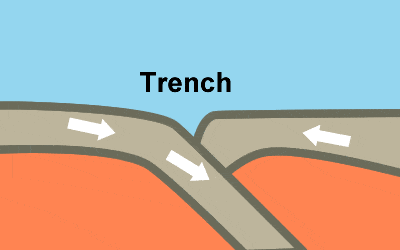
The Marianas Trench, where the Pacific Plate descends under the leading edge of the Eurasian Plate, is the deepest sea floor in the world. These ocean trenches form when two oceanic plates collide

a)

and the older, less dense of the two plates rides over the edge of the older plate.

b)

when convection currents in the mantle force the older plate downward.

c)

and the younger, denser of the two plates, rides over the edge of the older plate.

d)

and the plates are approximately the same age and density.