wayground logo

Free Printable Worksheets

Font size

S
M
L
XL
Worksheets

Properties of Soil

Total questions: 100

Worksheet time: 2hrs 47mins

Name
Class
Date
1.

Which soil is best for gardening?

a)

sand

b)

loam

c)

clay

d)

plants

2.

Which soil doesn't hold water, but allows it to pass through?

a)

sand

b)

loam

c)

clay

d)

air

3.

Which soil has grains that slip easily through your fingers.

a)

sand

b)

loam

c)

clay

d)

water

4.

Which plants below can grow well in sandy soil?

a)

farm crops

b)

cacti

c)

jungle plants

d)

rocks

5.

Which word best describes the texture of sandy soil?

a)

gritty

b)

smooth

c)

sharp

d)

water

6.

Which of these is NOT part of the contents of soil?

a)

weathering

b)

water

c)

air

7.

When a stream of water flows into a pond, organic material ___________ in the bottom.

a)

weathers

b)

floats

c)

settles

d)

gritty

8.

Which soil type would create muddy water in a stream?

a)

clay

b)

sand

c)

loam

d)

weather

9.

Select all of the non-living things that can be found in nature.

a)
b)
c)
d)
10.

Select all of the living things that can be found in nature.

Select all that apply.

a)
b)
c)
d)
11.

What are the properties of sand.

Select all that apply.

a)

smooth

b)

gritty

c)

tan

d)

doesn't hold water

12.

What are the properties of clay?

Select all that apply.

a)

smooth

b)

gritty

c)

gray

d)

holds water

13.

If a plant needs a lot of water, which soil should you use?

a)

sand

b)

potting soil

14.

If a plant does not need a lot of water, which soil should you use?

a)

sand

b)

potting soil

15.
Which type of soil can hold the greatest amount of water?
a)
sand
b)
silt
c)
clay
d)
loam
16.
Organic matter is made of materials that….
a)
Were once living
b)
Were once nonliving
c)
Were once living and nonliving
17.
Which of the following is NOT an organic material
a)
Worms
b)
Decayed animals
c)
Rocks
d)
Decayed plants
18.
Which of the following is NOT one of the three types of soil?
a)
clay
b)
sand
c)
silt
d)
mud
19.
_______ is the type of soil used most often with plants and on farms. It is a mixture of clay, sand, and silt.
a)
loam
b)
humus
c)
soil
d)
dirt
20.
Ellen grabs a topsoil sample in her hand. She rolls it into a ball. The soil feels gritty and the ball falls apart. What part of the topsoil most likely made the topsoil feel gritty?
a)
clay
b)
sand
c)
silt
d)
humus
21.
When plants, animals, and other organisms die, they break down and become part of the soil. What is this part of the soil called?
a)
sand
b)
silt
c)
clay
d)
humus
22.
Which of the following is the largest particle in soil?
a)
sand
b)
silt
c)
humus
d)
clay
23.
You dig a small hole in the soil and the next day it rains. The hole fills with water, but does not empty even after several days of dry weather. What is the soil mostly made of?
a)
clay
b)
sand
c)
humus
d)
silt
24.
Which type of soil can hold the greatest amount of water?
a)
sand
b)
silt
c)
clay
d)
loam
25.
Many plants cannot grow in sandy soil. Why is this true?
a)
Sandy soil does not hold enough water.
b)
Air cannot pass through sandy soil.
c)
Roots cannot easily push through sandy soil.
d)
Sandy soil has too many nutrients.
26.
Soil is made of
a)
weathered rocks and minerals
b)
dead plants and animals
c)
air and water
d)
all of the above
27.
A student pours 50 mL of water over a soil sample, and 32 mL of the water drains into a cylinder. How much water was retained? 
a)
18 mL
b)
28 mL
c)
32 mL
d)
50 mL
28.
A lab requires students to use sand and silt. What piece of safety equipment is most important?
a)
fire extinguisher
b)
goggles
c)
first aid kit
d)
gloves
29.
What property of soil could be tested by rubbing soil between fingers?
a)
color
b)
ability to retain water
c)
weathering
d)
texture
30.
To test which type of soil best supports plant life, which variable should be the one to change? 
a)
the type of soil used
b)
the type of seed planted
c)
the type of soil used and the type of seed planted
d)
the amount of sunlight
31.

Which of the following is NOT a property of soil?

a)

Color

b)

Texture

c)

Where it's located

d)

Ability to retain water

32.

Texture depends on-

a)

color

b)

particle size

c)

plant growth

d)

the amount of sunlight soil gets

33.

Moana is using the chart below to categorize soil. What property of soil is she finding?

a)

ability to support plant growth

b)

water retention

c)

texture

d)

color

34.
Which type of soil can hold the greatest amount of water?
a)
sand
b)
silt
c)
clay
d)
loam
35.

Ellen grabs a topsoil sample in her hand. She rolls it into a ball. The soil feels gritty and the ball falls apart. What property of soil is Ellen testing?

a)

color

b)

texture

c)

ability to support plant growth

d)

water retention

36.
This type of soil is sticky when wet and hard when dry. 
a)
clay
b)
silt
c)
sand
d)
gravel
37.

If Carol poured 500 mL of water into the soil and 400 mL can now be found in the jar, then the other 100 mL must have been-

a)

retained

b)

drained

c)

lost in space

d)

in the bathroom sink

38.

Which soil would retain the most water?

a)

loam

b)

sand

c)

silt

d)

clay

39.

Which soil would retain the least amount of water?

a)

gravel

b)

silt

c)

sand

d)

clay

40.
Many plants cannot grow in sandy soil. Why is this true?
a)
Sandy soil does not hold enough water.
b)
Air cannot pass through sandy soil.
c)
Roots cannot easily push through sandy soil.
d)
Sandy soil has too many nutrients.
41.

The more water a soil retains, the less it -

a)

stands still

b)

drains

42.
Soil formation begins with the weathering of_______.
a)
Humas
b)
Subsoil
c)
Litter
d)
Rock
43.
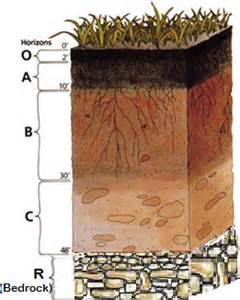
The layer of soil which the topsoil is found.
a)
Horizon A
b)
Horizon B
c)
Horizon C
d)
Horizon D or R
44.
Decayed organic material in soil is called______.
a)
Litter
b)
Silt
c)
Humus
d)
Clay
45.
In which horizon is most of the HUMUS?
a)
Horizon A
b)
Horizon B
c)
Horizon C
d)
Horizon D or R
46.
Soil's one of the Earth’s most valuable resources. Everything on Earth depends on soil somehow.
a)
True
b)
False
47.
Soil layers are called horizons because...
a)
The layers are all different
b)
The layers are vertical
c)
The layers are horizontal
d)
The layers are above one another
48.

What color of soil has a lot of humus?

a)

black soils

b)

white soils

c)

reddish colored soils.

49.

Clay is a type of soil that can be used in:

a)

pottery.

b)

sand boxes.

c)

recipes.

50.
Which of the following is NOT one of the three types of soil?
a)
clay
b)
sand
c)
silt
d)
mud
51.
Ellen grabs a topsoil sample in her hand. She rolls it into a ball. The soil feels gritty and the ball falls apart. What part of the topsoil most likely made the topsoil feel gritty?
a)
clay
b)
sand
c)
silt
d)
humus
52.
When plants, animals, and other organisms die, they break down and become part of the soil. What is this part of the soil called?
a)
sand
b)
silt
c)
clay
d)
humus
53.
Which of the following is the largest particle in soil?
a)
sand
b)
silt
c)
humus
d)
clay
54.
Which of the following best describes soil erosion?
a)
A.  the breakdown of soil 
b)
A.  the improvement of soil
c)
A.  the addition of soil
d)
A.  the movement of soil by wind or water
55.
Soil is made of
a)
weathered rocks and minerals
b)
dead plants and animals
c)
air and water
d)
all of the above
56.
Ms. Ahlswede wants to plant a garden. Which type of soil would be best? 
a)
Loam
b)
Clay 
c)
Sand 
d)
Mulch 
57.
Andrea is trying to convince her mom that an unknown soil sample she has will not work well for her plants.  The unknown soil has very small grains and has a high capacity to retain water.  What unknown soil is Andrea talking about?
a)
sand
b)
clay 
c)
loam 
d)
gravel 
58.

Which of the following are ways to prevent soil erosion on a hillside?

a)

Plant vegetation

b)

Add more soil

c)

Remove all the grass

d)

Plow the hillside

59.

Which of the following is NOT a component of soil?

a)

rocks

b)

plant roots

c)

water

d)

minerals

60.

A component of soil made of small pieces of rock or pebbles.

a)

Clay

b)

Gravel

c)

Retain

d)

Sand

61.

To hold inside, as soil does with water.

a)

Sand

b)

Gravel

c)

Clay

d)

Retain

62.

A component of soil made by the weathering of rocks into tiny grains; rough and gritty texture.

a)

Clay

b)

Gravel

c)

Topsoil

d)

Sand

63.

Which of the following is NOT a component of soil?

a)

Water

b)

Animal

c)

Plastic

d)

Air

64.

Which of the following is NOT a commonly studied property of soil?

a)

Color

b)

Texture

c)

Water Retention

d)

Taste

65.

Which property of soil can be described with the words, "smooth," and "rough"?

a)

Shape

b)

Texture

c)

Size

d)

Color

66.

Which vocabulary word means: How a soil sample feels

a)

particle

b)

retain

c)

physical property

d)

texture

67.

Which vocabulary word means: To hold water

a)

particle

b)

retain

c)

physical property

d)

texture

68.

Many plants cannot grow in sandy soil. Why is this true?

a)

Sandy soil does not hold enough water.

b)

Air cannot pass through sandy soil.

c)

Roots cannot easily push through sandy soil.

d)

Sandy soil has too many nutrients.

69.
It is important for soil to retain water to 
a)
withstand weathering
b)
erode more slowly
c)
help plants to grow
d)
keep it from being dry
70.

Marlin grabs a soil sample in his hand. He rolls it into a ball. The soil feels gritty and the ball falls apart. What type of soil does he have?

a)

clay

b)

sand

c)

gravel

d)

topsoil

71.

Aniyah grabs a soil sample in her hand. She rolls it into a ball. The soil feels sticky and easily forms a ball. What type of soil does she have?

a)

gravel

b)

sand

c)

clay

d)

topsoil

72.

A student wanted to investigate which type of soil retains the most water. She put 200 mL of water in each type of soil. The results are shown above.

According to the diagram above, which soil retains the LEAST amount of water?

a)

Soil A

b)

Soil B

c)

Soil C

d)

Soil D

73.

Mr. Barco's class poured 100mL of water through a soil sample. They collected and measured the water that drained out of the soil. The water collected had a volume of 45 mL. How much water did the soil retain?

a)

65

b)

55

c)

45

d)

32

74.

To hold inside, as soil does with water

a)

soil

b)

retain

c)

water

75.

small pieces of rock

a)

gravel

b)

sediment

c)

dirt

76.

the breakdown or rock into smaller particles from the effects of wind, water, and ice.

a)

erosion

b)

weathering

c)

deposition

77.

to rot and break down into small parts

a)

soil

b)

loam

c)

decay

78.

A component of soil made of very tiny grains; sticky and soft when wet but turns hard when dry

a)

clay

b)

loam

c)

humus

79.

A component of soil made of small pieces of rock; pebbles; usually has a smooth texture

a)

gravel

b)

sand

c)

loam

80.

A component of soil made by the weathering of rocks into tiny grains; has a rough and gritty texture

a)

gravel

b)

sand

c)

rock

81.

The removal and movement of sediment from one place to another by gravity, water, wind, or ice

a)

deposition

b)

weathering

c)

erosion

82.

soil rich in nutrients that is good for plant growth

a)

loam

b)

humus

c)

sand

83.

the size of soil particles

a)

soil

b)

properties

c)

soil texture

84.

A mixture of sand, silt, clay, rock, and humus (plant and animal remains)

a)

humus

b)

soil

c)

loam

85.

decaying plant and animal material in the soil

a)

soil

b)

humus

c)

dirt

86.
What is a mixture of weathered rock, decayed organic matter, mineral fragments, water, and air called?
a)
soil
b)
organic matter
c)
decomposed matter
87.
What is the remains of something that was once alive?
a)
inorganic matter
b)
organic matter
88.
What is the process of changing once living material into dark colored organisms?
a)
composition
b)
decomposition
89.
Texture of Soil:
Sand feels...
a)
rough
b)
smooth
c)
sticky
90.
Texture of Soil:
Silt feels...
a)
rough
b)
 smooth
c)
sticky
91.
Texture of Soil:
Clay feels...
a)
rough
b)
smooth
c)
sticky
92.
What is made up of equal parts of clay, sand, and silt is called
a)
foam
b)
loam
c)
soil
93.
What is the average weather of an area called?
a)
temperature
b)
topography
c)
climate
94.
What is all of the organisms that live in a region that allows air and water into a soil?
a)
parent material
b)
biota
c)
topography
95.
What is the shape of the land?
a)
parent material
b)
topography
c)
biota
96.
Organisms that break the remains of dead organisms into smaller pieces and digest them with chemicals are called
a)
decomposers
b)
composers
97.
Equal layers of soil formed from the movements of the products of weathering is called
a)
horizons
b)
decomposers
c)
composers
98.
What breaks down and digests plant remains?
a)
fungi
b)
bacteria
c)
earthworms
d)
burrowing animals
99.
What are microscopic decomposers that cause decay?
a)
fungi
b)
bacteria
c)
earthworms
d)
burrowing animals
100.
What does most of the work mixing humus with other material in soil and eats through the soil?
a)
fungi
b)
bacteria
c)
earthworms
d)
burrowing animals