
 Worksheets
ST 2 Review (All)
Total questions: 94
Worksheet time: 47mins
As the United States acquired more land between 1803 and 1850, controversy over new territories focused on which MAJOR issue?
the expansion of slavery
the need for schools and colleges
the failure to conserve natural resources
the construction of transcontinental railroads
In the first half of the 1800s, how did western migration of citizens impact democracy?
Women were allowed many new rights, including suffrage.
"Common Men" were no longer allowed to vote.
The balance of power between slave and free states was disrupted.
More African Americans in northern states were able to vote.
The western states often agreed with northern states on issues concerning tariffs. This is MOST LIKELY true, for which of the following reasons?
Most westerners were abolitionists, as were most northerners in the three decades before the Civil War.
Industrialization was the primary occupation in the west prior to the Civil War and thus, tariffs would help those factories.
Tariffs paid for internal improvements, such as infrastructure, and helped keep the cost of federal land low.
The west was settled mostly by northerners and the two regions always held the same political beliefs.
What BEST explains why immigrants were discouraged from the settling in the South during the Antebellum period?
Nativist sentiments were very strong.
Economic opportunities were limited.
Abolitionists recruited them in the North.
Railroad construction did not exist there.
What was a MAIN outcome of the Mexican American War?
It set the northern-most territory of the United States at the 54' 40 line.
The United States acquired Guam, Puerto Rico, and the Philippines
The United States acquired present-day California and New Mexico.
The United States lost the territory of Texas.
What was the ORIGINAL motivation to purchase the Louisiana territory from the French in 1803?
It would close the western territories to slavery.
It would remove the Spanish from North America.
It would expand the nation's boundary to the Pacific Ocean.
It would secure control of the Mississippi River and provide transportation access.
What was the PRIMARY goal of the Monroe Doctrine?
to prevent further European colonization of Latin America
to create an opportunity for the annexation of Canada
to protect the site of a canal across Central America
to help European nations establish new colonies in the Western Hemisphere
Why did the United States use protective tariffs during the Antebellum Period?
to encourage foreign trade
to help the nation's manufacturers
to reduce the cost of consumer goods
to improve the quality of goods
Why were most northern industrialists NOT opposed to slavery in the South?
They needed cheap cotton to support their factories
They utilized slaves in the factories in the North
They supported abolition of southern plantation owners
They were receiving foreign pressure from European powers
x What action did Americans justify as a result of Manifest Destiny?
the extension of slavery into the territories
war with Russia over the Oregon territory
the acquisition of the colonies in Latin America
westward expansion into lands claimed by other nations
x What makes the acquisition of Texas DIFFERENT than the acquisition of California, Oregon, and Louisiana?
Texas was conquered in battle.
Texas was purchased.
Texas asked to be annexed by the U.S.
Texas was negotiated by treaty.
What was the major motivation behind the Free Soil movement?
Extension of slavery was unfair to white labor and farmers.
Slavery and those that supported it were morally evil.
Keeping European powers out of the Western Hemisphere.
Wanted to remove Native Americans to encourage cheap land prices.
During the mid 1800s, how did the federal government encourage the settlement of the West?
provide forty acres of land and a mule to formerly enslaved persons
provide free land to people who would create a home there
provide mining claims for prospectors seeking gold and silver
provide land to Native Americans east of the Mississippi River
The phrase "Bleeding Kansas" was used to describe violent clashes between which two groups?
Spanish landowners and new American settlers
Native Americans and white settlers
Chinese and Irish railroad workers
proslavery and antislavery groups
The statement that best expresses the principle of "popular sovereignty" is
individual states have the right to reject congressional decisions pertaining to slavery
settlers in a given territory have the sole right to decide whether or not slavery will be permitted there
citizens can decide each for themselves whether or not to hold slaves
Congress has the right to determine where slavery shall and shall not exist
Which part of the Compromise of 1850 received the greatest support from southern planters?
the admission of California as a free state
the passage of a strict fugitive slave law
the end of the slave trade in Washington, D.C.
the admission of Missouri as a slave state
Which statement BEST describes the policy of Mexico's government toward Texas during the first half of the nineteenth century?
Mexico tried to sell Texas to the United States at the time of the Louisiana Purchase
during the mid-1830s Mexico stressed the importance of establishing strong local government in Texas
Texas was governed by Mexico under harsh regulations in the 1820s
American settlement in Texas was encouraged by Mexico during the 1820s and early 1830s

x Which event led to the acquisition of the territories shown in red and tan on the map?
Mexican American War
Louisiana Purchase
Spanish American War
Oregon Purchase
x Why did many northern politicians oppose annexing Texas after it won its independence?
They feared such an act would be seen as an act of war by Mexico and would lead to war.
They fear it would become a slave state, and possibly several slave states, thereby giving supporters of slavery too much power in the national government.
They feared it would be admitted as a free state, thereby disrupting the balance of power in Washington and giving too much influence to those who opposed slavery.
They blamed Texans for defeat at the Alamo and did not want to allow them to become part of the United States.
Under Clay's American System, how did better roads and canals lead to greater industrial growth?
People could travel farther to buy goods.
American roads and canals could avoid the tariffs.
Industry could expand because raw materials would be cheaper to acquire.
It would be cheaper for workers to travel to find a job.
What effect did Uncle Tom’s Cabin and John Brown’s raid on Harper’s Ferry have on the South?
White Southerners increasingly distrusted the intentions of Northerners
Southerners gained seats in the US Congress.
Slavery was no longer an issue as new states were added to the Union.
Abolitionists in the South were be free to help runaway slaves.
What is the connection between Nat Turner, John Brown, and William Lloyd Garrison?
They were all strong opponents of slavery (abolitionists)
They were all strong supporters of the Free-Soil movement out West
They were all early Quakers who violently supported slave revolts.
They were all abolitionist authors who forced anti-slavery legislation
What was an IMMEDIATE effect of the completion of the Erie Canal in 1825?
Prices increased for food products along the Atlantic Coast.
Midwestern farmers could easily ship grain to eastern markets.
A territorial conflict began with Canada over the Great Lakes.
Railroads were forced to reduce their shipping rates
What was the significance of Seneca Falls in 1848?
the rise of the universal labor movement
the beginning of the abolition movement
the birth of the industrial revolution
the advent of the women's rights movement
Which Supreme Court decision created the need for a constitutional amendment that would grant citizenship to formerly enslaved persons?
Marbury v. Madison
McCulloch v. Maryland
Worcester v. Georgia
Dred Scott v. Sanford
x In the Antebellum South, what advantage did free blacks have over slaves?
Free blacks had civil and political rights.
Free blacks had Black Codes rather than Slave Codes.
Free blacks had freedom dues given.
Free blacks had better job opportunities as artisans.
How did the Southern states try to limit the effects of Radical Reconstruction after 1877?
by adopting federally-mandated segregation
by enacting Jim Crow laws
by abolishing the southern sharecropping system
by securing passage of new amendments to the Constitution
In the immediate years following the Civil War, how did most freedmen earn a living?
sharecropping on southern plantations
gold mining in California
working in northern factories
conducting trains on the Underground Railroad
What did Abraham Lincoln declare early in his presidency as his primary goal as president?
to enforce the Emancipation Proclamation
to preserve the Union
to end slavery throughout the entire country
to encourage sectionalism

What does the graphic above represent?
the difficulty in transporting goods throughout the United States
the Union strategy during the Civil War
the problems created because the USA did not have a transcontinental railroad
the superiority of southern naval armaments during the Civil War

What time period was this cartoon from?
The Civil War
The Gilded Age
Reconstruction
Antebellum
What was a common goal of the 13th, 14th, and 15th amendments to the United States Constitution?
punishing the South for seceding from the Union
granting basic rights to formerly enslaved persons
allowing the states to veto federal laws
creating a "separate but equal" society
What was a significant reason why Radical Republicans opposed President Abraham Lincoln's Reconstruction plan?
Lincoln's plan granted too many rights to formerly enslaved persons.
Lincoln's plan demanded payments from the South that would have damaged the South's economy
Lincoln's plan postponed the readmission of southern States into the Union for many years.
Lincoln's plan would have allowed white southerners to quickly return to power.
What was the significance of the 54th Massachusetts regiment during the Civil War?
The regiment defeated Union troops at Fort Sumter.
The regiment defended the Mississippi River at the Battle of Vicksburg.
The regiment achieved victory for the Union during the first naval battle fought between ironclads.
The regiment gained respect and notoriety for African American soldiers who joined the Union.
Which of the following was a major cause of early Confederate battle victories during the Civil War?
industrial output
foreign assistance
immigrant population
military leadership
Which of the following was NOT part the rulings of the Dred Scott case?
African-Americans were citizens and could bring lawsuits in federal courts.
Congress did not have the power to prohibit slavery in federal territories.
States did not have the power to prohibit slavery.
Slaves were to be considered as property in legal proceedings.
Which of these is most associated with the phrase "separate but equal?"
the citizenship status created by Black Codes
the Supreme Court’s ruling in Plessy v. Ferguson
the reasons for poll taxes and literacy tests
the role of the former Confederate states after the Civil War
In the 1830s, why did President Andrew Jackson support the Indian Removal policy?
Native Americans were attacking southern cities.
Jackson sought to annex the territories of Texas and Oregon.
White settlers desired the land on which Native Americans lived.
Jackson wanted to punish Native Americans for their political opposition.

The above drawing, which appeared in the Tuscaloosa (Alabama) Independent Monitor in 1868, issued a stern warning to
carpetbaggers and scalawags
slaves and "undesirable" immigrants
Ku Klux Klan members
Radical Republicans
What impact did the Election of 1876 have on the United States of America?
Samuel Tilden became the first Democratic President since the Civil War
A political compromise effectively ended Reconstruction.
This election marked the start of the Civil War.
This election marked the end of Manifest Destiny
What was the MAJOR issue of the Nullification Crisis of 1832?
the annexation of Texas
Jackson's opposition to a national bank
decreased trade with France
southern opposition to tariffs
What was the purpose of Black Codes during Reconstruction?
The codes provided 40 acres and a mule to freedmen.
The codes established educational standards for freedmen.
The codes were laws meant to protect the constitutional rights and liberties of freed slaves.
The codes were laws passed by mainly Southern states to keep African Americans economically dependent on whites.
What was the purpose of poll taxes and literacy tests imposed on African Americans?
to prevent them from voting
to limit their access to public facilities
to block their educational opportunities
to deny them economic advancements
Which agency was created by the United States Congress in 1865 to set up schools and churches, to supply food and clothing, and to solve employment problems for the former slaves?
The Tuskegee Institute
The Freedmen's Bureau
The American Missionary Association
the National Association for the Advancement of Colored People
Which group of slaves were promised freedom in the Emancipation Proclamation?
Those in the border states
those that agreed to stay in the South
those in Union held territories
those in Confederate held states and territories
2. In the early 1800s, why did many people in the United States migrate westward?
A. There was an abundance of available farmland.
B. There was tremendous growth in the timber industry.
C. Transportation was easier due to the Transcontinental Railroad.
D. They wanted to escape slavery, which was illegal in the western territories.
3. Which document was used to justify the South Carolina Nullification Crisis of 1832?
A. Magna Carta
B. Common Sense
C. The Federalist Papers
D. Kentucky and Virginia Resolutions
4. Which action in 1803, by President Thomas Jefferson, violated his strict interpretation of the Constitution?
A. Protesting the impressment of United States sailors
B. Purchasing the Louisiana Territory from France
C. Pardoning violators of the Alien and Sedition Acts
D. Using the United States Navy to subdue the Barbary pirates

Which event led to the acquisition of the territories shown in red and tan on the map?
A. Spanish American War
B. Oregon Purchase
C. Mexican-American War
D. Louisiana Purchase
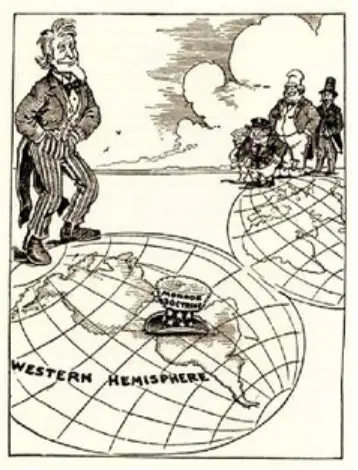
In 1823, which region did the Monroe Doctrine intend to protect from further European expansion?
A. Middle East
B. North Africa
C. Southeast Asia
D. Latin America
8. Why did the United States place few restrictions on immigration during the early 1800s?
A. The Constitution did not allow restrictions.
B. Labor unions welcomed new workers.
C. Southern landowners needed additional workers.
D. The industrial economy created new jobs.
9. How did Manifest Destiny result in conflict with other nations?
A. Northern expansion led to a proposal for Canadian annexation.
B. Westward expansion led to war with Russia over the Oregon Territory.
C. Southern expansion led to the acquisition of colonies in Latin America.
D. Westward expansion led to territorial issues and the Mexican-American War.
10. What was a MAIN outcome of the Mexican-American War?
A. It set the northernmost territory of the United States at the 54' 40 parallel.
B. The United States acquired Guam, Puerto Rico, and the Philippines.
C. It led to more sectional conflicts, which further divided Americans.
D. The United States lost the territories of Texas and California.
During the first half of the 1800s, what was a MAJOR effect of internal improvements, such as the Erie Canal?
A. Prices increased for food products along the Atlantic Coast.
B. Midwestern farmers could easily ship grain to eastern markets.
C. A territorial conflict began with Canada over the Great Lakes.
D. Railroads were forced to reduce their shipping rates.
14. As President, how did Andrew Jackson undermine the Supreme Court decision of Worcester v. Georgia?
A. He defied the courts ruling and allowed the Indian Removal Act to continue.
B. He supported the theory of nullification and states' rights.
C. He began an impeachment process of John Marshall in Congress.
D. He established voting and property rights for African American males.
Which of the following BEST explains the dramatic increase in the number of German and Irish immigrants to northern cities in the mid-1800s?
A. The growth of the cotton industry in the South supported the expansion of the northern textile system.
B. The large scale African American migration to the South created an abundance of available jobs in the North.
C. The KKK discouraged European immigration in the South, resulting in northern urbanization.
D. The decrease in cotton production led to high unemployment in the South.
In the mid-1800s, why did Northern cities like Lowell, Massachusetts see such dramatic population increases?
A. The purchase of the Louisiana Territory provided new land and mineral resources to frontier settlers.
B. Experimentation with utopian communities meant both men and women had expanded political and economic opportunities.
C. The migration of skilled labor to western territories led to a decrease in the number of available factory and farm workers in the East.
D. There was a direct connection between increases in Southern cotton production and factory opportunities in the North.
17. Which of the following best represents a Southern defense of the use of slave labor?
A. Northerners argued that slaves voluntarily chose that life because they were uneducated and unskilled.
B. Southern elites argued that slaves were treated better than factory workers in the Northeast.
C. Southerners paid slaves more than factory workers in the North.
D. Northern abolitionists made a lot of money off of cotton-to-textile industry.
What best explains why Andrew Jackson strongly opposed the Second National Bank?
A. He saw it as a constitutional violation of states' rights that favored the wealthy.
B. He resented the Whig Party's efforts to protect foreign investors.
C. It gave more financial power to Southern industrialists.
D. It encouraged sectionalism by only helping Western farmers.
20. Which of the following best increases growing sectionalism during the Antebellum Period?
A. Support for the Abolition Movement grew in the North after the publication of Uncle Tom's Cabin.
B. Native American populations saw a dramatic decline with the pursuit of Manifest Destiny.
C. The Women's Rights Movement began in Seneca Falls, further dividing the North and West.
D. Future presidents failed to continue Jefferson's exploration of the Louisiana Territory.
22. What was the South's main objection to the protective tariffs established by Henry Clay's American System?
A. Protective tariffs eventually affected the price of both imports and exports.
B. Protective tariffs established social welfare programs to aid poor immigrants.
C. Protective tariffs supported legislation outlawing most monopolies.
D. Protective tariffs required industry to provide safe working conditions for employees.
24. Which of the following best represents Henry Clay and the Whig Party platform of the 1830s and 1840s?
A. Believed in creating economic and political opportunities for Native Americans
B. Promoted states’ rights regarding economic matters such as slavery and tariffs
C. Wanted to boost American industry through protective tariffs and infrastructure projects
D. Supported the Second Great Awakening positions on slavery and temperance
27. In the years leading up to the Civil War, the invention of the cotton gin, the availability of new farmlands in the West, and the demand for cotton in Northern textile factories were all causes for
A. an increase in the demand for slaves.
B. a decrease in the demand for slaves.
C. a shift to an industrialized economy in the South.
D. the mass migration of free blacks from the rural north to southern cities.
31. What did Nat Turner, John Brown, and William Lloyd Garrison, and the Grimke sisters all have in common?
A. They were all strong abolitionists who actively opposed slavery.
B. They were all strong supporters of the Free-Soil movement in the West.
C. They were all early Quakers who violently supported slave revolts.
D. They were all northern newspaper editors who helped draft anti-slavery legislation.
33. How was the Seneca Falls Convention related to abolitionism?
A. Seneca Falls and abolitionism were both pursuing women's equality.
B. Seneca Falls and abolitionism were both met with militant opposition from Southerners.
C. The Seneca Falls Convention occurred due to women being denied a voice in abolitionism.
D. The Seneca Falls Convention focused on gaining suffrage for immigrants and freedmen.
35. Which of the following was the primary reason for secession, the Civil War, and eventually the 13th Amendment?
A. The annexation of Texas into the Union
B. The popularity of the abolitionist movement
C. The controversy over slavery as the nation moved west
D. Harriet Beecher Stowe’s book, Uncle Tom’s Cabin
36. What effect did Uncle Tom’s Cabin, the emergence of the Republican Party, and John Brown’s Raid on Harper’s Ferry have on the South?
A. White Southerners increasingly distrusted the intentions of Northerners.
B. Southerners gained seats in the United States Congress.
C. Slavery was no longer an issue as new states were added to the Union.
D. There was a dramatic rise in Southern abolitionism.
40. The Supreme Court ruling in Dred Scott v. Sandford (1857) increased sectional conflict because the decision
A. gave full citizenship to all enslaved persons.
B. prohibited slavery in lands west of the Mississippi River.
C. denied Congress the power to regulate slavery in U.S. territories.
D. allowed for the importation of enslaved persons for ten years.
How did the United States get possession of the Oregon Territory?
A. The United States bought the land as part of the Louisiana Purchase.
B. England gave up the land as part of a treaty with the United States.
C. The United States negotiated with Native Americans to trade for the land.
D. Mexico gave the land to the United States in an attempt to avoid war.
42. Where were the first shots of the Civil War fired?
A. Ft. Wagner
B. Vicksburg
C. Ft. Sumter
D. Lexington and Concord
43. Which situation was the most immediate result of Abraham Lincoln's election to the Presidency in 1860?
A. Kansas and Nebraska joined the United States as free states.
B. A constitutional amendment was adopted to end slavery.
C. Missouri entered the United States as a slave state.
D. Several Southern states seceded from the United States.
49. Which of the following was established by the Missouri Compromise?
A. The ability for new territories to vote on whether slavery was legal
B. The end of slavery in the Louisiana Territory and other territories
C. A boundary between free and slave regions
D. The end of the international slave trade in the southern states
50. Despite the Supreme Court decision in Worcester v. Georgia, what action did Andrew Jackson take against the Cherokee?
A. He had them forcibly relocated to land in Oklahoma.
B. He required them to pay federal taxes on their land.
C. He granted them additional land if they agreed to farm cotton.
D. He required them to pay tuition to attend public schools.
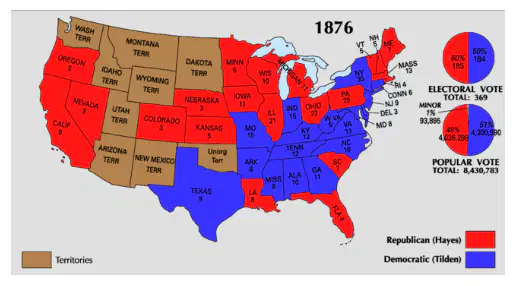
What was the result of the disputed Presidential Election of 1876?
A. Reconstruction ended as federal troops were removed from the South.
B. Slavery was re-established in the South by state legislatures.
C. New state laws were passed in the South to guarantee equal rights for African Americans.
D. A constitutional amendment was adopted to correct problems with the electoral college system.
9. Why was the Emancipation Proclamation also viewed as a diplomatic document?
A. It called on England and France to sell weapons to the Union army.
B. It made it hard for foreign nations to recognize and support the Confederacy.
C. It warned European nations to stay out of affairs in the Western Hemisphere.
D. It encouraged France to sell the Louisiana Territory to the United States.

Which action did southern states take to keep African Americans from exercising the rights guaranteed in this amendment?
A. Suspending habeas corpus and denying women the right to vote
B. Collecting poll taxes and requiring literacy tests
C. Establishing religious and property-holding requirements for voting
D. Passing Black Codes and establishing segregated schools
11. In the end, which of the following factors contributed to the South's defeat in the American Civil War?
A. Although the South had larger population, its leaders lacked the organization to effectively build an army.
B. The South could not overcome the superior military leadership possessed by the North.
C. The North had too many resources and too much manpower for the South to sustain its fight.
D. Many Southerners stopped supporting the Confederacy after they heard Lincoln had been killed.
12. What was one major result of the North's victory in the Civil War?
A. The power of the Supreme Court was limited.
B. Slave owners were compensated for their losses.
C. The influence of corporations on government was reduced.
D. The supremacy of the national government was upheld.
15. What was considered the turning point battle of the Civil War, securing a path to victory for the Union?
A. Gettysburg
B. Manassas
C. Saratoga
D. Antietam
16. Which Civil War battle resulted in the Union gaining strategic control of the Mississippi River, fulfilling the Western goal of the Anaconda Plan?
A. Antietam
B. Vicksburg
C. Gettysburg
D. Bull Run
20. What was the overall goal of the Thirteenth, Fourteenth, and Fifteenth Amendments?
A. Granting universal manhood suffrage
B. Upholding rights of free speech and religion
C. Decreasing the power of the federal government
D. Recognizing the basic civil liberties of African Americans
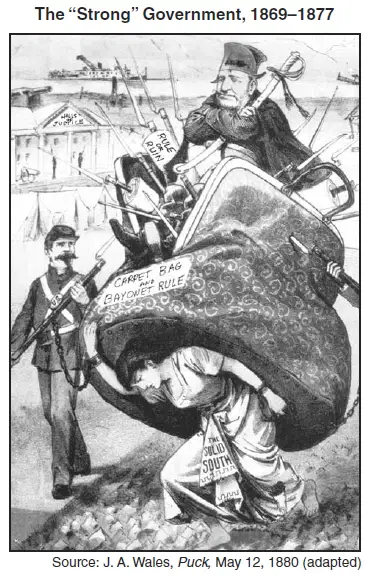
What is the main idea of this cartoon from the Reconstruction Era?
A. Southern society was oppressed by Radical Republican policies.
B. Constitutional law was necessary to stop southern secession.
C. United States soldiers forced women in the South to work in factories.
D. Sharecropping was an economic burden for women after the Civil War
22. After the Civil War, the sharecropping system was intended to help maintain continuity in the South by
A. providing a labor supply for plantation owners.
B. diversifying agricultural production.
C. guaranteeing economic equality for African Americans.
D. offering cheap land loans to free African Americans.
Why was General William T. Sherman's "March to the Sea" important to the Union’s war effort?
A. It placed the Mississippi River under Union control.
B. It convinced Great Britain to stop supporting the Confederacy.
C. Important railroad tracks were destroyed, severing supply lines for Confederate forces.
D. Ulysses S. Grant was forced to surrender his forces as a result of Sherman's victory.
Which of the following arguments did President Abraham Lincoln use against the secession of the southern states?
A. Slavery was not profitable and should not be relied on as a labor system.
B. The government was a union of people and not of states.
C. The southern states did not permit their people to vote on secession.
D. As the Commander-in-Chief, he had the duty to defend the United States against foreign invasion.
26. What was the result of the Plessy v. Ferguson decision of the Supreme Court in 1896?
A. De facto segregation was instituted.
B. De jure segregation was instituted.
C. Immediate integration was instituted.
D. Gradual integration would eventually occur.
What is one way the Federal Government sought to protect natural rights during Reconstruction?
A. The Freedmen's Bureau helped build schools to educate blacks and poor whites in the South.
B. The 13th Amendment required schools to be integrated immediately.
C. The Women's Auxiliary Corps lead recruitment drives to rebuild the United States Army.
D. The Department of the Interior helped to reunite separated enslaved families.
29. History has recorded that Lincoln once stated, “I hope to have God on my side, but I must have Kentucky.”
Which of the following BEST explains his statement?
A. Lincoln had a strong desire to keep the border states in the Union.
B. Kentucky had already freed its slaves prior to events at Fort Sumter.
C. Kentucky was key to maintaining political and economic ties with foreign countries.
D. Lincoln felt Kentucky was key to the successful war of attrition.

What was the principal purpose of this type of law?
A. Expand economic opportunities for freedmen
B. Establish universal suffrage
C. Maintain racial separation and support white supremacy
D. Encourage formerly enslaved persons to seek skilled jobs
39. What name was given to former slaves who migrated to the western plains looking to escape violent backlash in the post-Reconstruction South?
A. Homesteaders
B. Settlers
C. Pioneers
D. Exodusters
47. Which of the following was the MAIN reason for secession, the Civil War, and eventually the 13th Amendment?
A. the annexation of Texas into the Union
B. the popularity of the abolitionist movement
C. the controversy over slavery as the nation moved west
D. Harriet Beecher Stowe’s Uncle Tom’s Cabin
48. The Compromise of 1877 is BEST known for
A. establishing the Confederacy as a legitimate government.
B. allowing Native Americans to retain ownership of tribal lands in the Southeast.
C. removing the strong federal presence in the South, ending Reconstruction.
D. increasing the role Congress played in protecting racial equality.
49. Which of the following BEST represents a moral compromise Lincoln made during the Civil War?
A. To maintain high industrial output, protections for factory workers were erased from federal laws.
B. To keep the Republican Party unified, African Americans were never allowed to fight for the Union.
C. To keep the border states from joining the Confederacy, those states were allowed to keep their slaves.
D. To regain support in the South, Lincoln offered to resign, allowing Andrew Johnson the presidency.
50. Which of the following created division that ultimately led to Andrew Johnson's 1868 impeachment trial?
A. Johnson ignored the Supreme Court's decision regarding Native American lands
B. Johnson refused to support many Congressional Reconstruction plans
C. Johnson misused federal funds to help freedmen relocate to the Midwest
D. Johnson attempted to expand the presence and power of the US Army in southern states

