Wayground logo

Free Printable Worksheets

Font size

S
M
L
XL
Worksheets

REVISION CHAPTER 7 (OBJECTIVE)

Total questions: 30

Worksheet time: 2hrs 30mins

Name
Class
Date
1.
What are valence electrons?
a)
The innermost electrons
b)
The outermost electrons
c)
The bonds between two atoms
d)
When electrons are balanced
2.
What is the octet rule?
a)
Elements can only have 8 electrons in its outermost shell
b)
The elements must form an octopus like structure
c)
Is the outermost electrons
d)
Elements can only have 6 electrons in its outermost shell
3.
How many valence electrons does Carbon have
a)
1
b)
5
c)
8
d)
4
4.
How many valence electrons does Argon have
a)
5
b)
11
c)
8
d)
6
5.
Electron dot notation is . . . .
a)
A representation of an element in which only valence electrons of an atom are shown
b)
A representation of how compounds are formed.
c)
A representation of how the universe is made
d)
A representation of how Ionic bonds are made
6.
Three pairs of electrons are shared in a
a)
Single bond
b)
Double bond
c)
Triple bond
7.

Which is the correct molecular structure for carbon dioxide?

a)
b)
c)
d)
8.
In the correct Lewis structure for CH4, how many unshared electron pairs surround the carbon?
a)
2
b)
8
c)
0
d)
4
9.
This is a correct dot diagram for fluorine (F)
a)
true
b)
false
10.
This is a correct dot diagram for oxygen (O)
a)
true
b)
false
11.
This is a correct dot diagram for nitrogen (N)
a)
true
b)
false
12.

A molecule of methane, CH4 has what shape?

a)

Tetrahedral

b)

Triangular

c)

Pyramidal

d)

Octahedral

13.
The theory that is used to predict the arrangement of atoms about a central atom is called?
a)
Valence shell repulsion
b)
Valence shell electron sharing
c)
Valence shell electron pair repulsion
d)
Valence electron shell repulsion pair
14.

A molecular geometry of PF5 is............ and it is ...................... molecule

a)

Trigonal bipyramidal, polar

b)

Trigonal pyramidal, non-polar

c)

Trigonal bipyramidal, non-polar

d)

Octahedral, polar

15.

The bond angle of trigonal planar is

a)

90 degrees

b)

120 degrees

c)

Less than 120 degrees

d)

Less than 90 degrees

16.

What would be the bond angle between atoms in this molecule?

a)

180

b)

120

c)

90

d)

109.5

17.

What would be the bond angle between atoms in this molecule?

a)

109.5

b)

120

c)

180

d)

90

18.

What would be the bond angle between atoms in this molecule?

a)

90

b)

120

c)

180

d)

109.5

19.

Which Lewis Dot Model drawing correctly shows an O2 molecule?

a)
b)
c)
d)
20.

What is the correct ion charge for Nitrogen? State the type of its stability

a)

+5, noble gas configuration

b)

-5, pseudo noble gas configuration

c)

+3, pseudo noble gas configuration

d)

-3, noble gas configuration

21.
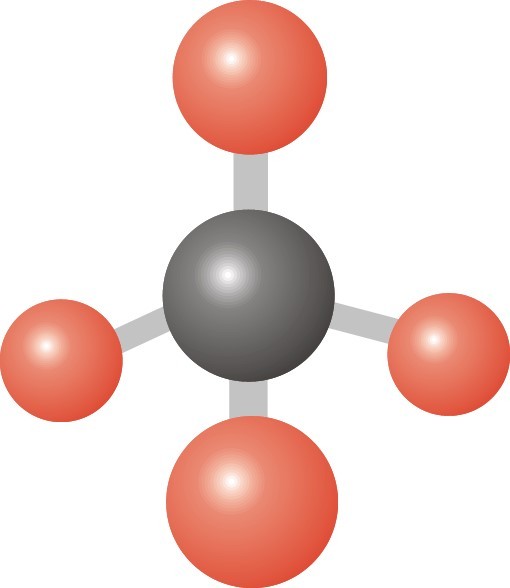
Who could this molecule be?
a)
CH4
b)
CO2
c)
PCl5
d)
BF3
22.

Will CS2 molecule be polar or nonpolar? State the type of intermolecular force present.

a)

polar, dipole-dipole forces

b)

nonpolar, london dispersion forces

c)

polar , hydrogen bond

d)

non-polar , ionic bond

23.

What is the shape of HF molecule? State the type of intermolecular forces present.

a)

Linear, H bond, dipole-dipole forces, london dispersion forces

b)

Linear , dipole-dipole forces, london dispersion forces

c)

Linear, H bond, dipole-dipole forces,

d)

Tetrahedral, H bond, dipole-dipole forces, london dispersion forces

24.
What is the shape of this molecule?
a)
Linear
b)
Bent
c)
tetrahedral
d)
Trigonal Pyramidal
25.

Which of the following is the correct Lewis diagram for ammonia, NH3?

a)
b)
c)
d)
26.
How do you determine the number of valence electrons an element has?
a)
Look at its period
b)
Look at its group
c)
Look at its atomic number
d)
Look at its atomic mass
27.

HCN is a linear molecular geometry. What is the polarity of HCN molecule?

a)

Polar molecule

b)

Non-polar molecule

28.

Opposite electrically charged areas _______________. It forms ______________________

a)

repel each other, Ionic bond

b)

attract each other, Van der Waal forces

29.

State the exception of octet rule for AlCl3

a)

expanded octet

b)

Octet

c)

incomplete octet

d)

Odd number electron

30.

State the exception of octet rule for XeF2

a)

expanded octet

b)

Octet

c)

incomplete octet

d)

Odd number electron