
 Worksheets
IB ESS Topic 6
Total questions: 30
Worksheet time: 30mins
Which layer of the atmosphere has weather?
troposphere
stratosphere
mesosphere
thermosphere
Which gas makes up the largest portion of air?
oxygen
nitrogen
carbon dioxide
methane
What is albedo?
A measurement of the time it takes for a ray to go from the Sun to the Earth
The percent of sunlight that gets through the atmoshere
A measurement of the reflectivity of snow (or soil)
The temperature rise from the sun shining on something
Something pure white and something pure black have an albedo of what?
100 (white) and 0 (black)
0 (white) and 100 (black)
1 (white) and 0 (black)
0 (white) and 1 (black)
As the Earth's temperature rises, the polar ice caps melt and shrink. This exposes more ocean which has low reflectivity. So more of the Sun's energy is abosorbed and the Earth's temperature goes up even more. This is an example of what?
Positve feedback loop
Negative feedback loop
Equilibrium
As the Earth's temperature rises, the polar ice caps melt and shrink. This exposes more ocean which has low reflectivity. So more of the Sun's energy is abosorbed and the Earth's temperature goes up even more. This is called what?
Eutrophication
Global Warming
Desertification
El Nino Effect

Which of the following are greenhouse gases?
Carbon dioxide
Methane
Water vapor
All answers are correct
Which agreement allowed for a reduction, and eventual elimination, of CFC production and use?
Montreal Protoccol
Kyoto Protoccol
Paris Agreement
Washington Agreement
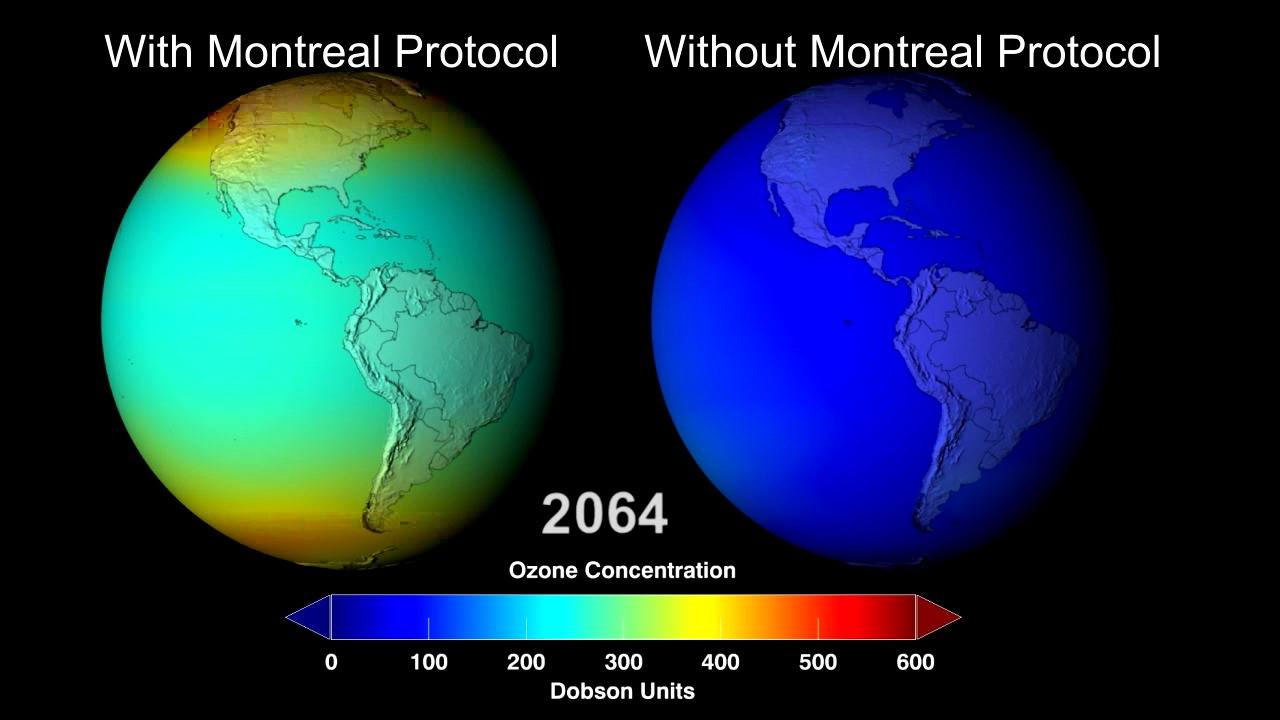
Which is NOT a result of the reduction in stratospheric ozone?
reduced photosynthetic activity
increased skin cancer
increased likelihood of cataracts
increased birth defects
Which is not an example of an ecological consequence of reduced stratospheric ozone?
loss of biodiversity from reduced photosynthesis in plants
collapse of marine food webs
reduced crop yield
reduced terrestrial biome productivity
The burning of which fuel is the main source of industrial smog?
Oil
Coal
Natural Gas
Biomass
Which product of incomplete combustion gives photochemical smog its yellowish color?
PANs
Ozone
VOCs
Nitrous oxide
Photochemical smog is mostly likely to be formed under which of the following conditions
High levels of sunlight
High emissions due to combustion of fossil fuels
Calm or light winds
Dry weather
Correct topography

The diagram shows normal conditions and a thermal inversion. Which side shows the thermal inversion A or B
(a)
Which on of the following is NOT damage caused by photochemical smog


Which are primary pollutants that lead to acid deposition? select all that apply
CO2
NO2
SO2
O2
O3
In Sweden, _____ is added to lakes to ______.
sulfur is added to increase pH
sulfur is added to decrease pH
lime is added to increase pH
lime is added to decrease pH
Which of the following represent acid rain? (select all that apply)
pH 3.6
pH 5.1
pH 5.5
pH 5.6
pH 7
Which of the following is FALSE regarding impacts of acid deposition?
A.D. can directly impact the plant's structure.
A.D. can indirectly impact a plant by decreasing the soil's nutrients.
A.D. can have toxic impacts on plants by increasing some metal concentrations in soil.
A.D. can have toxic impact on animals by causing aluminum to build up on fish gills.
A.D. has beneficial impacts on microbial interactions in the soil.
Which are effects of acid deposition? (select all that apply)
coral bleaching
phytoplankon loss
plant chlorosis & decreased photosynthesis
decreased crop yield
fish suffocation
Oceanic shellfish such as oysters and coral are impacted negatively by ocean acidification.
true
false
How can acid deposition be mitigated? (select all that apply)
burn less fossil fuels (reduces CO2)
burn less coal or use scrubbers (reduces SO2)
burn less fossil fuels (reduces NO2)
carbon capture and sequestration (reduces CO2)
catalytic converters (reduces NO2)
Acid Rain is a ____ problem because ____.
Local because the acid clouds don't move very far.
Local because the pollution that creates the acid rain doesn't move very far from its source.
Regional because the acid clouds can travel several hundred miles.
Regional because the pollution that creates the acid rain can move several hundred miles before precipitating.
All rain has always been slightly acidic. Why?
Humans have always been burning coal, releasing SO2.
CO2 has always been in the atmosphere, since it's a byproduct of cellular respiration of all living organisms.
CO2 has always been released from burning fossil fuels.

