wayground logo

Free Printable Worksheets

NEW

Font size

S
M
L
XL
Worksheets

Evolution-Natural Selection

Total questions: 39

Worksheet time: 25mins

Name
Class
Date
1.
A characteristic that improves an individual's ability to survive and reproduce in a particular environment.
a)
Ancestor
b)
Adaptation
c)
Descendant
d)
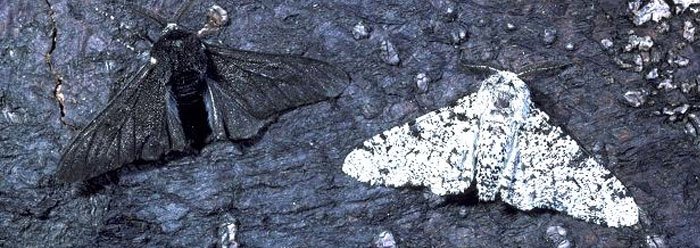
Fossil
2.
The information provided by fossils about the Earth's history.
a)
Fossil Record
b)
Extinction
c)
Evolution
d)
Genetic Variation
3.
A trait passed from parent to offspring through DNA.
a)
Natural Resources
b)
Survival of the Fittest
c)
Genetic variation
d)
Genetic trait
4.
Definition: adaptation
a)
inherited characteristic that increases chances of survival
b)
organisms with traits well suited to their environment survive and reproduce at a greater rate
c)
a growing population causes a scarcity of resources
d)
differences in the DNA sequence
5.
Definition: natural selection
a)
inherited characteristic that increases chances of survival
b)
organisms with traits well suited to their environment survive and reproduce at a greater rate
c)
a growing population causes a scarcity of resources
d)
differences in the DNA sequence
6.
Definition: fitness
a)
ability to survive and reproduce in a specific environment
b)
organisms with traits well suited to their environment survive and reproduce at a greater rate
c)
a growing population causes a scarcity of resources
d)
differences in the DNA sequence
7.

The Theory of Evolution was proposed by what scientist?

a)

Charles Darwin

b)

Albert Einstein

c)

Steven Hawking

d)

Isaac Newton

8.
Evolution means...
a)
Change over time in a population.
b)
That everything is the same.
c)
That organisms never change.
d)
Negative traits are acquired in populations.
9.
Why are advantageous traits more likely to be passed on to the offspring?
a)
Because parents with those traits can teach their offspring
b)
Because parents with those traits can surive and reproduce better
c)
Because parents with those traits care more about their offspring
10.
Which term refers to the process by which individuals that are better suited to the environment survive and reproduce therefore passing down their genes to their offspring? 
a)
Evolution 
b)
Variation 
c)
Adaptation
d)
Natural Selection 
11.
The white feathers of a snowy owl allow it to blend in with its environment during the winter months (snow). This is an example of ________________
a)
Species
b)
Environmental Change
c)
Adaptation
d)
Variation
12.
Remains of ancient organisms are called
a)
Extinctions
b)
Fossils
c)
Mutations
d)
Variations
13.
What is another name for natural selection?
a)
survival of the smartest
b)
survival of the fastest
c)
survival of the biggest
d)
survival of the fittest
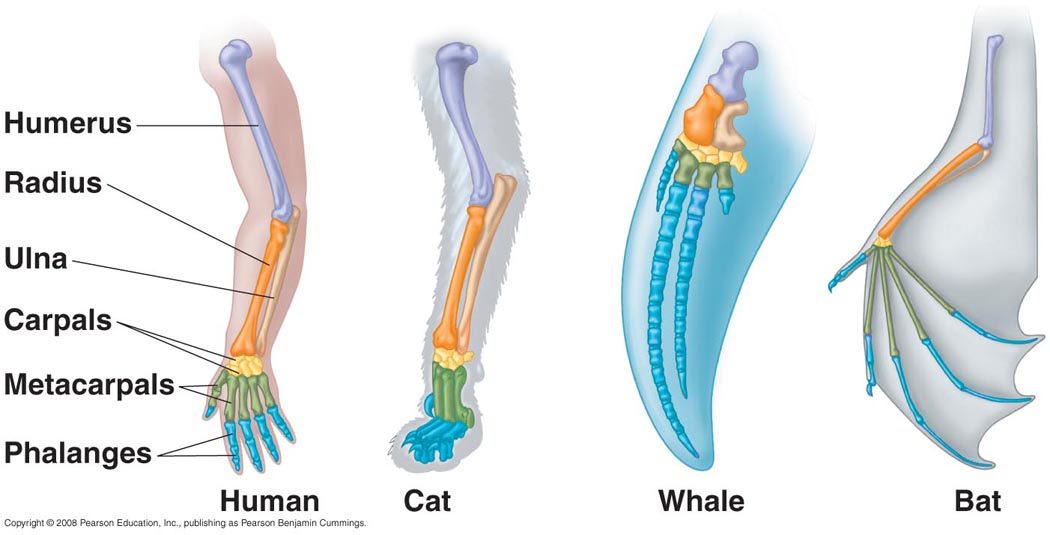
14.
What does these image depict? 
a)
Vestigial Structures 
b)
Fossils 
c)
Adaptations
d)
Species 
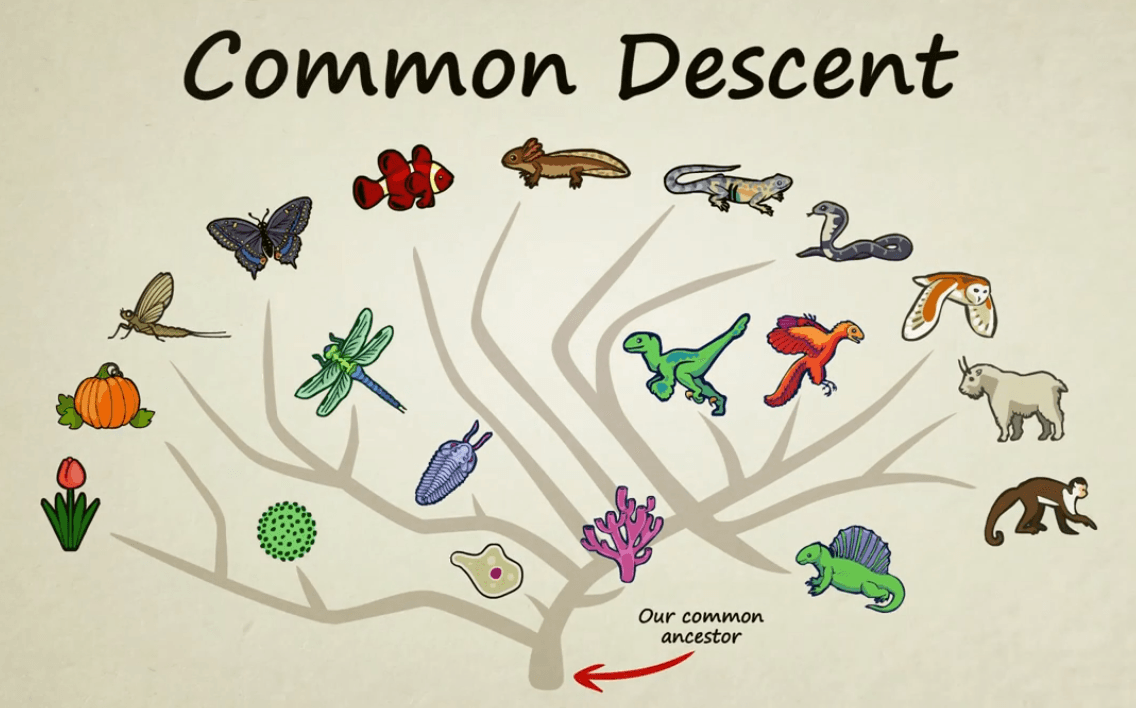
15.
What does this image suggest? 
a)
Law of Superposition 
b)
Specations 
c)
Common Descent 
d)
Five Finger Discount 
16.
You look at two species and see very similar DNA. What does this likely tell you?
a)
These are the same animal.
b)
These animals have a common ancestor.
c)
These animals are not likely related.
d)
These animals are likely becoming one species.
17.
Horse breeding for specific desired traits is an example of which type of evolutionary evidence?
a)
Artificial selection
b)
Embryology
c)
Fossils
d)
Biochemical molecules
18.
When every organism of a species has died.
a)
Evolution
b)
Natural Selection
c)
Extinction
d)
Artificial Selection
19.

Which of the following is a factor in natural selection?

a)

Individuals of species compete with one another to survive.

b)

All species are genetically diverse.

c)

Individuals better able to adapt to changes leave more offspring.

d)

All of the above.

20.

The theory of ‘common descent with modification’ states that all modern organisms

a)

can change in response to environmental change

b)

are descended from a single ancestral species

c)

can be arranged in a linear order from “least evolved” to “most evolved”

d)

Have not changed over time

21.

Structures with the same parts but have different functions, suggesting that organisms with a backbone share common ancestry is called…

a)

Not related

b)

Not homologous

c)

Homologous

d)

Young in origin

22.

Comparing the human hemoglobin amino acid sequence to the chimpanzees, horses, kangaroos, and chickens, reveal that humans have the fewest amino acid differences with

a)

kangaroos

b)

horses

c)

chickens

d)

chimpanzees

23.

What is suggested by the similary of early embryos of different species of vertebrates?

a)

No evolutionary relationship between the groups

b)

A recent common ancestry

c)

Similar environments in the past

d)

Evolution from a distant common ancestor
24.
The trees these moths used to live on were white, but have been covered in soot from coal factories. Which moth will be more successful in this environment?
a)
Dark moth
b)
Light moth
c)
Both will be equally successful
d)
Neither will be successful
25.
Since the 1800s humans have stopped burning coal, and the trees have returned to their original color. Which moth will be more successful in this environment?
a)
Dark moth
b)
Light moth
c)
Both will be equally successful
d)
Neither will be successful
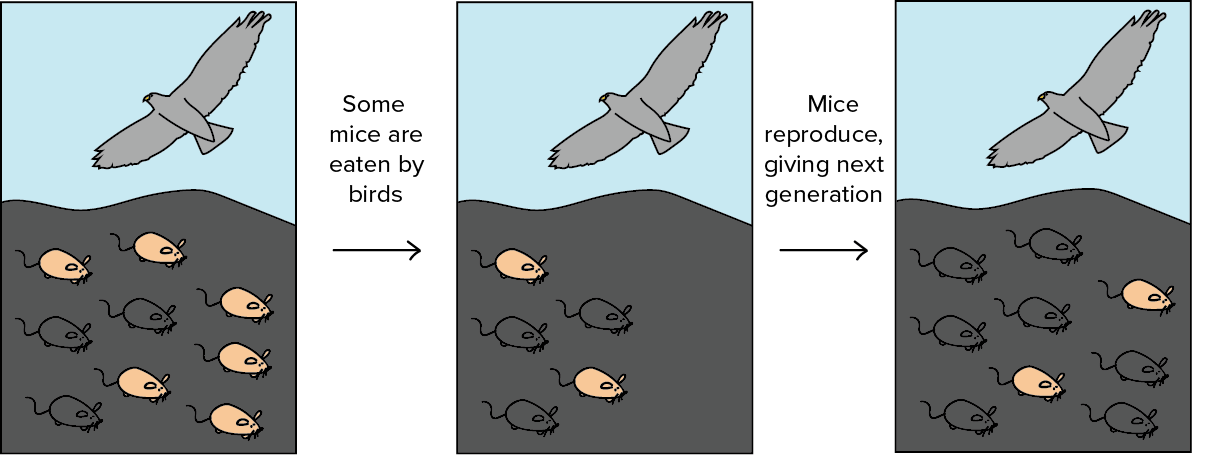
26.
Why is the mouse population changing over time?
a)
The light mice can reproduce more successfully than the dark mice
b)
The hawks eat more dark mice than light mice because the dark mice taste better
c)
The hawks eat more light mice than dark mice because they can see the light mice more easily
d)
The hawks eat more dark mice than light mice because they can see the dark mice more easily
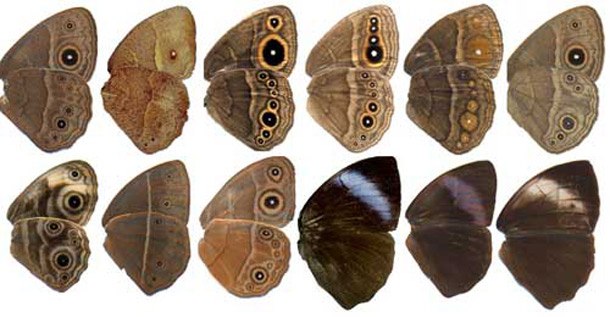
27.
These moths are all the same species. The differences between their wings is an example of ________________
a)
Natural Selection
b)
Variation
c)
Homeostasis
d)
Extinction
28.
What is the advantage of having different shaped beaks?
a)
To look different from other species.
b)
To be able to eat the food readily available in the environment.
c)
To protect itself against predators.
d)
To protect itself against prey.
29.
Which statement best describes the process of evolution?
a)
Populations can survive in different locations on earth
b)
Environmental conditions limit the number of species on Earth
c)
Populations grow when resources are abundant
d)
The traits of a species can change over time
30.
Definition: competition
a)
inherited characteristic that increases chances of survival
b)
organisms with traits well suited to their environment survive and reproduce at a greater rate
c)
a growing population causes a scarcity of resources
d)
differences in the DNA sequence
31.
Which layer is the oldest?
a)
1
b)
2
c)
3
d)
4
32.
Some lizards have different size legs.  Lizards with longer legs are able to better access food. Over time, lizards with short legs became less common.
What is the successful adaptation?
a)
Lizards
b)
Long legs
c)
Food
d)
Leg sizes
33.

Adaptations can be:

a)

camouflage

b)

ability to survive cold weather

c)

hunting skills

d)

all of the above

34.

A yellow morph and green morph of an insect lives in the rainforest canopy. You would expect:

a)

the green population to increase and the yellow to decrease

b)

both populations should stay the same

c)

both populations will increase

d)

the green population to decrease and the yellow to increaseThis is a wrong answer

35.

What is the advantage of having different shaped beaks?

a)

To look different from other species.

b)

To be able to eat the food readily available in the environment.

c)

To protect itself against predators.

d)

To protect itself against prey.

36.

Remains of ancient organisms are called:

a)

Extinctions

b)

Fossils

c)

Mutations

d)

Variations

37.
In his book On the Origin of the Species, Charles Darwin described how species change over time. Which of the following is NOT part of his observations that describes the mechanisms of natural selection?
a)
Organisms produce more offspring than can survive.
b)
Disease and natural disaster will limit population growth.
c)
Species today descended with modifications from ancestral species.
d)
Organisms with advantages will survive and reproduce.
38.
Theodosius Dobzhansky discovered that successful species tend to have a wide variety of genes that do not appear to be useful to the species in its present environment. What did this discovery help explain about genetics and the changes that occur in a species over time?
a)
Environments with more organisms tend to have more successful species.
b)
Species with greater genetic diversity adapt more easily to changing environments.
c)
 Changing environments prevent species from adapting and surviving.
d)
 Species in a stable environment are more resistant to a changing environment.
39.
This picture is an example of
a)
homologous structures
b)
embryological similarities
c)
analogous structures
d)
vestigial structures