
 Worksheets
Quizz for CIA Portion
Total questions: 75
Worksheet time: 1hrs 3mins
The amount of time for a complete cycle is called
period
frequency
harmonic
amplitude

What is the Amplitude for the Graph?
10 cm
5 cm
15 cm
25 cm
Resonance occurs when
The frequency of an periodic force (Added Force) is smaller than the natural frequency
The frequency of an periodic force (Added Force) is equal to the natural frequency
The frequency of an periodic force (Added Force) is larger than the natural frequency
Which is NOT a property of waves
Frequency
Amplitude
Speed
Weight
In this type of wave the energy travels perpendicular to the wave
Longitudinal Waves
Transverse Waves
In this type of wave the energy travels in the same dirction as the wave
Longitudinal Waves
Transverse Waves
In this type of wave there are rarefraction and compression areas
Longitudinal Waves
Transverse Waves
How does a microwave use resonance?
the microwaves have the same frequency as the natural frequency of water molecules, causing them to vibrate with a larger amplitude, increasing their temperature
The microvaves use damping to decrease the amplitude of the oscillations, allowing heat to go from the water molecules into the food being heated.
The microwaves have different frequencies, which cause all the molecules of the food to vibrate with greater amplitude, increasing their temperature.
The microwaves cause critical damping of the water molecules, capturing their energy and creating heat.
True or False: The time for a complete back-and-forth swing of a pendulum is its frequency.
True
False
The number of cycles that are completed per second is called the ________ and is measured in _________.
frequency, Hertz
wavelength, meters
amplitude, meters
period, seconds

The period of a pendulum is 10 s. What is its frequency?
10 Hz
1 Hz
0.5 Hz
0.1 Hz


Standing waves are created by
Two identical waves reflecting off each other
Two identical waves being diffracted together
Two identical waves move through each other in opposite directions
Two identical waves are diffracted from two identical sources
In the diagram which letters represent the nodes
A B C
A C E
B D
B D E
A C D


How many antinodes does this standing wave have?
5
6
7
8
The second harmonic on a string fixed at both ends shows
A wavelength
Half a wavelength
Two wavelengths
The first harmonic has
1 antinode
1 node
2 antinodes
no nodes

∎ Progressive waves are travelling along the string in both directions.
∎ The standing wave is an example of superposition.
∎ The wavelength of the standing wave is d.

Which one of these statements is true?
Standing waves are created by
Two identical waves reflecting off each other
Two identical waves being diffracted together
Two identical waves move through each other in opposite directions
Two identical waves are diffracted from two identical sources
Do standing waves carry energy from one area to another?
Yes
No
Which statement is correct about the half wave A B C
All particles in this half wave are in phase with each other as they all move in the same direction
The particles A B C are in phase with the next half wave C D E because they all move in the same direction
All particles in this part of the wave are out of phase with each other as they all move in different directions
All particles in A B C have carried energy from one area to another



Who hears the jet's engines making a lower pitched noise as it approaches?
the pilot
the man on the ground
both hear the same pitch

A leaf is green. What does this tell you about the light that is being absorbed?
The light is a UV ray.
The light is not a part of the light spectrum.
All colors are reflected except green.
All colors are absorbed except green
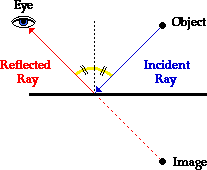
What is the angle of reflection equal to?
The angle of refraction
The angle of incidence
The angle of absorption
The angle of light

What happens when light hits a shiny or smooth surface?
It disappears.
It is refracted.
It is absorbed.
It is reflected.

What is it called when light bends as it moves from one substance to another?
Absorption
Reflection
Refraction
Incidence

When you look into a mirror, what is happening to the light?
It is increasing in wavelengths.
It is being refracted.
It is being absorbed.
It is being reflected.
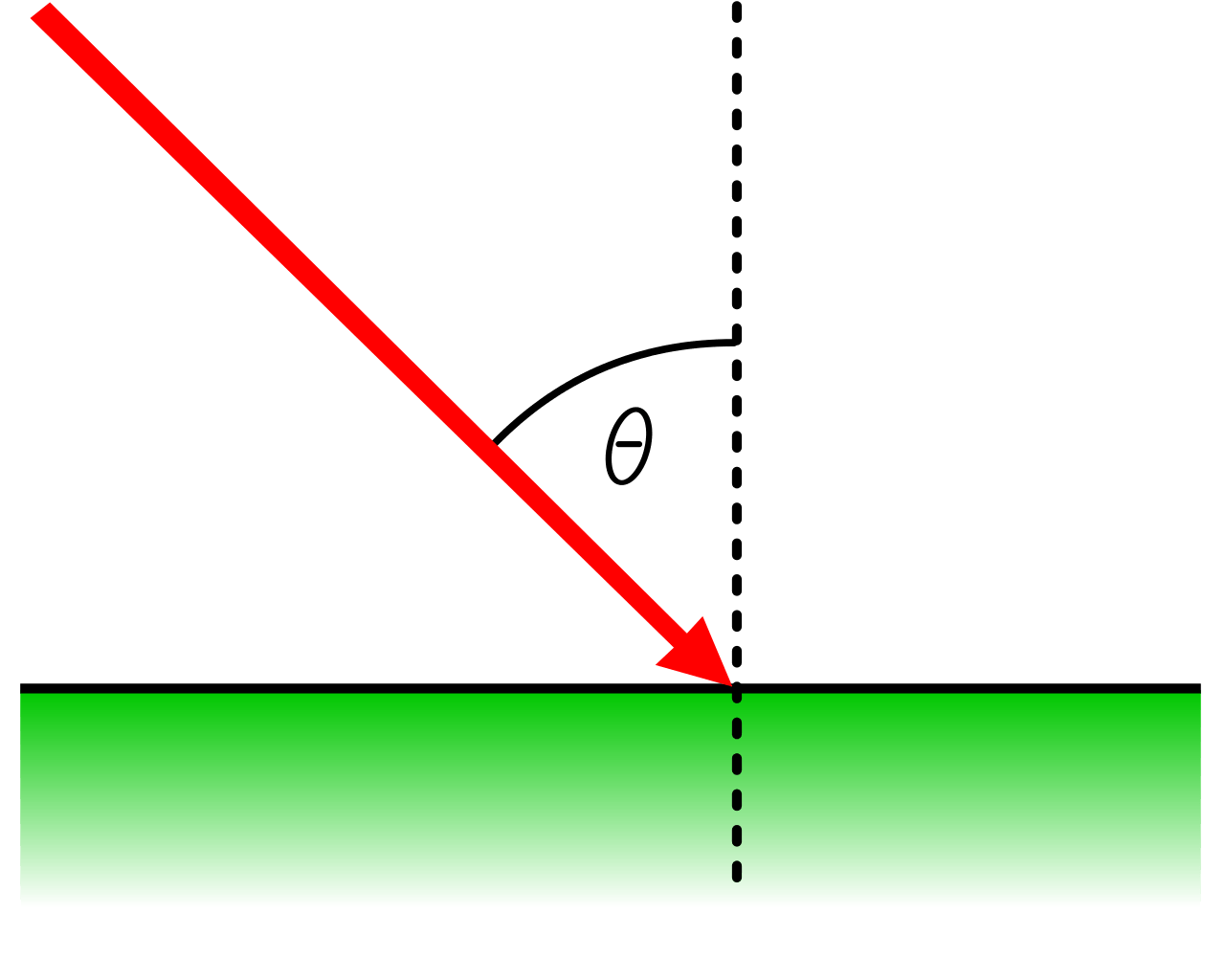

What happens to light during total internal reflection?
The angle of incidence is greater than the critical angle.
The angle of reflection is the same as the critical angle.
The angle of refraction is less than the critical angle.
The angle of incidence is zero.
When angle of incident (i) equals to critical angle (c) if light is traveled from a denser medium to a less dense medium,
total internal reflection occurs.
angle of refraction is equal to 90 degree.
light is refracted out
light travel in straight line

What type of interference is represented in this diagram?
Constructive
Destructive

What type of interference is represented in the diagram?
Constructive
Destructive
Which of the following statements are true?
- LASER is used as optical source in single mode fibers.
- LASER lights are highly incoherent.
1. is true and 2. is false
1. is false and 2. is true
Both 1 & 2 are true
Both 1 & 2 are false
The coherent nature of light from LASER is due to
Spontaneous emission
Stimulated Emission
Absorption
Pumping
The process in which the electrons in the ground state are vibrated to the excited states by providing extra energy from energy sources is called as
Population Inversion
Spontaneous emission
Stimulated emission
Pumping
Laser is a coherent source of light. This means all the light waves....
are out of phase
are in phase
have different directions
have same direction
In gas lasers the output power is directly proportional to
Diameter of quartz tube
Brewster window
Concave mirrors
Length of the discharge tube
CO2 laser produces a light of the range of wavelength
50 μ m -24.8 μ m
10.6 μ m and 9.6 μ m
50 μ m and 20 μ m
10 nm and 50 nm
In which laser transition takes place between the different vibrational states of the molecule?
Ruby laser
Carbon di oxide laser
Nd-YAG laser
Semiconductor laser
What is the use of He gas in CO2 laser?
to increase the population of atoms in the upper
level of CO2
to depopulate the atoms in the lower level of CO2
to depopulate the atoms in the lower level of CO2
and also to cool the discharge tube
to increase power output
What is the process responsible for producing photons in diode laser?
Fermi level shift
Majority carrier injection
Carrier freeze out
Electron-hole recombination
Example of solid state laser is
He-Ne laser
co2 laser
Nd:YAG Laser
Dye laser
How can lasers remove tattoos from skin?
by burning away skin cells containing tattoo ink
by chemically changing tattoo ink so that it is invisible
by breaking down the molecules that make up the ink
laser tattoo removal is currently impossible
When too many people stand on a bridge it collapses, why?
Due to increase in stress
Due to improper construction
Due to overweight
Due to friction
What happens when the stress applied to the body is increased beyond the maximum value and is removed after some time?
The body will come back to its original position
The body will oppose the stress
The body cannot return to its original position
The body becomes hot
Stress-strain diagram has five stages in the material; select the correct sequence of the stages:
Elastic region - Yielding - Strain hardening - Necking - Fracture
Elastic region - Strain hardening - Yielding - Necking - Fracture
Elastic region - Yielding - Necking - Strain hardening - Fracture
Yielding - Elastic region - Necking - Strain hardening - Fracture

Which letter is pointing to the elastic limit?
A
B
C
D

Tick which point/points do you think that are obeying Hooke's Law
Point A
Point B
Point C
Point D
Rank the points on the graphs of stress against strain from first point to final points
proportionality limit, upper yield point, lower yield point, fracture, UTS
proportionality limit,lower yield point, upper yield point, UTS, fracture
lower yield point, proportionality limit, UTS, upper yield point, fracture
None of above
Modulus of rigidity is the ratio of ______
Lateral strain and linear strain
Linear stress and lateral strain
Shear stress and shear strain
Shear strain and shear stress
What is the form of displacement due to torsion?
Axial strain
Shear strain
Elongation
Contraction
The twisting couple per unit twist of wire or cylinder is also called_____________
Torsional rigidity
Young modulus
Bulk modulus
None
The twisting couple is equal and opposite to the ________
Force
Work
Pure shear
Restoring couple

