
NEW
Font size
 Worksheets
Fingerprints
Total questions: 25
Worksheet time: 13mins

What pattern is this? (Right Hand)
Tented Arch
Plain Arch
Ulnar Loop
Plain Whorl

What type of fingerprint is this?
Central Pocket Whorl
Plain Whorl
Accidental Whorl
Double Loop Whorl

What type of fingerprint is this?
Central Pocket Whorl
Plain Whorl
Accidental Whorl
Double Loop Whorl

What type of fingerprint is this?
Plain Arch
Tented Arch
Accidental Whorl
Radial Loop

What type of fingerprint is this?
Central Pocket Whorl
Ulnar Loop
Accidental Whorl
Double Loop Whorl

What is the name of this minutiae?
Bifurcation
Splitting Ridge
Delta
Y

What is the name of this minutiae?
Enclosure/Eye
Island
Dot
Bifurcation

What is the name of this minutiae?
Bridge
Junction
Connector
Zigzag
Prints that are not readily visible are called _____ prints.
latent
visbile
plastic
Prints impressed into a bar of soap or other material (such as clay) are known as _________ prints.
latent
visible
plastic
Which chemical method creates a permanent white fingerprint?
super glue fuming
ninhydrin
iodine fuming
This chemical method creates a temporary brown/orange fingerprint.
super glue fuming
ninhydrin
iodine fuming
The number of deltas found in an arch pattern is ______.
zero
one
two
three
The number of deltas found in a loop pattern is ______.
zero
one
two
three
Prints are called __________ prints when the ridges made contact with a colored substance, such as blood, paint or oil prior to being impressed on a surface.
latent
plastic
visible
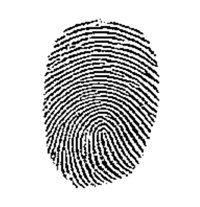
What pattern is this? (Right hand)
Ulnar Loop
Radial Loop
Plain Whorl
Tented Arch
How many times will your fingerprint pattern change throughout your life?
Three times
Your fingerprint pattern will change anytime you get a scar or due to skin disease.
The pattern will never change.
It will change as you grow from a baby to an adult.
Which fingerprint pattern is the most common?
Loop
Arch
Whorl
Ridge
What is a delta?
A triangular region near a loop.
The centre of a whorl or loop.
It distinguishes one fingerprint from another.
A circular region near a loop.
In what layer of skin is the ridge patterns of fingerprints formed?
Epidermis
Dermis
Dermal papillae
Hypodermis
The transfer of oils, sweat, amino acids, and carbohydrates are responsible for the formation of _________________ on surfaces
patent prints
latent prints
plastic prints
none of these
What procedure has the development of livescan technology largely replaced?
iodine fuming
the Henry classification system
rolling fingers on an inkpad and onto a print card
carbon powder and tape
The individuality of a fingerprint is determined by __________________
its general shape
the amino acids found in the print
the minutiae or ridge patterns
the general pattern
What was Alphonse Bertillion’s system of identification?
Portrait Parle
Treatise of Anatomy
“Finger Prints”
Classifying Prints

