
 Worksheets
Types of Bonds & Ionic Compounds
Total questions: 26
Worksheet time: 20mins
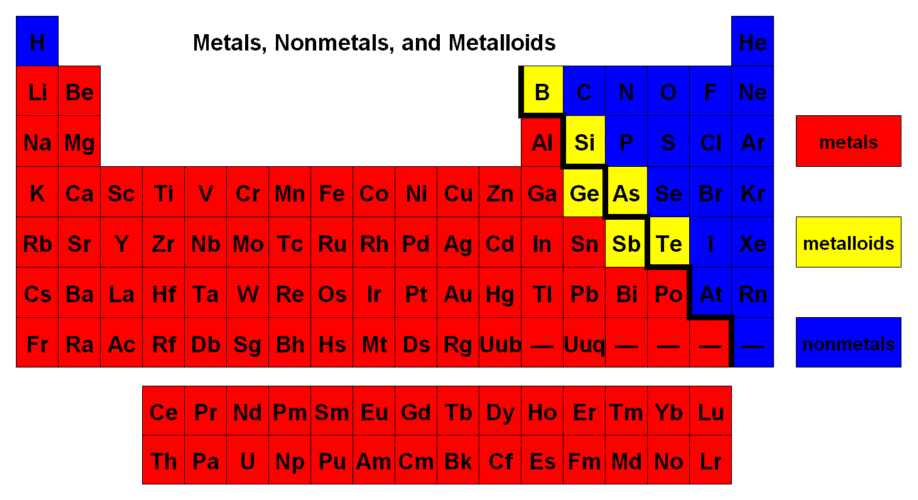
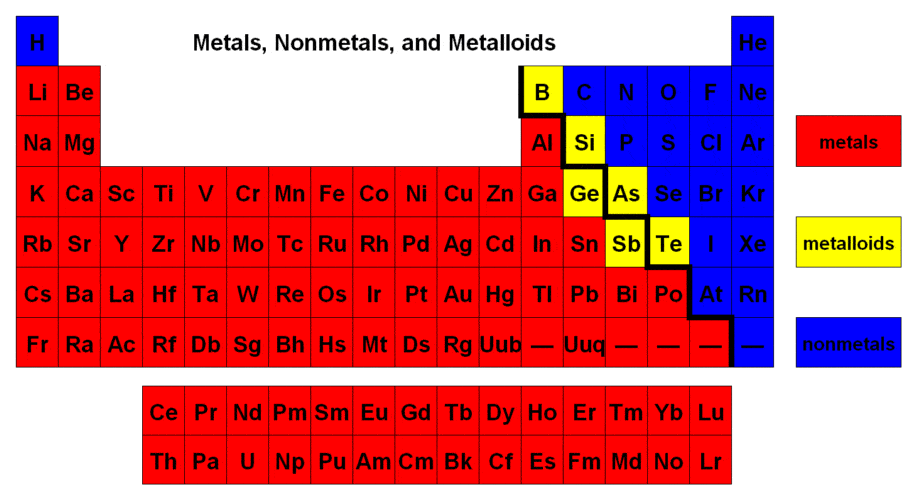
Predict the bond that will form between Be and F.
Ionic
Covalent
metallic
Predict the bond that will form between Se and Cl.
Ionic
Covalent
metallic
Predict the bond that will form between Sr and S.
Ionic
Covalent
metallic
Predict the bond that will form between Cu and Zn.
Ionic
Covalent
metallic
Ionic compounds have high melting points.
If a substance conducts electricity as a solid, its probably ____.
ionic
polar covalent
non-polar covalent
metallic
a yellow liquid that does not conduct electricity and is not water soluble probably has ______ bonds.
ionic
polar covalent
non-polar covalent
metallic
a white solid that dissolves in water but doesn't conduct electricity in water probably has ______ bonds.
ionic
polar covalent
non-polar covalent
metallic
a white solid that dissolves in water and is an electrolyte (conducts in water) probably has ______ bonds.
ionic
polar covalent
non-polar covalent
metallic
two atoms with electronegativities 0.4 and 2.9 will form _____ bonds.
ionic
polar covalent
non-polar covalent
two atoms with electronegativities 3.0 and 3.5 will form _____ bonds.
ionic
polar covalent
non-polar covalent
two atoms with electronegativities 3.5 and 3.5 will form _____ bonds.
ionic
polar covalent
non-polar covalent
If Na+1 and Cl-1 combine what is the resulting formula?
NaCl
NaCl2
Na2Cl
Na
If Mg+2 and Br-1 combine what is the resulting formula?
MgBr2
MgBr
Mg2Br
Br
If Ca+2 and S-2 combine, what is the resulting formula?
CaS
Ca2S
CaS2
Ca
Potassium and Sulfur create...
KS
KS2
K2S
K2S2
The formula of calcium and phosphate (PO4)3- is
CaPO4
Ca2(PO4)3
Ca3PO4
Ca3(PO4)2
Fe +2 and (SO4)-2
FeSO4
Fe4(SO4)2
FeSO2
correct answer is not given
Ca +2 and (OH) -
Ca2OH
CaOH2
Ca(OH)2
correct answer is not given
Be careful with this question.....
(SO4) -2 and Al +3
(SO4)3Al2
(SO4)2Al3
Al3SO4
Al2(SO4)3

